组成图示
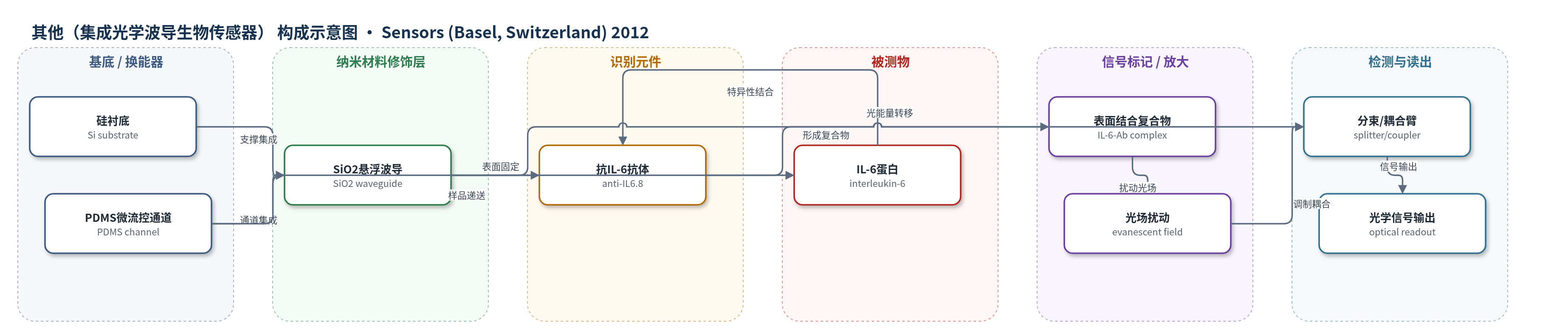
点击图片查看大图 · 依据论文自动绘制
传感器类型
其他(集成光学波导生物传感器)
检测对象
白介素6(IL-6);样品基质:微流控通道内水溶液/缓冲液(模拟条件)
检测原理
该传感器为无标记光学波导免疫传感。抗IL-6抗体(anti-IL6.8)固定于悬浮二氧化硅(SiO2)波导表面,微流控通道中的IL-6在压力驱动层流下经平流和扩散到达波导上下表面,并与抗体按Langmuir动力学结合。结合事件改变波导表面附近的局部折射率和倏逝光场,使分束/耦合臂间的光能量转移或光学模式发生变化,从而被光学读出。悬浮结构将传感区置于通道中部,减少扩散距离并允许双面结合,提高质量传输效率;信号随IL-6浓度和结合量增加而增强,无需外源标记或酶放大。
检测灵敏度
未报告LOD、线性范围、灵敏度斜率或R^2;模拟设定检测阈值 [Cs]min = 10 pg/mm2(3.85 × 10−10 mol/m2,约2.5%表面覆盖);入口浓度范围: 10−13 M–10−7 M;KD = 6.67 × 10⁻¹² M
效应效果
本文为有限元模拟研究,未报告RSD、稳定性、实际样品回收率或与ELISA/HPLC/qPCR的实验对比。模拟显示,抗体功能化提供对IL-6的特异性识别,非特异吸附被忽略。与平面基底器件相比,位于通道中部的悬浮波导传感器在除最慢流速外均使相对检测时间缩短2倍以上;平衡时间相近,但单位长度结合抗原分子数超过平面器件2倍,且更大比例结合分子与倏逝场相互作用。低抬升高度会因底部间隙阻碍平流而显著延长平衡时间。结果支持通过优化抬升高度提高样品递送效率、降低样品消耗并改善响应时间。
传感器的构成
- 基底/支撑层:硅(Si)衬底,支撑悬浮波导结构并决定抬升高度
- 换能/波导层:二氧化硅(SiO2)悬浮波导分束/耦合器,限制光场并在表面结合时产生光学信号变化
- 微流控通道:聚二甲基硅氧烷(PDMS)通道,承载压力驱动层流样品
- 识别元件:抗IL-6抗体(anti-IL6.8)固定于波导表面,特异性结合IL-6
- 被测物:白介素6(IL-6),水溶液/缓冲液样品基质
- 信号读出:波导分束/耦合臂间光能量转移监测,结合量改变光信号
中文摘要
基于集成光子器件的无标记光学生物传感器已实现对生物分析物的灵敏、选择性检测。将这些传感平台集成到微流控器件中,可减少所需样品体积,并加快样品向传感表面的递送,从而改善响应时间。传统器件通常嵌入或邻近基底,有效传感区位于微流控通道底部的慢流区,降低了样品递送效率。近期发展的悬浮波导传感器将器件抬离基底,使传感区不接触基底;该结构将传感区置于抛物线速度剖面中部,缩短粒子通过扩散到达传感表面的距离,并允许传感器上下两个表面同时结合分析物。本文采用有限元模型,模拟白介素6(IL-6)这一信号蛋白在微流控通道内不同抬升高度的波导生物传感器上的平流、扩散与特异性结合过程。研究比较了悬浮波导传感器与传统平面器件的瞬态性能,重点考察检测阈值响应时间和达到平衡所需时间,并建立了预测悬浮传感器行为的理论框架。模拟与理论结果为优化传感器性能、降低测量所需样品量提供了路线图。
英文摘要
Label-free optical biosensors based on integrated photonic devices have demonstrated sensitive and selective detection of biological analytes. Integrating these sensor platforms into microfluidic devices reduces the required sample volume and enables rapid delivery of sample to the sensor surface, thereby improving response times. Conventionally, these devices are embedded in or adjacent to the substrate; therefore, the effective sensing area lies within the slow-flow region at the floor of the channel, reducing the efficiency of sample delivery. Recently, a suspended waveguide sensor was developed in which the device is elevated off of the substrate and the sensing region does not rest on the substrate. This geometry places the sensing region in the middle of the parabolic velocity profile, reduces the distance that a particle must travel by diffusion to be detected, and allows binding to both surfaces of the sensor. We use a finite element model to simulate advection, diffusion, and specific binding of interleukin 6, a signaling protein, to this waveguide-based biosensor at a range of elevations within a microfluidic channel. We compare the transient performance of these suspended waveguide sensors with that of traditional planar devices, studying both the detection threshold response time and the time to reach equilibrium. We also develop a theoretical framework for predicting the behavior of these suspended sensors. These simulation and theoretical results provide a roadmap for improving sensor performance and minimizing the amount of sample required to make measurements.