组成图示
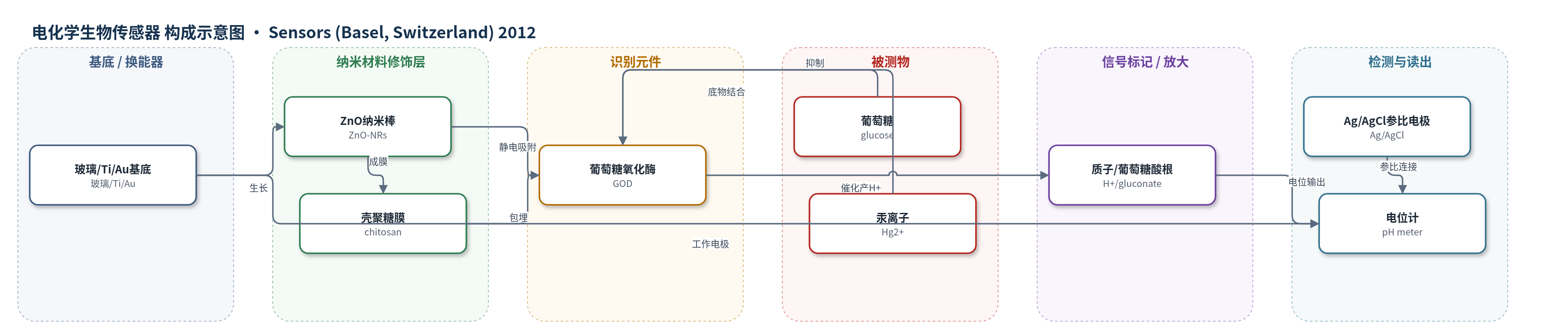
点击图片查看大图 · 依据论文自动绘制
传感器类型
电化学生物传感器
检测对象
汞离子(Hg2+),样品基质为磷酸盐缓冲液(PBS,pH 7.4)模拟环境水样
检测原理
该传感器为电位型酶抑制生物传感器。GOD 固定在 ZnO-NRs 表面,催化葡萄糖氧化生成葡萄糖酸根和 H+,使工作电极与 Ag/AgCl 参比电极间电位随 H+ 活度按 Nernst 关系变化。加入 Hg2+ 后,Hg2+ 与 GOD 非活性位结合,引起酶构象改变,形成可逆混合抑制,降低葡萄糖氧化产 H+ 的速率,导致电位响应下降。以无抑制剂响应 I0 和含抑制剂响应 I 计算抑制度 I%=(I0−I)/I0×100,抑制度随 Hg2+ 浓度增加而增大,并在对数浓度范围内呈线性。ZnO-NRs 提供高比表面和稳定界面,增强酶固定与电位响应;电位法无持续电流通过,适合生物样品检测。
检测灵敏度
LOD: 0.5 nM;线性范围: 0.5×10⁻⁶ mM–0.5×10⁻⁴ mM 和 0.5×10⁻⁴ mM–20 mM(固定 1 mM 葡萄糖,相关系数: 0.99);线性范围: 10−3 mM–6 mM(固定 10 mM 葡萄糖);葡萄糖电位响应斜率: 41.9 mV/decade
效应效果
该传感器对 Hg2+ 响应快速,响应时间为 8 s(1 mM Hg2+、固定 1 mM 葡萄糖)。选择性方面,对 Cu2+、Zn2+、Fe2+、Co2+ 的选择系数分别为 −3.05226、−3.05009、−2.60417、−2.86609,Hg2+ 灵敏度比 Cu2+ 和 Zn2+ 高约 1000 倍,比 Fe2+ 和 Co2+ 高约 100 倍,干扰可忽略。重现性方面,5 个独立电极在标准葡萄糖溶液中 RSD 小于 ±5%。稳定性方面,4 °C 干燥保存三周后仍保留约 90% 原始酶活性/灵敏度。再生性方面,受抑制电极浸入 10 mM PBS 5 min 可恢复约 70%,7 min 可恢复 70% 以上。与 AAS、CVAFS 等传统方法相比,该传感器成本低、硬件需求少、操作简便,适合非专业人员现场检测汞离子。
传感器的构成
- 基底/换能器电极:玻璃基底上 Ti 粘附层与 Au 导电层(Ti/Au),提供导电通路和纳米棒生长基底
- 纳米材料修饰层:氧化锌纳米棒(ZnO-NRs),低温水相化学生长(ACG),提供高比表面、生物相容性和电位响应界面
- 识别元件:葡萄糖氧化酶(GOD),催化葡萄糖氧化产生 H+ 和葡萄糖酸根,并受 Hg2+ 抑制
- 固定/成膜材料:壳聚糖(chitosan)膜,包埋 GOD,提高酶稳定性、成膜性和生物相容性
- 交联/固定剂:戊二醛(GA),加入 GOD-壳聚糖混合液,辅助固定 GOD
- 参比电极:Ag/AgCl 参比电极,提供稳定电位参考
- 缓冲电解液:10 mM 磷酸盐缓冲液(PBS,pH 7.4),维持酶活性和离子环境
中文摘要
本文报道了一种基于葡萄糖氧化酶(GOD)固定在氧化锌纳米棒(ZnO-NRs)上的电位型葡萄糖生物传感器,用于间接检测环境中的汞离子。ZnO-NRs 通过低温水相化学生长法生长在镀金玻璃基底上。GOD 与壳聚糖膜及戊二醛(GA)混合后,采用简单物理吸附法固定在 ZnO-NRs 表面,构成电位工作电极。在 1 mM 磷酸盐缓冲液(PBS)中,测量工作电极与 Ag/AgCl 参比电极之间的电位响应。汞离子传感器的检出限为 0.5 nM。在固定 1 mM 葡萄糖条件下,抑制响应在 0.5×10⁻⁶ mM 至 0.5×10⁻⁴ mM 和 0.5×10⁻⁴ mM 至 20 mM 两个范围内呈线性;在固定 10 mM 葡萄糖条件下,线性范围为 10−3 mM 至 6 mM。受抑制电极浸入 10 mM PBS 7 min 后可恢复 70% 以上活性,保存三周仍保留约 90% 原始酶活性。该传感器灵敏、选择性好、稳定、重现性高、抗干扰能力强且响应快速,具有成本低、硬件需求少、适合非专业人员现场检测汞离子的应用潜力。
英文摘要
A potentiometric glucose biosensor based on immobilization of glucose oxidase (GOD) on ZnO nanorods (ZnO-NRs) has been developed for the indirect determination of environmental mercury ions. The ZnO-NRs were grown on a gold coated glass substrate by using the low temperature aqueous chemical growth (ACG) approach. Glucose oxidase in conjunction with a chitosan membrane and a glutaraldehyde (GA) were immobilized on the surface of the ZnO-NRs using a simple physical adsorption method and then used as a potentiometric working electrode. The potential response of the biosensor between the working electrode and an Ag/AgCl reference electrode was measured in a 1mM phosphate buffer solution (PBS). The detection limit of the mercury ion sensor was found to be 0.5 nM. The experimental results provide two linear ranges of the inhibition from 0.5 × 10(-6) mM to 0.5 × 10(-4) mM, and from 0.5 × 10(-4) mM to 20 mM of mercury ion for fixed 1 mM of glucose concentration in the solution. The linear range of the inhibition from 10(-3) mM to 6 mM of mercury ion was also acquired for a fixed 10 mM of glucose concentration. The working electrode can be reactivated by more than 70% after inhibition by simply dipping the used electrode in a 10 mM PBS solution for 7 min. The electrodes retained their original enzyme activity by about 90% for more than three weeks. The response to mercury ions was highly sensitive, selective, stable, reproducible, and interference resistant, and exhibits a fast response time. The developed glucose biosensor has a great potential for detection of mercury with several advantages such as being inexpensive, requiring minimum hardware and being suitable for unskilled users.