组成图示
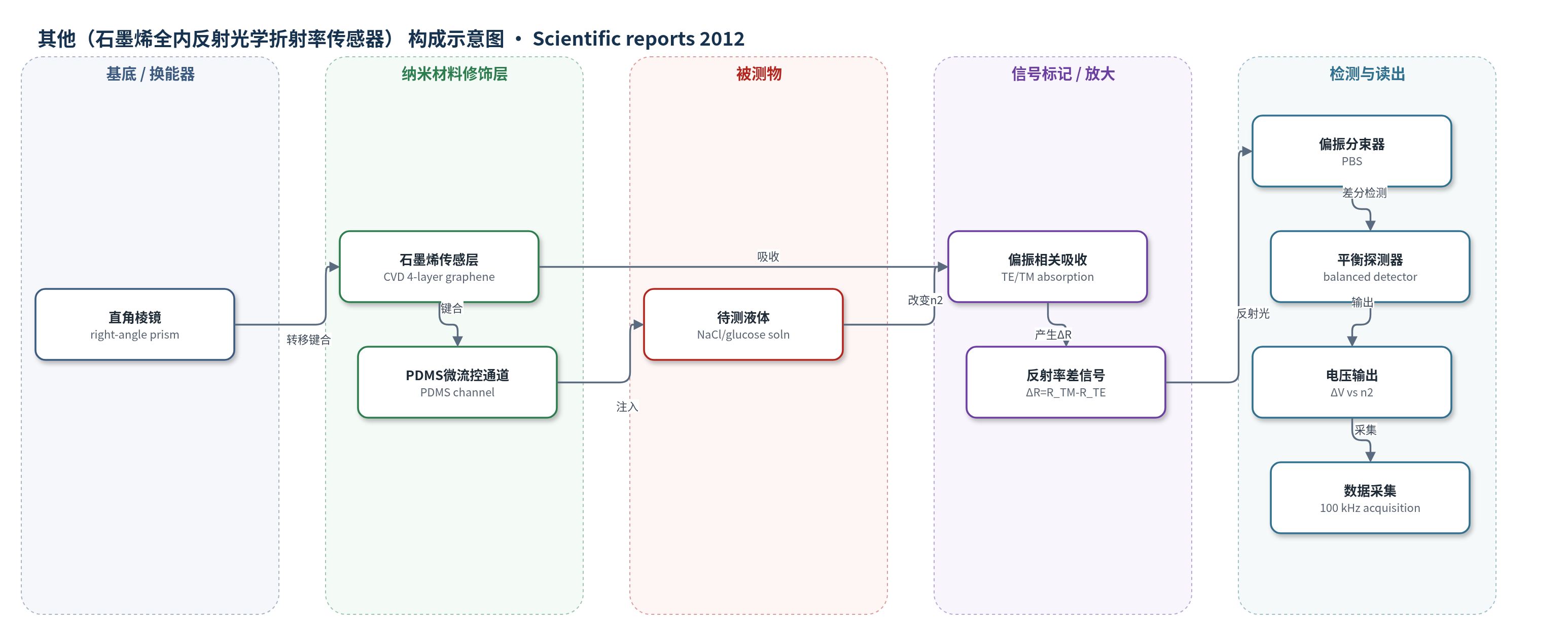
点击图片查看大图 · 依据论文自动绘制
传感器类型
其他(石墨烯全内反射光学折射率传感器)
检测对象
折射率(refractive index, RI);样品基质:微流控通道内液体(去离子水、NaCl溶液、葡萄糖溶液、有机溶剂)
检测原理
圆偏振光经棱镜入射到石墨烯/液体界面并发生全内反射。石墨烯对 TE(s)和 TM(p)偏振倏逝场的吸收不同,使反射率 R_TE 与 R_TM 随界面液体折射率 n2 变化。PBS 将反射光分为 s 和 p 两路,平衡探测器输出两路光电流差,对应 ΔR=R_TM-R_TE。当样品中 NaCl 或葡萄糖浓度升高时,溶液折射率增大,差分电压随之变化;通过标准液体校准,可实时、无标记地监测折射率变化。平衡检测抑制光源波动,提高灵敏度。
检测灵敏度
灵敏度: 10^5 RIU^-1;实验斜率 dv/dn: 5.1×10^5 mV/RIU;动态范围: Δn>0.5;折射率范围: 1.0–1.438;分辨率: 1×10^-4;响应时间: <10 ms
效应效果
该传感器在 1.0–1.438 折射率范围内实现实时监测,动态范围 Δn>0.5,响应时间 <10 ms,灵敏度达 10^5 RIU^-1,实验斜率 dv/dn 为 5.1×10^5 mV/RIU,与 SPR 的 10^4–10^6 RIU^-1 相当。无石墨烯对照信号接近 0 V,说明石墨烯起关键作用。在 5–300 mL/s 流速下,100 kHz 采集可获得连续稳定曲线;空气/水切换电压变化约 10 V 且可重复。可分辨去离子水与 0.1% NaCl 的折射率差 0.00048,电压差约 245 mV,噪声约 45 mV,分辨率约 1×10^-4。作者认为其适合生物/化学相互作用监测。
传感器的构成
- 基底/换能器:直角棱镜(right-angle prism),提供全内反射(TIR)界面与光路,折射率 n1
- 传感修饰层:CVD 四层石墨烯(graphene, G),厚度约1.36 nm,利用 TE/TM 偏振相关吸收作为折射率敏感层
- 样品通道:PDMS 微流控通道(poly(dimethylsiloxane), PDMS microfluidic channel),承载液体样品并与石墨烯/棱镜键合
- 光源与偏振调制:523 nm 连续波激光器(523 nm CW laser)、Glan-Taylor 偏振片与四分之一波片,产生圆偏振光入射
- 信号分离与读出:偏振分束器(PBS)与平衡探测器(balanced detector),分离 s/p 偏振光并输出差分电压
中文摘要
基于石墨烯在全内反射条件下的偏振敏感吸收特性,作者构建了一种结合石墨烯与微流控结构的光学传感器,用于对折射率进行高灵敏实时监测。石墨烯具有原子级厚度和强宽带吸收,在全内反射结构中,其对横电(TE)和横磁(TM)偏振模式表现出明显不同的反射率,且该反射率对与石墨烯接触的介质折射率变化敏感。该石墨烯折射率传感器能够快速、灵敏地监测局部折射率变化,具有快速响应时间和宽动态范围。结果表明,将石墨烯用于简单高效的全内反射结构并结合微流控技术,是制备折射率传感器和生物传感器器件的理想材料,可满足高需求应用。
英文摘要
Based on the polarization-sensitive absorption of graphene under conditions of total internal reflection, a novel optical sensor combining graphene and a microfluidic structure was constructed to achieve the sensitive real-time monitoring of refractive indexes. The atomic thickness and strong broadband absorption of graphene cause it to exhibit very different reflectivity for transverse electric and transverse magnetic modes in the context of a total internal reflection structure, which is sensitive to the media in contact with the graphene. A graphene refractive index sensor can quickly and sensitively monitor changes in the local refractive index with a fast response time and broad dynamic range. These results indicate that graphene, used in a simple and efficient total internal reflection structure and combined with microfluidic techniques, is an ideal material for fabricating refractive index sensors and biosensor devices, which are in high demand.