组成图示
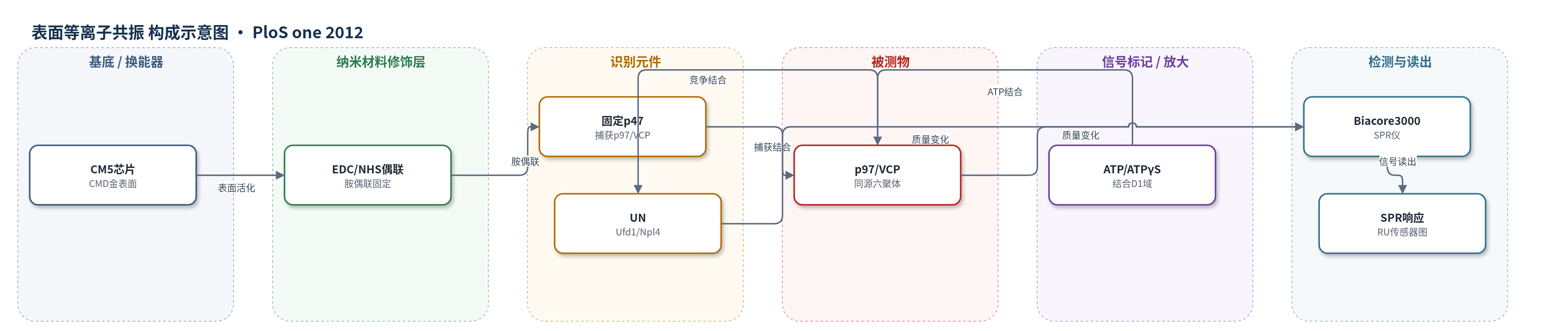
点击图片查看大图 · 依据论文自动绘制
传感器类型
表面等离子共振(SPR)生物传感器
检测对象
p97/VCP(valosin-containing protein)、Ufd1/Npl4(UN)、p47 适配体蛋白;样品基质为重组蛋白 PBS 缓冲液(含 5 mM β-巯基乙醇、0.005% P20)
检测原理
该 SPR 生物传感器将 p47 或 p97/VCP 通过 EDC/NHS 胺偶联固定于 CM5 芯片 CMD 表面,随后注入 p97/VCP、UN 或 p47。蛋白结合使界面质量与折射率改变,Biacore 3000 以响应单位(RU)实时记录传感器图。竞争实验中,固定 p47 先捕获约 500 RU 的 p97/VCP,再共注入 UN 与 ATP;ATP 结合 p97/VCP 近端 D1 域后增强 UN 与 N 域的结合,使 p97/VCP 从 p47 表面解离,RU 下降幅度增大。ATPγS 和 AMP-PNP 可替代 ATP,说明信号增强依赖 ATP 结合而非水解。
检测灵敏度
原文未报告检测限(LOD)、线性范围、灵敏度斜率或相关系数。
效应效果
SPR 方法可实时监测结合/解离,p47 固定表面经 50 mM NaOH 再生后可重复使用 100 次以上。竞争实验中,2 μM ATP 使 0.5 μM UN 的竞争效果相当于无 ATP 时 5 μM UN,约 10 倍增强;无 UN 时 ATP 不影响 p97/VCP 从 p47 解离,BSA 不能竞争,显示选择性。ATPγS 与 AMP-PNP 效果类似,ADP 无效果,说明依赖 ATP 结合而非水解。ATP 将 p97/VCP–UN 第二结合组分亲和力由约 400 nM 提高至约 100 nM,但不影响 p47 结合。p97-N-D1 片段重现全长蛋白行为;DLS 显示 ATP 使全长 p97/VCP 水动力直径由 19.41 nm 增至 19.74 nm,p97-N-D1 由 16.14 nm 增至 18.18 nm;DSF 显示 p97-N-D1 熔解温度由 50°C 升至 64°C。作者认为该 SPR 竞争法可用于高通量筛选调节 p97/VCP 适配体招募的小分子。
传感器的构成
- 基底/换能器:CM5 传感器芯片,金表面羧甲基葡聚糖(CMD)层,提供 SPR 换能界面
- 表面活化/偶联层:EDC/NHS 活化羧基,胺偶联固定 p47 或 p97/VCP 配体
- 识别/捕获元件:固定 p47 捕获 p97/VCP,或固定 p97/VCP 结合 Ufd1/Npl4(UN)/p47
- 分析物/竞争元件:p97/VCP 同源六聚体、UN 异源二聚体、p47 同源三聚体,在 PBS 中注入
- 调节/放大元件:ATP、ATPγS、AMP-PNP、ADP 与 D1 域结合,调节 UN 与 N 域结合
- 读出系统:Biacore 3000 SPR 仪器,监测响应单位(RU)传感器图
中文摘要
p97/Valosin-containing protein(VCP)是 AAA-ATPase 家族成员,参与细胞分裂、胞内运输和内质网相关降解(ERAD)等过程。p97/VCP 为同源六聚体,每个亚基含串联的 D1 和 D2 ATPase 结构域以及 N 端和 C 端适配体结合区,其功能由不同适配体蛋白定向。本研究聚焦仅结合 p97/VCP N 域并分别导向 ERAD 或高尔基体同源融合的 Ufd1/Npl4(UN)和 p47。利用表面等离子共振(SPR)生物传感器实时监测结合动力学。竞争实验显示,ATP 存在时 UN 能更有效地与 p47 竞争结合 p97/VCP。使用不可水解 ATP 类似物和六聚体截短 p97-N-D1 片段证明,ATP 与近端 D1 域的结合而非水解增强了 UN 与 N 域的关联,从而调节 UN 或 p47 的招募。该结果赋予 D1 AAA-ATPase 结构域新的功能,并将 p97/VCP 的多重功能与细胞代谢状态联系起来。
英文摘要
p97/Valosin-containing protein (VCP) is a member of the AAA-ATPase family involved in many cellular processes including cell division, intracellular trafficking and extraction of misfolded proteins in endoplasmic reticulum-associated degradation (ERAD). It is a homohexamer with each subunit containing two tandem D1 and D2 ATPase domains and N- and C-terminal regions that function as adaptor protein binding domains. p97/VCP is directed to its many different functional pathways by associating with various adaptor proteins. The regulation of the recruitment of the adaptor proteins remains unclear. Two adaptor proteins, Ufd1/Npl4 and p47, which bind exclusively to the p97/VCP N-domain and direct p97/VCP to either ERAD-related processes or homotypic fusion of Golgi fragments, were studied here. Surface plasmon resonance biosensor-based assays allowed the study of binding kinetics in real time. In competition experiments, it was observed that in the presence of ATP, Ufd1/Npl4 was able to compete more effectively with p47 for binding to p97/VCP. By using non-hydrolysable ATP analogues and the hexameric truncated p97/N-D1 fragment, it was shown that binding rather than hydrolysis of ATP to the proximal D1 domain strengthened the Ufd1/Npl4 association with the N-domain, thus regulating the recruitment of either Ufd1/Npl4 or p47. This novel role of ATP and an assigned function to the D1 AAA-ATPase domain link the multiple functions of p97/VCP to the metabolic status of the cell.