组成图示
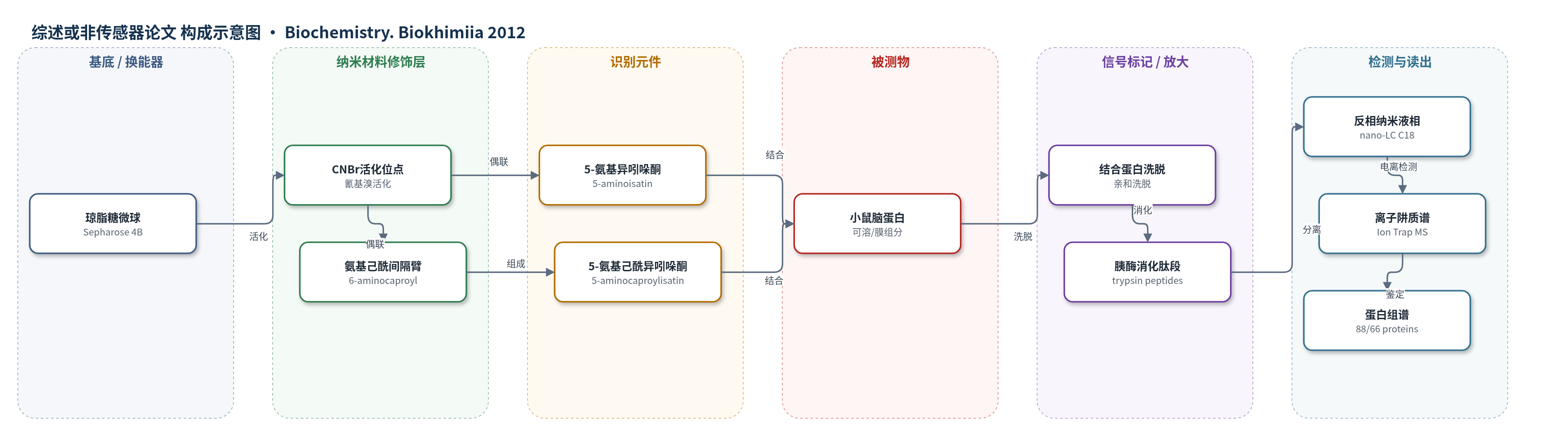
点击图片查看大图 · 依据论文自动绘制
传感器类型
综述或非传感器论文
检测对象
异吲哚酮结合蛋白(isatin-binding proteins,包括多种小鼠脑蛋白);样品基质:小鼠脑 30% 匀浆的可溶、颗粒和膜组分
检测原理
本研究并非基于换能器信号响应的传感器,而是小分子亲和色谱-质谱蛋白组学方法。首先将 5-氨基异吲哚酮或 5-氨基己酰异吲哚酮通过氨基与氰基溴活化 Sepharose 4B 上的 CNBr 基团共价偶联,形成异吲哚酮亲和吸附剂。小鼠脑匀浆的可溶、颗粒和膜组分上柱后,具有异吲哚酮结合位点的蛋白与固定化配体发生特异性结合,非特异结合蛋白经洗涤去除。洗脱结合蛋白后,用胰蛋白酶消化为肽段,经反相纳米液相色谱分离,再由离子阱质谱进行 MS/MS 检测,并与数据库比对鉴定蛋白。信号输出为肽段谱和蛋白鉴定数,而非连续浓度响应。不同间隔臂长度改变配体空间可达性和蛋白亲和力,导致捕获蛋白谱不同。
检测灵敏度
原文未报告。
效应效果
方法选择性通过未偶联配体的对照 Sepharose 校正非特异结合,去除 II 型和 I 型角蛋白等背景蛋白;每个蛋白至少在三次独立实验中重复鉴定,保证重现性。使用 5-氨基己酰异吲哚酮鉴定 66 种蛋白,使用 5-氨基异吲哚酮鉴定 88 种蛋白,短间隔臂使蛋白数提高约 25%,但两种蛋白谱仅 22 种相同,说明配体长度显著影响亚蛋白组捕获。已知高敏感靶点如 MAO B、ANP 刺激颗粒鸟苷酸环化酶和 NO 刺激可溶鸟苷酸环化酶未被检出,提示亲和配体亲和力或空间匹配不足。作者认为内源异吲哚酮结合蛋白数量仍被低估,需针对不同类似物构建药理学蛋白组。
传感器的构成
- 载体基底:氰基溴活化 Sepharose 4B(琼脂糖微球,提供 CNBr 活化基团用于配体偶联)
- 亲和配体层:5-氨基异吲哚酮(5-aminoisatin)或 N-(6-氨基己酰)-5-氨基异吲哚酮(5-aminocaproylisatin),通过氨基与 CNBr 基团共价偶联,捕获异吲哚酮结合蛋白
- 样品基质:小鼠脑 30% 匀浆的可溶、颗粒和膜组分(Triton X-100 裂解/去垢处理)
- 洗脱与酶解:亲和洗脱后胰蛋白酶(trypsin)消化为肽段
- 分离与检测:Agilent 1200 nano-flow HPLC-Chip Cube 反相 C18 柱(Zorbax 300 SB-C18)和 Agilent 6340 Ion Trap 质谱(LC-MS/MS)
中文摘要
小分子亲和色谱用于分离特定亚蛋白组时,常需对母体化合物进行化学修饰,以便将其共价偶联到固相载体。异吲哚酮(isatin,indoledione-2,3)是哺乳动物脑、外周组织和体液中存在的内源性吲哚,具有多种生物活性。作者此前用 5-氨基己酰异吲哚酮(5-aminocaproylisatin)对啮齿动物脑匀浆组分进行蛋白组学分析,鉴定出 60 多种蛋白;但后续光学生物传感器验证显示,不同蛋白对固定化 5-氨基己酰异吲哚酮和 5-氨基异吲哚酮(5-aminoisatin)的亲和力不同。本研究比较了以两种异吲哚酮类似物作为亲和配体分离的小鼠脑异吲哚酮结合蛋白谱。结果显示,使用较短的 5-氨基异吲哚酮时鉴定蛋白数更高(88 对 66),两种蛋白谱中仅 22 种蛋白相同。因此,用于偶联到 Sepharose 的氨基与异吲哚酮基团之间的间隔臂长度显著影响脑异吲哚酮结合蛋白的蛋白组学分析,提示与内源性未修饰异吲哚酮相互作用的脑蛋白数量仍被低估。
英文摘要
Use of small molecules for isolation of particular sub-proteomes is often complicated by the need for chemical modification of a parent compound for affinity sorbent preparation. Isatin (indoledione-2,3) is an endogenous indole that exhibits a wide spectrum of biological activities. Using 5-aminocaproylisatin for proteomic profiling of fractionated rodent brain homogenates, we previously identified more than sixty individual proteins. However, proteins tested in an optical biosensor study for validation of their isatin-binding capacity demonstrated different affinity for immobilized 5-aminocaproylisatin and 5-aminoisatin. In this study, we comparatively evaluated proteomic profiles of isatin-binding proteins separated using both isatin analogs as the affinity ligands. The total number of identified proteins was higher with the shorter isatin analog (88 versus 66), and only 22 proteins were identical in the two proteomic profiles. Thus, proteomic profiling of brain isatin-binding proteins is significantly influenced by the length of the spacer between the amino group used for affinity ligand coupling to Sepharose and the isatin moiety. This suggests that the actual number of brain proteins interacting with endogenous (unmodified) isatin still remains underestimated due to different affinity of proteins for the isatin analogs used for the affinity-based proteomic profiling.