组成图示
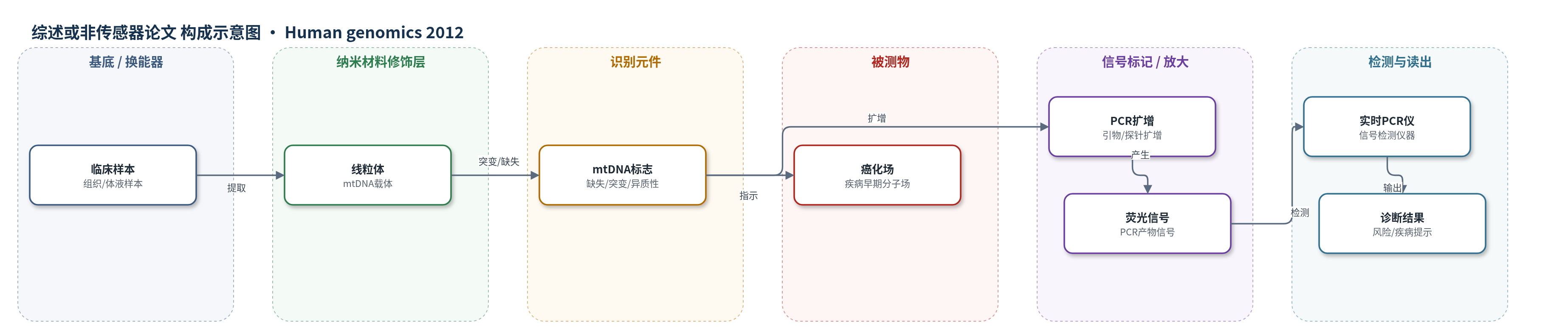
点击图片查看大图 · 依据论文自动绘制
传感器类型
综述或非传感器论文
检测对象
线粒体DNA缺失/突变(mtDNA deletions/mutations)、异质性(heteroplasmy);样品基质:组织活检、前列腺穿刺组织、体液
检测原理
本文所述并非传统换能器型传感器,而是以线粒体基因组为分子传感标志的早期疾病检测策略。线粒体DNA(mtDNA)在疾病早期即可发生缺失、突变和异质性改变,且其突变率高于核DNA,相关改变可早于组织病理学异常出现,形成癌化场分子特征。检测时从组织活检、前列腺穿刺组织或体液中获取样本,提取mtDNA,利用实时PCR等核酸扩增方法针对特定缺失或突变位点进行识别与扩增。PCR将目标序列指数放大,荧光或产物量随目标mtDNA标志物丰度变化,从而反映疾病风险或癌化场存在。该策略以核酸分子识别和PCR放大为核心,不依赖电极界面或纳米材料修饰。
检测灵敏度
原文未报告LOD、线性范围、灵敏度斜率或相关系数。
效应效果
本文未报告RSD、稳定性、抗干扰、回收率等传感性能数据。其应用价值主要体现在:利用mtDNA缺失/异质性识别癌化场,可弥补前列腺穿刺活检的采样误差;文中提到3.4 kb mtDNA缺失在前列腺肿瘤及周围外观正常组织中均存在,可用于识别假阴性/真阴性穿刺核心。早期检测还可与化学预防结合,降低治疗成本:乳腺癌首年治疗平均约30,000美元,5年他莫昔芬约3,700美元、雷洛昔芬约5,800美元,若避免进展治疗可节省超过80%;2008年美国癌症总经济影响约2281亿美元。
传感器的构成
- 综述说明:本文为综述,未报道具体传感器装置或电极结构
- 识别标志:线粒体DNA(mtDNA)缺失、突变与异质性(heteroplasmy)作为疾病早期分子识别事件
- 信号读出:实时PCR(real-time PCR)用于扩增并检测mtDNA分子标志物
中文摘要
开发疾病早期检测生物传感器一直是人类基因组计划的长期目标,但迄今收效有限。相比之下,线粒体具有独特的生物学特性,其基因组又相对简单,这使线粒体具备作为生物传感器的突出功能,也使线粒体基因组学在推动个性化医学取得重大进展方面处于战略优势地位。多种因素使线粒体特别适合用作早期疾病检测生物传感器,其应用不仅限于肿瘤学,还可拓展到人类健康与疾病的许多其他方面。疾病的早期检测能够转化为更有效、更低成本的治疗策略,并显著改善具有较高疾病发生风险人群的总体预后。本文进一步指出,线粒体基因组学有望成为连接基因组发现与临床预防医学的重要桥梁。
英文摘要
Developing early detection biosensors for disease has been the long‒held goal of the Human Genome Project, but with little success. Conversely, the biological properties of the mitochondrion coupled with the relative simplicity of the mitochondrial genome give this organelle extraordinary functionality as a biosensor and places the field of mitochondrial genomics in a position of strategic advantage to launch significant advances in personalized medicine. Numerous factors make the mitochondrion organelle uniquely suited to be an early detection biosensor with applications in oncology as well as many other aspects of human health and disease. Early detection of disease translates into more effective, less expensive treatments for disease and overall better prognoses for those at greater risk for developing diseases.