组成图示
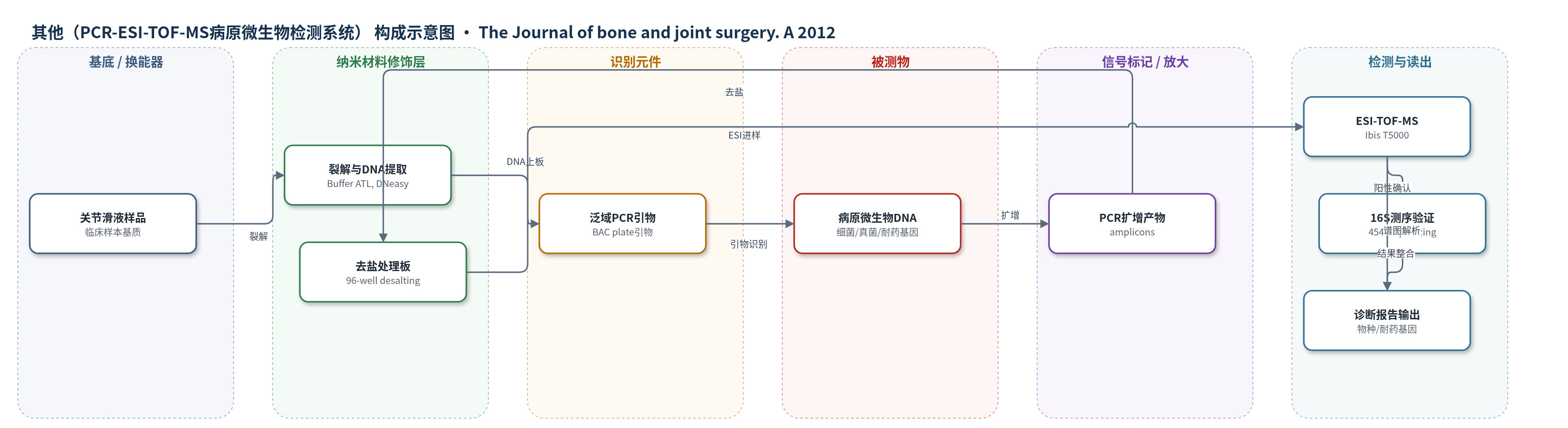
点击图片查看大图 · 依据论文自动绘制
传感器类型
其他(PCR-ESI-TOF-MS病原微生物检测系统)
检测对象
病原微生物(bacteria/fungi,含细菌属种与念珠菌 Candida)、抗生素耐药基因(vanA/vanB、KPC、mecA);样品基质:关节滑液(synovial fluid)
检测原理
关节滑液经 Buffer ATL 与蛋白酶K裂解后,用 DNeasy 提取总 DNA。DNA 加入 BAC detection PCR plate,其中泛域引物、属/种引物和耐药基因引物分别识别细菌、念珠菌及 vanA/vanB、KPC、mecA 等靶序列,PCR 将痕量靶 DNA 指数扩增为不同长度和碱基组成的扩增子。扩增子经 96-well 去盐后由 ESI 离子化进入 TOF-MS,不同扩增子因质荷比不同形成特征质谱峰;系统根据峰质量推断碱基组成并匹配数据库,输出物种、置信度和每孔基因组数。信号强度/基因组数随靶 DNA 拷贝数增加而增加,PCR 提供放大,质谱提供多重无标记读出。
检测灵敏度
原文未报告 LOD、线性范围、灵敏度斜率或相关系数。
效应效果
23 例临床感染病例中,Ibis 与培养一致:18 例培养阳性中 17 例检出相同病原菌,5 例培养阴性中 4 例检出微生物;培养阳性者无 Ibis 阴性。8 例耐甲氧西林葡萄球菌培养阳性者均检出 mecA。57 例非感染翻修病例中 50 例(88%)检出微生物。诊断指标:≥1 种微生物敏感性 95.7%、特异性 12.3%;葡萄球菌/链球菌敏感性 87.0%、特异性 73.7%;mecA 特异性 98.3%、阳性预测值 87.5%;置信度>0.7 敏感性 95.7%、阴性预测值 96.0%;基因组数>200 特异性 96.5%。阳性均经 16S 测序确认。作者认为其有助于培养阴性 PJI 病原鉴定,但高敏感性限制单独诊断。
传感器的构成
- 样品前处理层:Buffer ATL 裂解缓冲液与蛋白酶K(proteinase K),裂解滑液中的细胞/组织并释放核酸。
- 核酸提取层:DNeasy Blood & Tissue kit(Qiagen),从裂解样品中提取总 DNA。
- 识别元件层:BAC detection PCR plate(Abbott Molecular)中的泛域引物、属/种引物及耐药基因引物(vanA/vanB、KPC、mecA),特异性扩增目标微生物 DNA。
- 信号放大层:PCR 扩增产物(amplicons),通过指数扩增将痕量靶 DNA 转化为可检测的质谱分析物。
- 样品净化层:96-well 去盐板,去除 PCR 产物中的盐分,降低电喷雾离子化抑制。
- 换能读出层:ESI-TOF-MS 与 Ibis T5000 仪器,将 PCR 产物离子化并按质荷比检测,输出物种与耐药基因信息。
中文摘要
假体周围关节感染(periprosthetic joint infection, PJI)的诊断难点之一是难以分离出感染病原菌。Ibis T5000 生物传感器系统采用泛域引物进行多轮聚合酶链式反应(PCR),可鉴定并分型几乎所有细菌和真菌,并检测关键抗生素耐药基因。本研究前瞻性收集 82 例患者 87 次关节置换手术(65 次膝关节翻修、15 次髋关节翻修、7 次初次膝关节置换)的关节滑液,同时送常规培养和 Ibis 分析;外科医生临床判断 23 例为感染性失败、57 例为非感染性失败。结果显示,在 23 例临床判断感染病例中,Ibis 在 18 例培养阳性病例中的 17 例检出与培养相同的病原菌,并在 5 例培养阴性病例中的 4 例检出一种或多种微生物;在 57 例 presumed noninfectious 病例中,Ibis 在 50 例(88%)检出微生物。结论:Ibis 技术不仅有助于培养阴性疑似 PJI 的病原菌检测,也提示许多既往被认为无菌的翻修病例可能合并未被识别的亚临床感染。
英文摘要
BACKGROUND: The diagnosis of periprosthetic joint infection poses many challenges, one of which is the difficulty of isolating the infecting organism. Recently, a sophisticated modality (the Ibis Biosciences T5000 biosensor system) has been introduced that uses pan-domain primers in a series of polymerase chain reactions (PCRs) to identify and speciate essentially all bacteria and fungi as well as to identify key antibiotic resistance genes. We investigated the role of the Ibis in identifying infecting organisms in cases of known and suspected periprosthetic joint infection.
METHODS: Synovial fluid specimens were collected prospectively from eighty-two patients undergoing eighty-seven arthroplasty procedures (sixty-five knee revisions, fifteen hip revisions, and seven primary knee arthroplasties) and were sent for both conventional culture and Ibis analysis. The surgeon's clinical determination of the cause for revision arthroplasty was failure due to infection in twenty-three cases and noninfectious failure in fifty-seven cases.
RESULTS: In the twenty-three cases that were considered on clinical grounds to involve a periprosthetic joint infection, the Ibis detected the same pathogen isolated by conventional culture in seventeen of eighteen cases and also detected one or more organisms in four of the five culture-negative cases. In addition, the Ibis detected organisms in fifty (88%) of the fifty-seven cases in which revision arthroplasty was performed for a presumed noninfectious failure.
CONCLUSIONS: The Ibis technology was not only effective at detecting organisms in cases of suspected periprosthetic joint infection in which cultures were negative, but it also suggested that many of the revision arthroplasty cases that have previously been considered to be purely aseptic may have a component of unrecognized, subclinical infection.