组成图示
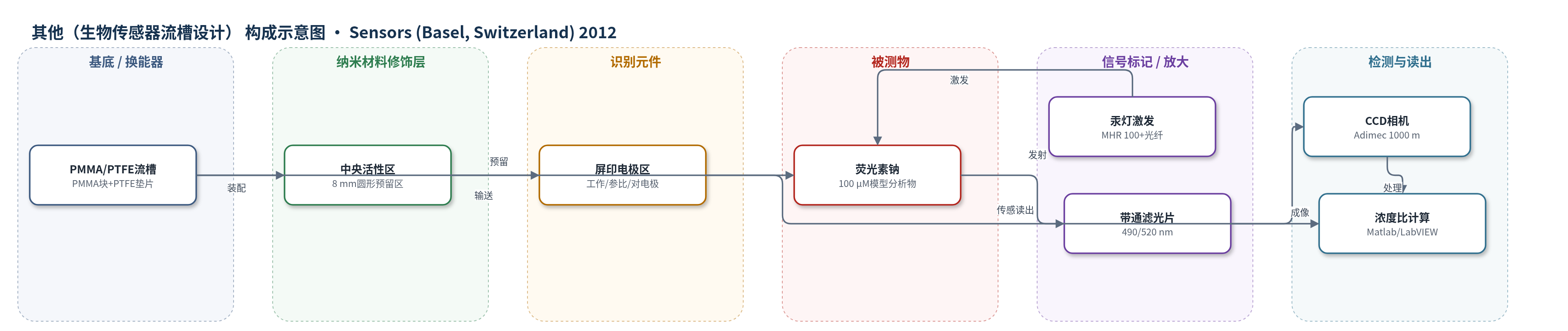
点击图片查看大图 · 依据论文自动绘制
传感器类型
其他(生物传感器流槽设计)
检测对象
荧光素钠(sodium fluorescein),水溶液(去离子水背景)
检测原理
本系统未涉及生物识别事件,核心是流槽内分析物输运与荧光浓度读出。荧光素钠随进料进入 PMMA/PTFE 流槽,在 1 mm 通道和中央活性区内受平流与扩散共同输运;当通道扩张形成涡流时,涡内主要靠扩散,导致活性区平均浓度趋近进料浓度变慢。荧光素钠被汞灯激发后发射约 515 nm 荧光,荧光强度与浓度在 0–100 µM 内呈线性关系。经 490/520 nm 带通滤光片后由 CCD 相机成像,Matlab 计算像素浓度比 C_ratio 和平均浓度比 CCR。因此信号随分析物浓度线性变化,并随流速、流槽几何和涡流发展而改变响应时间。
检测灵敏度
未报告 LOD;线性范围: 0–100 µM(原文:0–100 µM showed a linear relationship);未报告灵敏度斜率;未报告 R^2。
效应效果
实验重复性良好,平均浓度比误差棒(±1标准差)不超过平均值的3.5%。三种通道流槽在低流速下平流主导,随流速增加出现涡流,达到99% CCR所需时间和体积增加。方形流槽在所有流速存在角涡,体积随流速增加;圆形流槽约1 mL/min出现涡,最优1 mL/min,体积0.85 mL,时间51 s;iCell约2.5 mL/min出现涡,最优1.75–2.5 mL/min,体积0.75–0.81 mL,时间26–20 s,综合最优。涡流跨满宽度分别约3.75、5.0、15 mL/min。商用冲击射流流槽除最高流速外表现较差。作者建议设计平缓扩张/收缩并控制流速防止再循环,以获得可重复高效生物传感。
传感器的构成
- 基底/流槽主体:PMMA 上下块与 PTFE 垫片,构成密封流道
- 流道/活性区:1 mm 入口/出口矩形通道连接中央方形、圆形或 iCell 区,通道高度 1.5 mm
- 换能器/传感元件(预留):屏印电极(工作、参比、对电极,如 Dropsens C223AT),用于生物传感器测量
- 模型分析物/示踪剂:100 µM 荧光素钠(sodium fluorescein),作为浓度示踪剂
- 激发光源:汞灯(Dolan Jenner MHR 100)配光纤导光,提供激发光
- 光学滤波:490 nm 与 520 nm 带通滤光片,选择 515 nm 荧光发射
- 信号读出:CCD 单色相机(Adimec 1000 m)与显微镜,LabVIEW 25 fps 采集
- 数据处理:Matlab 计算像素浓度比 C_ratio 与平均浓度比 CCR
中文摘要
本文报道了三种生物传感器流槽的效率。三种流槽均在传感元件附近设有扩展的中央通道,以提供相同直径的活性区,但通道扩张与收缩速率不同。对每种流槽,作者采用有限元模型数值计算,并用流动荧光技术实验测定传感室内分析物浓度对进料分析物浓度变化的响应速率。结果表明,三种设计在流速增加时效率均下降,原因是扩散相对于平流的重要性增加,且效率受再循环流区(涡流)发展的限制。然而,通道扩张最平缓的设计在更高流速下才出现涡流,因此在所研究流速范围内具有明显更高的效率。作者建议,生物传感器流槽应设计为尽量减少并避免流再循环的发展,并在防止涡流形成的条件下运行。
英文摘要
The efficiency of three different biosensor flow cells is reported. All three flow cells featured a central channel that expands in the vicinity of the sensing element to provide the same diameter active region, but the rate of channel expansion and contraction varied between the designs. For each cell the rate at which the analyte concentration in the sensor chamber responds to a change in the influent analyte concentration was determined numerically using a finite element model and experimentally using a flow-fluorescence technique. Reduced flow cell efficiency with increasing flow rates was observed for all three designs and was related to the increased importance of diffusion relative to advection, with efficiency being limited by the development of regions of recirculating flow (eddies). However, the onset of eddy development occurred at higher flow rates for the design with the most gradual channel expansion, producing a considerably more efficient flow cell across the range of flow rates considered in this study. It is recommended that biosensor flow cells be designed to minimize the tendency towards, and be operated under conditions that prevent the development of flow recirculation.