组成图示
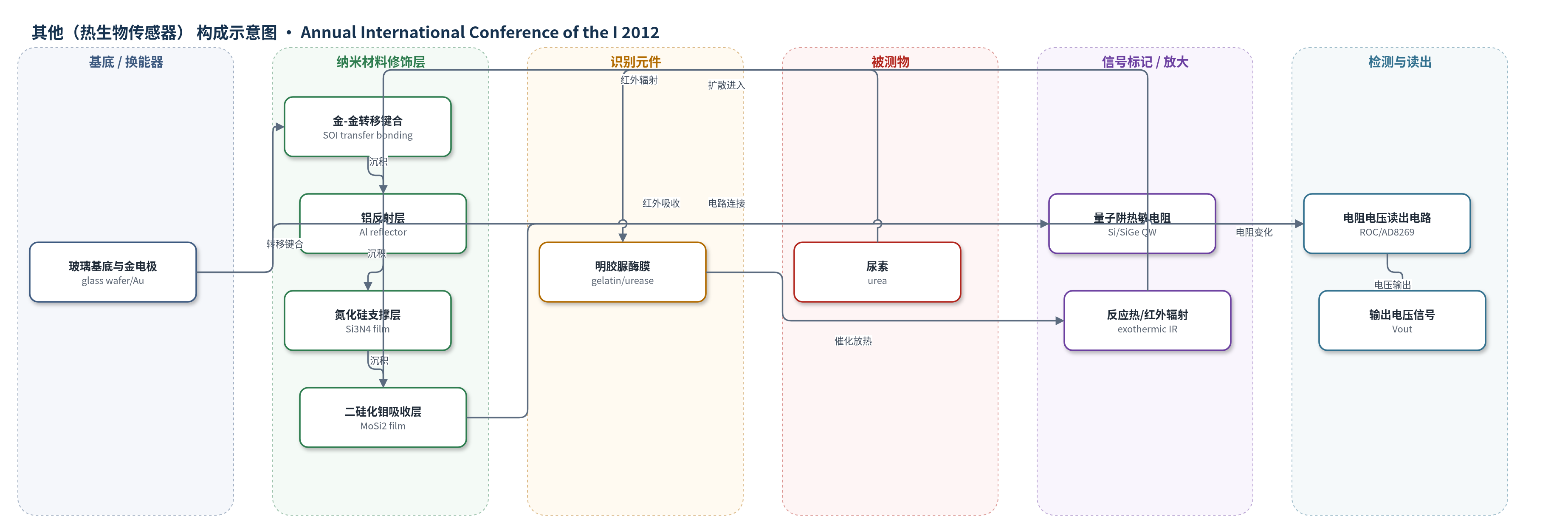
点击图片查看大图 · 依据论文自动绘制
传感器类型
其他(热生物传感器)
检测对象
尿素(urea);样品基质:100 mM 磷酸盐缓冲液(PB)水溶液(pH 6.5–7.5)
检测原理
尿素从 PDMS 微流控通道扩散进入明胶脲酶膜,脲酶催化尿素水解为二氧化碳和氨并释放反应热。反应热以红外辐射形式传递至传感器表面,MoSi2 吸收层与 Al 反射层在 10–13 µm 波段形成高吸收光学结构,使悬空薄膜温度升高。Si/SiGe 量子阱热敏电阻具有高 TCR,温度变化引起电阻变化,经 ROC 电路转换为电压输出。尿素浓度越高,单位时间放热越多,温升和输出电压越大,在 0.5–150 mM 范围内近似线性。MEMS 悬空结构和梁结构降低热损失、提高热阻,将最大温差从 600 mK 提升至 1850 mK,实现低焓变反应的高灵敏检测。
检测灵敏度
线性范围: 0.5mM to 150mM;RSD: less than 1%
效应效果
传感器对尿素在 0.5–150 mM 范围内线性响应,RSD 小于 1%。pH 7 时响应最佳,pH 7.5 影响不明显,pH 6.5 时响应明显降低;260 mM 尿素因脲酶饱和而偏离线性。引入梁结构后最大温差由 600 mK 提高到 1850 mK,响应时间为 30 ms,无梁结构为 8 ms;样品量可降至微升级。酶膜冰箱保存并每 3 天用 128 mM 尿素测试,稳定性超过设计周期,半衰期可超过 1 个月,更换酶膜后可重复使用。作者认为该传感器可用于低焓变生化反应和单细胞代谢研究。
传感器的构成
- 基底与电极:玻璃晶圆(glass wafer)+ SU-8 光刻胶 + 电镀金(Au)导电腿/焊盘,提供电路与信号读出
- 转移键合层:SOI 晶圆与玻璃晶圆金-金超声键合,将 Si/SiGe 量子阱结构转移到带电路基底
- 反射层:铝(Al)反射层,增强红外辐射吸收并形成光学谐振
- 机械支撑层:氮化硅(Si3N4)悬空薄膜,提供机械强度并限制热传导
- 红外吸收层:二硅化钼(MoSi2)薄膜,增强 10–13 µm 红外辐射吸收
- 换能层:Si/SiGe 量子阱热敏电阻,将温度变化转换为电阻/电压信号
- 热阻结构:梁(beam)结构,提高热阻并增大传感区与环境温差
- 识别/催化层:明胶(gelatin)酶膜固定脲酶(urease),催化尿素水解放热
- 微流控层:PDMS 微流控通道盖,输送样品并保护电路
中文摘要
本文提出一种基于红外辐射能的热生物传感器,用于生化反应量热检测。该传感器结合微机电系统(MEMS)技术进行结构设计,并采用具有高温度系数(TCR)和低 1/f 噪声的 Si/SiGe 量子阱传感材料,因而具有实现高灵敏度和实时检测的潜力。作者以尿素酶催化尿素水解反应验证传感器性能,结果表明其线性检测范围为 0.5 mM 至 150 mM,相对标准偏差小于 1%。在制备工艺中,晶圆级转移键合是关键步骤,它使量子阱传感材料与悬空结构集成成为可能,并降低传感器向周围环境的热损失,从而提高热信号响应。
英文摘要
In this paper, a thermal biosensor based on the infrared radiation energy is proposed for calorimetric measurement of biochemical reactions. Having a good structure design combined with MEMS technology as well as employing the Si /SiGe quantum well sensing material with a high TCR and low 1/f noise, the sensor shows potentials to be high sensitive and real-time. The urea enzymatic reaction was tested to verify the performance of sensor, which demonstrates a linear detection range from 0.5mM to 150mM and a relative standard deviation less than 1%. For the sensor fabrication, wafer-level transfer bonding is a key process, which makes the integration of quantum well material and a free standing structure possible. It reduces the heat loss from the sensor to the surrounding environment.