组成图示
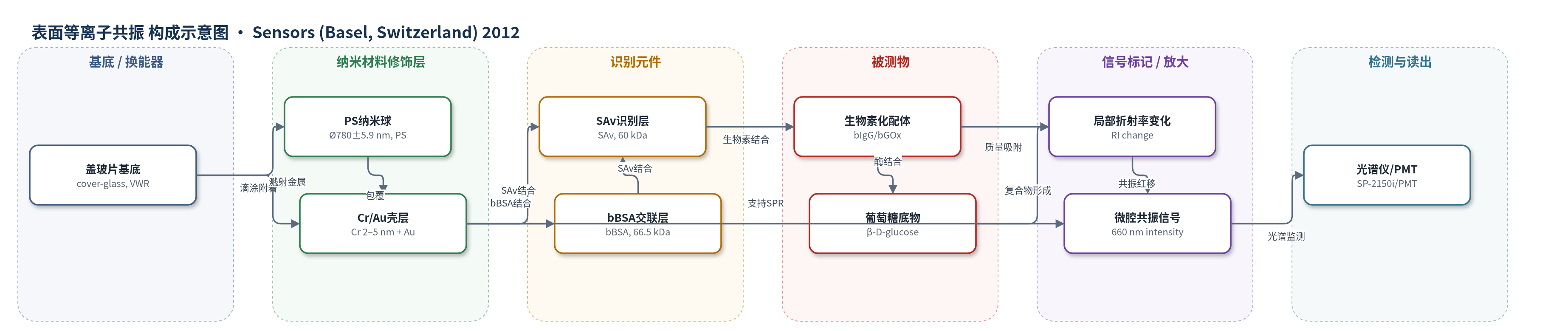
点击图片查看大图 · 依据论文自动绘制
传感器类型
表面等离子共振(SPR)生物传感器
检测对象
生物素化山羊抗小鼠免疫球蛋白G(biotin-conjugated goat anti-mouse IgG, bIgG)、生物素化葡萄糖氧化酶(biotin-conjugated glucose oxidase, bGOx)、β-D-葡萄糖(β-D-glucose, βDGlu);样品基质:Dulbecco磷酸盐缓冲液(DPBS),文中面向体液生物标志物。
检测原理
微腔生物传感器由金壳包覆聚苯乙烯纳米球构成,白激发下形成微腔表面等离子体共振峰。样品中的生物素化配体与金表面固定的链霉亲和素结合,或经bBSA-SAv多层捕获,使金表面附近生物分子质量增加,局部折射率升高。由于表面等离子体穿透深度约5–30 nm,结合事件主要改变微腔共振的波长与振幅:共振峰红移、660 nm处发射强度下降。配体浓度越高,结合量越大,强度下降越大直至饱和。结合动力学可用Langmuir模型描述,信号幅度与配体浓度、结合速率kon和解离速率koff相关。葡萄糖氧化酶与β-D-葡萄糖形成可逆复合物,产生额外慢速信号;L-葡萄糖折射率相同但不结合,用于扣除非特异折射率变化。器件无需荧光或酶标记,通过光谱仪实时读出共振强度变化。
检测灵敏度
LOD: 130 to 230 SAv molecules;detection threshold: 116 molecules;detection threshold: 30 IgG molecules;limit of detection: 22 GOx molecules;实验覆盖范围: 1 nM to 100 nM;另报道范围: 1 µM to 100 mM;R^2(SAv)=0.88, R^2(bIgG)=0.84;R^2(SAv)=0.99, R^2(bGOx)=0.96;R^2(SAv)=0.90, R^2(bIgG)=0.94;R^2(bBSA)=0.91, R^2(SAv)=0.78, R^2(bGOx)=0.97
效应效果
选择性良好:单个微传感器可区分葡萄糖氧化酶与β-D-葡萄糖结合,而不与L-葡萄糖、D-甘露糖或2-脱氧-D-葡萄糖结合,Biacore 3000 SPR无法做到;L-葡萄糖折射率相同但不结合。重复洗脱/注入循环一致,SAv-bGOx冲洗后信号恒定。约35,000个葡萄糖氧化酶分子(9.6 fg或60 zmol)即可饱和,比Biacore 3000少约10^6倍;SAv饱和需<56,000分子(约5.6 fg),最低信噪比17.9±2.3。样品体积<5 µL,流速约0.2 nL/s,饱和时间<5 min。适合体液生物标志物连续监测、高通量阵列和单细胞分泌检测。
传感器的构成
- 基底:光学盖玻片(cover-glass, VWR No.1½, 50×24×0.18 mm)作为透明支撑与微腔基底。
- 粘附层:铬(Cr, 2–5 nm)溅射于玻璃与纳米球表面,增强金层粘附并延长器件寿命。
- 纳米核:聚苯乙烯纳米球(PS nanospheres, Ø780±5.9 nm, Polysciences)随机附着于玻璃,形成介电微腔核心。
- 金属壳层:金(Au, 120–250 nm)全向溅射包覆纳米球与玻璃,形成微腔表面等离子体共振结构。
- 识别元件:链霉亲和素(SAv, 60 kDa)直接结合金表面,作为高亲和生物素识别位点。
- 交联/捕获层:生物素化牛血清白蛋白(bBSA, 66.5 kDa)结合金表面,再结合SAv,用于多层功能化。
- 配体/酶标记:生物素化山羊抗小鼠IgG(bIgG, 150 kDa)或生物素化葡萄糖氧化酶(bGOx, 160 kDa)结合SAv,提供识别或酶催化响应。
- 微流控封装:聚二甲基硅氧烷(PDMS, Sylgard 184)微通道芯片(SU-8 2010模具,50 µm通道,~10 nL腔室)输送样品并封装传感器阵列。
中文摘要
个性化医学有望通过实时监测多种生物标志物改善疾病诊断、治疗优化和医疗成本控制。将基础研究发现转化为符合监管要求的临床应用,需要能够同时监测多个生物标志物的临床高效生物传感器。本文讨论微腔光学生物传感器这一关键组件,用于在生理相关浓度下无标记监测生物分子相互作用。与多数研究侧重提高灵敏度不同,本文强调临床实用所需的稳健性、易制造性、易集成性和可重构性。作者提出一种基于微腔表面等离子体共振的微传感器,可集成到微流控平台,用于临床体液中生物标志物的连续监测、密集二维随机阵列中的高通量药物库筛选与互作组学研究,以及实验室单细胞分泌行为监测。
英文摘要
Personalized medicine has the potential to improve our ability to maintain health and treat disease, while ameliorating continuously rising healthcare costs. Translation of basic research findings to clinical applications within regulatory compliance is required for personalized medicine to become the new foundation for practice of medicine. Deploying even a few of the thousands of potential diagnostic biomarkers identified each year as part of personalized treatment workflows requires clinically efficient biosensor technologies to monitor multiple biomarkers in patients in real time. This paper discusses a critical component of a regulatory system, a microcavity optical biosensor for label-free monitoring of biomolecular interactions at physiologically-relevant concentrations. While most current biosensor research focuses on improving sensitivity, this paper emphasizes other characteristics a biosensor technology requires to be practical in a clinical setting, presenting robust microcavity biosensors which are easy to manufacture and integrate with microfluidics into flexible and redesignable platforms making the microcavity biosensors deployable for continuous monitoring of biomarkers in body fluids in the clinic, in dense 2D random arrays for high-throughput applications like drug-library screening in interactomics, and of the secretory behavior of single cells in the laboratory.