组成图示
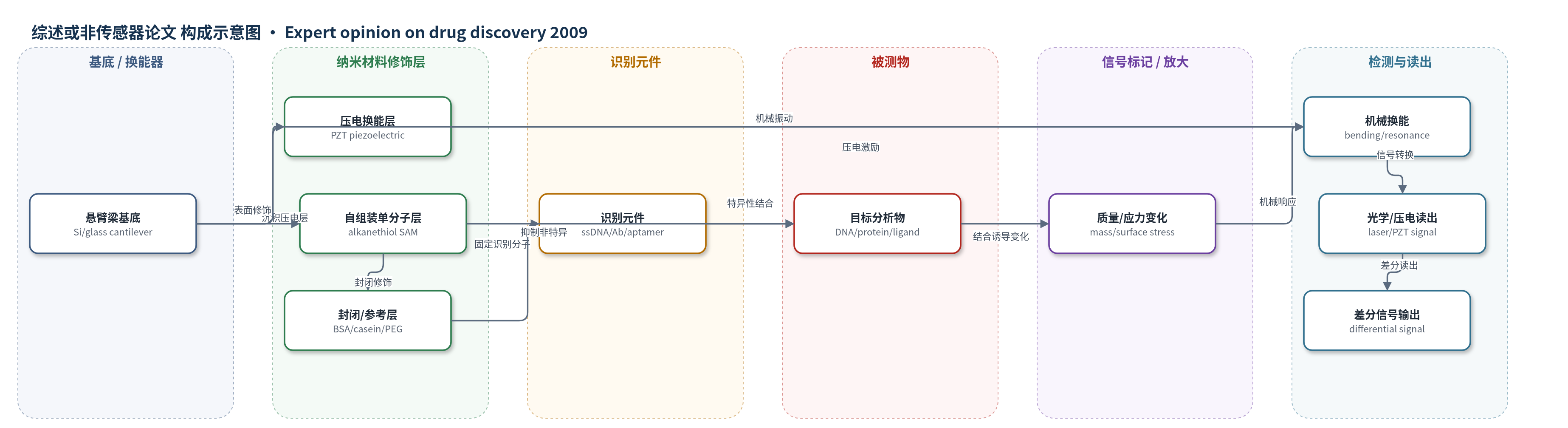
点击图片查看大图 · 依据论文自动绘制
传感器类型
综述或非传感器论文
检测对象
单链DNA(ssDNA)、蛋白(BSA、HSA、PSA、AMACR、CEA、HER2、AFP、肌红蛋白 myoglobin、肌酸激酶 creatine kinase、CRP)、T5噬菌体、药物/配体(vancomycin、serotonin、MDL-72222)、转录因子(SP1、NF-kB);样品基质:缓冲液、人血清/血浆、尿液、食品、细胞裂解液、空气/水。
检测原理
悬臂梁表面固定ssDNA、抗体、适配体或膜蛋白等识别元件。目标分子结合后,在界面产生差异表面应力或附加质量。弯曲模式下,表面应力差Δσ使悬臂梁发生偏转Δz,偏转量与目标浓度和结合亲和力相关;共振模式下,结合质量Δm使等效质量增加,共振频率f下降,Δf/f0≈-1/4·Δm/m_eff。信号通过激光偏转、压电自激/激励或压阻方式读出。参考悬臂梁与差分信号用于扣除非特异吸附;封闭剂(BSA、casein、PEG、1-巯基己醇)降低背景。液相中粘滞阻尼会降低Q值,宽悬臂梁或高次模可提高雷诺数并维持灵敏度。该体系为无标记检测,未使用酶催化或核酸扩增放大。
检测灵敏度
综述报道多体系数值:DNA杂交 LOD: 1 fM(人血清);PSA 检测范围: 0.2 ng/ml–60 µg/ml;PSA LOD: 1 ng/ml;PSA 检测范围: 0.1–100 ng/ml(未稀释血清);AMACR LOD: 10 fg/ml(尿液);T5噬菌体: 30 fM;vancomycin: 10 nM;SP1: 80 nM;NF-kB: 100 nM;myoglobin LOD: 85 ng/ml 或 1 ng/ml;CRP LOD: 100 ng/ml。
效应效果
综述强调悬臂梁传感器为无标记检测,可避免标记引入的构象与表位变异。参考悬臂梁差分与封闭剂(BSA、casein、PEG、1-巯基己醇)抑制非特异结合;PEMC在人流体/血浆中检测1 fM DNA时未出现明显检测损失。T5噬菌体-FhuA体系在30 fM–3 pM范围响应,阴性对照casein基本无结合。vancomycin与肽聚糖类似物在血清中10 nM可区分敏感/耐药。PSA可在未稀释血清0.1–100 ng/ml检测,AMACR在尿液10 fg/ml无需样品制备,检测时间可<30 min。阵列可扩至320–960、1024,适合高通量筛选,但均匀固定、非特异结合和串扰仍待解决。
传感器的构成
- 基底/换能器:硅(Si)、玻璃(glass)或压电PZT薄膜微悬臂梁,提供机械支撑与压电/压阻换能。
- 表面修饰层:烷硫醇自组装单分子层(alkanethiol SAM)、1-巯基己醇(1-mercaptohexanol),用于固定识别分子并降低非特异结合。
- 识别元件:单链DNA(ssDNA)/寡核苷酸探针、抗体(antibody/mAb)、适配体(aptamer)、膜蛋白受体(FhuA、5-HT3AS),特异性结合目标。
- 封闭/参考层:牛血清白蛋白(BSA)、酪蛋白(casein)、聚乙二醇(PEG)或惰性SAM,抑制非特异吸附并提供参考校正。
- 信号换能:无标记质量增加或表面应力变化,通过激光偏转、压电激励/自激(PZT)、压阻(piezoresistive)读出。
中文摘要
本文综述了悬臂梁生物传感器在药物发现中的发展与应用。药物发现需要低成本、高灵敏、高通量的药物-靶标相互作用测量方法。悬臂梁生物传感器是超高灵敏机电传感器,可通过弯曲模式测量结合诱导的表面应力偏转,或通过共振模式测量结合质量引起的频率偏移,实现无标记检测。文章介绍了悬臂梁测量原理、液相中粘滞阻尼与雷诺数影响、识别分子固定及非特异结合抑制策略,并总结DNA-DNA杂交、蛋白-蛋白、膜蛋白-配体、蛋白-DNA等相互作用测量。综述还讨论PSA、AMACR、CEA、HER2、AFP、肌红蛋白、肌酸激酶、CRP等生物标志物检测,以及病原体和毒素检测。作者指出,悬臂梁阵列可借助半导体工艺规模化制造,具有无标记、快速、低成本和高通量潜力,但识别分子均匀固定、非特异结合和阵列串扰仍是关键技术挑战。
英文摘要
IMPORTANCE OF THE FIELD: There is a growing need for inexpensive and highly sensitive methods in high-throughput format for measuring drug-target interactions. Cantilever biosensors are ultra-high sensitive electromechanical sensors that have been successfully used for label-free detection of a large number of biological entities. They are emerging as a technology that appears attractive for high-throughput drug discovery applications. Therefore, a brief description of this technology is provided here.
AREAS COVERED IN THIS REVIEW: The objective of this review is to present an overview of the development in cantilever biosensor field reported to date and examine applications of cantilever biosensors for biomolecular interaction characterization and drug discovery. The subareas included in the review are: cantilever measurement principles, various interactions measured such as DNA-DNA, protein-protein, membrane protein-ligand and DNA-protein. Discussion on biomarker detection is also included.
WHAT THE READER WILL GAIN: We analyze the recent publications on cantilever biosensors with an emphasis on drug discovery and biomarker detection. The reader will become informed on the detection sensitivity and limit of detection achieved to date. A description of ongoing commercial activity that is likely to result in a practical instrument for researchers is also included. Technical issues that concern current researchers in the field of cantilever biosensors are also summarized.
TAKE HOME MESSAGE: The cantilever biosensors provide an extraordinarily sensitive method for binding affinity measurement using label-free reagents. They can be fabricated in array format for high-throughput applications using semiconductor manufacturing techniques. When they become commercially available in future, it is anticipated that they will be cost-competitive and easy to use in a research bioanalytical laboratory.