组成图示
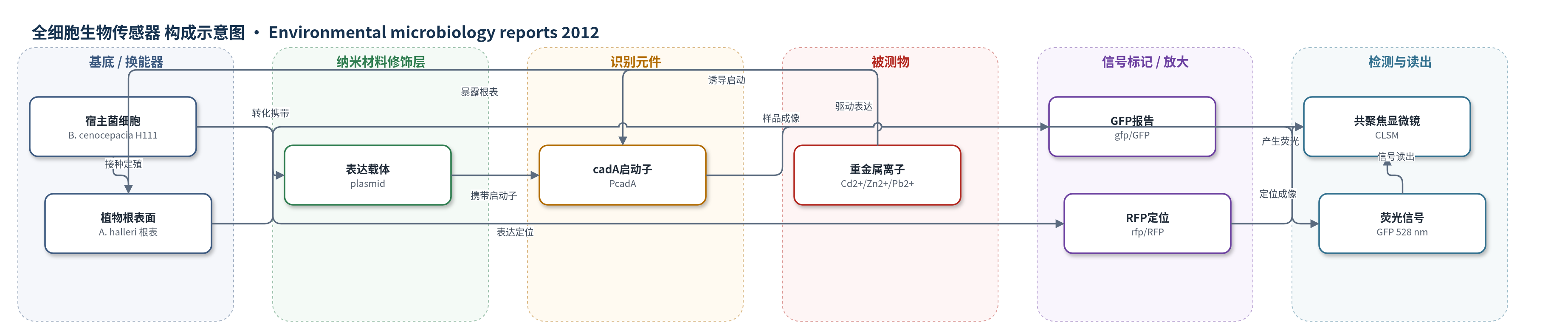
点击图片查看大图 · 依据论文自动绘制
传感器类型
全细胞生物传感器
检测对象
镉(Cd2+,CdSO4/CdCl2)、锌(Zn2+,ZnSO4)、铅(Pb2+,Pb(NO3)2);样品基质:LB/矿物盐培养基、水培培养基、Arabidopsis halleri 根表
检测原理
该传感器以嗜烟伯克霍尔德菌H111为全细胞平台。当环境中存在Cd2+、Zn2+或Pb2+时,重金属响应启动子PcadA被诱导,启动下游gfp转录。GFP蛋白在菌体内积累,其荧光强度随诱导水平升高而增强;中性pH下响应更快、更强,镉激活阈值为30 nM。菌体同时表达RFP作为位置标记,使共聚焦显微镜能够区分传感器菌位置与GFP信号。通过比较GFP与RFP通道,可在植物根表等复杂样品中实现单细胞水平的镉原位检测。该过程依赖基因表达放大,而非电极或纳米材料换能。
检测灵敏度
激活阈值: 30 nM cadmium
效应效果
该传感器对Cd2+、Zn2+和Pb2+具有选择性,不被Ni2+、Cu2+和Co2+诱导。CadA缺失/转座子突变体在1 mM CdSO4中不能生长,在2 mM Cd2+、2 mM Pb2+和5 mM Zn2+下生长严重受损,而Ni2+、Cu2+和Co2+抗性不受影响。中性pH下PcadA–gfp诱导更早且更强,镉激活阈值为30 nM。接种到A. halleri根表后,传感器菌无论有无镉均形成微菌落;仅在水培液含1 mM CdSO4/CdCl2时出现强GFP荧光。作者认为该全细胞荧光传感器可用于复杂环境样品中单细胞水平的镉原位监测。
传感器的构成
- 宿主细胞:Burkholderia cenocepacia H111,作为活细胞传感器并承载重金属响应系统
- 表达载体:质粒(plasmid),携带PcadA–gfp融合以维持报告基因表达
- 识别元件:cadA启动子(PcadA),响应Cd2+、Zn2+和Pb2+并驱动转录
- 报告基因:gfp,编码绿色荧光蛋白(GFP),产生可测荧光信号
- 定位标记:rfp,编码红色荧光蛋白(RFP),标记传感器菌在根表的位置
- 应用界面:Arabidopsis halleri根表/水培培养基,用于原位单细胞监测
中文摘要
伯克霍尔德菌属对重金属具有高度抗性,但其抗性机制尚不清楚。本研究筛选了约5000个嗜烟伯克霍尔德菌H111的mini-Tn5转座子插入突变体,寻找镉耐受性缺失突变。共鉴定出4个相关基因,其中3个影响外膜生物合成与完整性或DNA修复。第4个基因BCAE0587编码CadA家族P1型ATP酶CadA,属于重金属外排泵。CadA缺失菌株在镉、锌和铅存在下不能生长,而对镍、铜和钴的抗性不受影响。将cadA启动子与gfp融合的表达分析证实,该启动子仅被镉、锌和铅诱导。中性pH下启动子活性最高,镉激活阈值为30 nM。将携带PcadA–gfp融合并标记RFP的菌株接种到重金属超富集植物Arabidopsis halleri上,证明该生物传感器可在自然环境中以单细胞水平监测镉。
英文摘要
Burkholderia species are highly resistant to heavy metals (HMs), yet their resistance mechanisms are largely unknown. In this study we screened 5000 mini-Tn5 transposon insertion mutants of Burkholderia cenocepacia H111 for loss of cadmium tolerance. Of the four genes identified three affected outer membrane biogenesis and integrity or DNA repair. The fourth gene, BCAE0587, encoded a P1-type ATPase belonging to the CadA family of HM exporters. CadA-deficient strains lost the ability to grow in the presence of cadmium, zinc and lead, whereas resistance to nickel, copper and cobalt was not affected. Expression studies using a transcriptional fusion of the cadA promoter to gfp confirmed this specificity, as induction was only observed in presence of cadmium, zinc and lead. The promoter activity was found to be highest at neutral pH with an activation threshold of 30 nM cadmium. Inoculation of the HM-hyperaccumulating plant Arabidopsis halleri with a RFP-marked derivative of B. cenocepacia H111 containing the PcadA -gfp fusion demonstrated the applicability of this biosensor for monitoring cadmium at the single cell level in a natural environment.