组成图示
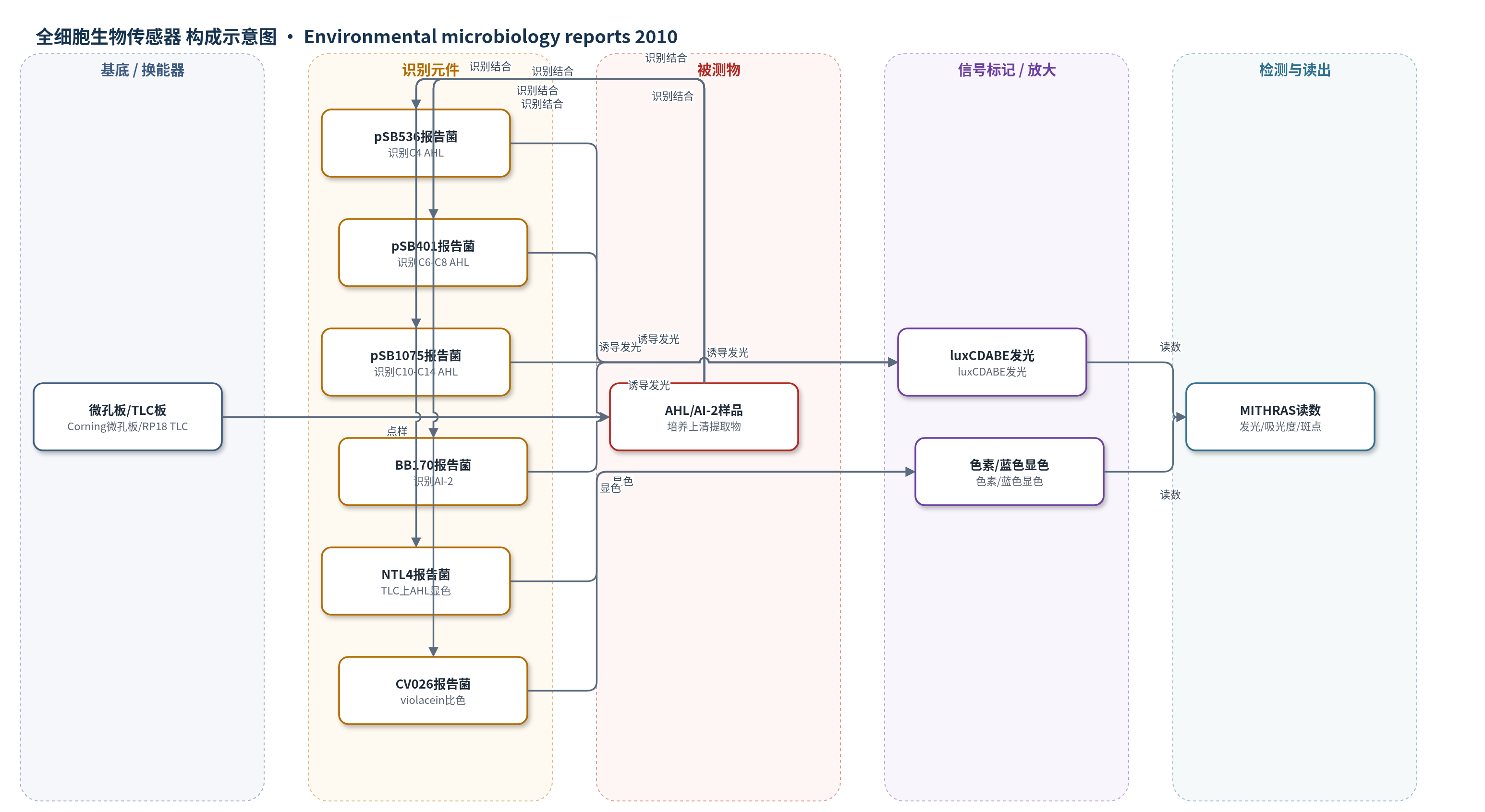
点击图片查看大图 · 依据论文自动绘制
传感器类型
全细胞生物传感器
检测对象
N-酰基高丝氨酸内酯(AHLs)、自诱导剂-2(AI-2);样品基质为弧菌培养上清(marine broth培养上清)及RP-TLC提取物
检测原理
该检测基于全细胞生物报告菌的群体感应响应。弧菌培养上清中的AHL或AI-2进入样品层后,与报告菌中的特异性受体结合:pSB536、pSB401和pSB1075中的LuxR变体分别识别C4、C6-C8和C10-C14 AHL,BB170通过LuxP/LuxU/LuxO/LuxR通路识别AI-2。识别事件激活luxCDABE荧光素酶基因表达,荧光素酶催化荧光素氧化产生发光;在RP-TLC体系中,AHL从薄层扩散至NTL4或CV026,诱导蓝色或紫色色素显色。信号强度(发光、620 nm吸光度或斑点颜色)随AHL/AI-2浓度增加而增强,基因转录翻译过程提供信号放大。C. violaceum中若存在QS抑制剂,则紫色色素被抑制,形成无色环。
检测灵敏度
未报告。
效应效果
方法筛查29株珊瑚相关弧菌:29株均激活AI-2生物传感器,17株激活AHL生物传感器,其中14株激活pSB536,显示链长选择性;P. rosenbergii未检出AHL。RP-TLC显示18、25、30°C下AHL谱随菌株变化;R-21446和LMG 19703的AHL产生随温度升高下降,R-21415在18°C额外产生两条短链AHL。酶活测定中,过氧化氢酶、溶血素和蛋白酶活性在25/30°C通常高于18°C,SD≤17.24%,P=0.05。R-21446在较高温度下使C. violaceum出现无色抑制环,且未显示AHL降解。作者认为这有助于解释高温下弧菌在珊瑚共生体中的竞争优势。
传感器的构成
- 支撑层:Corning微孔板与RP18 F254 TLC板,承载样品、报告菌并用于显色/读数
- 识别元件:E. coli pSB536/pSB401/pSB1075 lux报告菌,LuxR受体分别识别C4、C6-C8、C10-C14 AHL并启动lux基因表达
- 信号标记物:luxCDABE荧光素酶基因簇,催化荧光素氧化产生发光信号
- 识别元件:V. harveyi BB170 AI-2报告菌,LuxP/LuxU/LuxO/LuxR系统识别AI-2并诱导发光
- 识别元件:A. tumefaciens NTL4(pCF218/pCF372)AHL生物报告菌,用于RP-TLC板上AHL显色
- 识别元件:C. violaceum CV026,QS调控violacein紫色色素产生,用于AHL检测与抑制筛选
- 读出层:Berthold MITHRAS微孔板读数仪,测量发光与620 nm吸光度;TLC板显色读取蓝/紫斑点
中文摘要
珊瑚表面及组织内存在复杂微生物群落,其变化与珊瑚生长、存活及疾病密切相关。许多研究提示弧菌在珊瑚病害中可能起关键作用,而群体感应(QS)信号分子可调控弧菌定殖、毒力因子和胞外酶产生。本研究筛选了来自健康与患病珊瑚的29株弧菌,检测其产生N-酰基高丝氨酸内酯(AHLs)和自诱导剂-2(AI-2)的能力。采用大肠杆菌lux型AHL生物传感器pSB536、pSB401和pSB1075以及Vibrio harveyi BB170 AI-2生物传感器进行筛查,结果显示29株菌均激活AI-2生物传感器,但仅17株激活AHL生物传感器。进一步利用反相薄层色谱(RP-TLC)结合A. tumefaciens NTL4生物报告菌分析温度对AHL产生的影响,发现不同菌株间差异显著。研究首次报道Vibrio harveyi R-21446在较高温度下可抑制群体感应,且该抑制并非由AHL降解引起。结果表明,弧菌多样性及温度对信号产生的调控可能部分解释珊瑚相关微生物群落随环境变化而复杂变化的原因。
英文摘要
Corals are inhabited by complex communities of microbes that affect their growth and survival. Several studies suggest that coral disease may be attributed to the success of vibrios in out-competing other bacteria in the mucus and tissues of corals. Vibrios utilize a variety of quorum sensing (QS) signal molecules to regulate processes that could be used to colonize corals during adverse environmental conditions. We therefore screened a range of Vibrios isolated from a variety of healthy and diseased corals, for the production of the QS signal molecules, N-acylhomoserine lactones (AHLs) and the AI-2 (autoinducer-2) small furanone signal molecule. All 29 strains examined activated the AI-2 biosensor, but only 17 activated an AHL biosensor. Using reverse phase thin-layer chromatography, we showed that the effect of temperature on AHL production varied considerably among the isolates. For the first time, the QS inhibition by Vibrio harveyi is reported. This only occurred at higher temperatures and does not appear to be due to degradation of AHLs. The large diversity of vibrios and the different effects of temperature on signal production may partly explain the complexity of coral-associated community changes in response to environmental factors.