组成图示
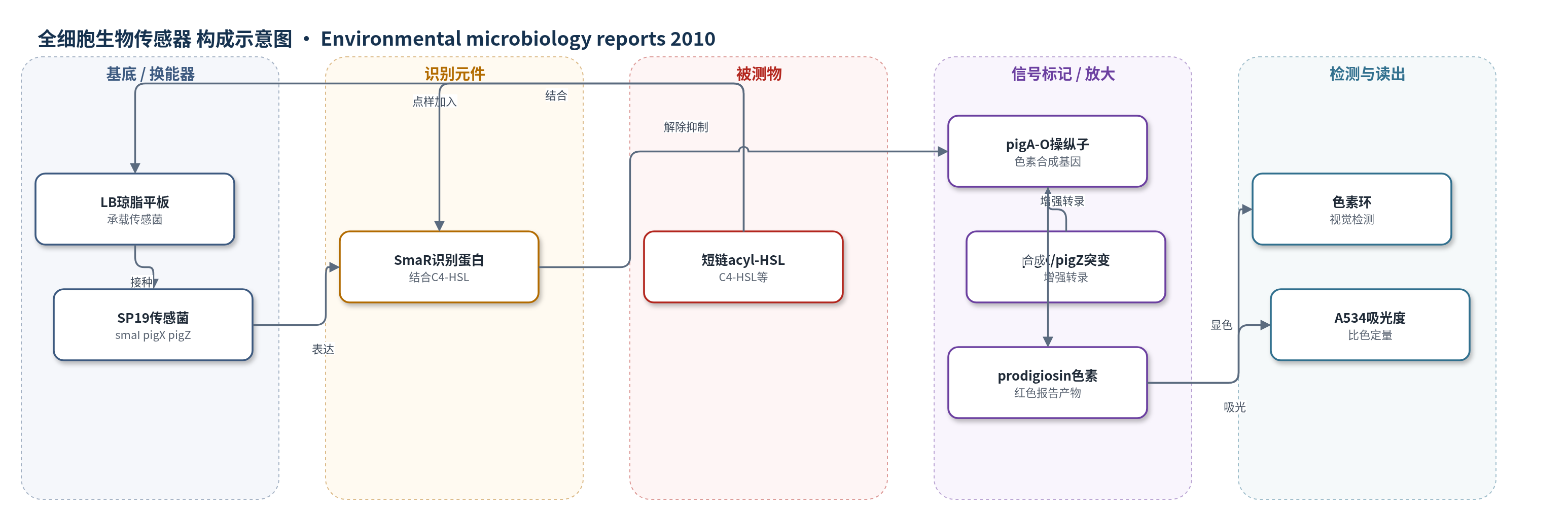
点击图片查看大图 · 依据论文自动绘制
传感器类型
全细胞生物传感器
检测对象
短链N-酰基高丝氨酸内酯(short-chain acyl-HSLs,如C4-HSL、3-oxo-C4-HSL、C6-HSL);样品基质:合成酰基-HSL溶液、细菌培养上清、琼脂平板点样
检测原理
SP19 为 smaI 缺失突变株,不能合成内源 C4-HSL,因此不产生 prodigiosin。当外源短链 acyl-HSL 进入传感菌后,C4-HSL 等配体与 SmaR 转录阻遏蛋白结合,使 SmaR 对 pigA-O 操纵子的抑制解除,启动 prodigiosin 生物合成基因转录。pigX 和 pigZ 突变进一步增强 pigA-O 操纵子转录,使相同 acyl-HSL 浓度下产生更多红色 prodigiosin。色素积累形成肉眼可见的红色色素环,也可在 A534 nm 处吸光度升高。被测物浓度越高,SmaR 解除抑制程度越高,pigA-O 转录和 prodigiosin 产量越高,信号越强。
检测灵敏度
[AHL]50: C4-HSL 70 nM;3-oxo-C4-HSL 6.4 μM;C6-HSL 870 nM;C8-HSL 7 000 nM;C10-HSL 76 000 nM
效应效果
SP19 对短链 C4-HSL 和 3-oxo-C4-HSL 的响应强于 CV026 和 Agrobacterium NTL4(pZLR4),后两者对 C6–C8 及更长链 acyl-HSL 更敏感。SP19 可检测 Serratia ATCC 39006 和 Pseudomonas aeruginosa PA01 培养上清中的 C4-HSL,对 C. violaceum(C6-HSL)和 E. carotovora ssp. carotovora(3-oxo-C6-HSL)呈弱响应,不响应 E. carotovora SCC3193(3-oxo-C8-HSL)。pigX/pigZ 双突变使 prodigiosin 产量约为野生型 9 倍,比单突变高 2–3 倍,且未改变 acyl-HSL 特异性。作者认为 SP19 可替代 CV026,用于 C4-HSL 产生菌的简单视觉检测,无需昂贵仪器。
传感器的构成
- 传感细胞:Serratia sp. ATCC 39006 三重突变株 SP19(smaI、pigX、pigZ),作为全细胞传感平台,不产生内源 acyl-HSL 和 prodigiosin。
- 识别元件:SmaR 转录阻遏蛋白,结合短链 acyl-HSL(尤其 C4-HSL)后解除对 pigA-O 操纵子的抑制。
- 信号放大元件:pigX 和 pigZ 突变背景,增强 pigA-O 操纵子转录,使 prodigiosin 超产。
- 报告产物:prodigiosin(红色三吡咯色素),作为可视和比色信号分子。
- 检测介质:LB 琼脂平板或 LB 液体培养基,用于培养 SP19 并接触 acyl-HSL 或培养上清。
- 信号读出:肉眼观察色素环/颜色,或以 A534 nm 吸光度定量 prodigiosin。
中文摘要
许多革兰氏阴性菌通过群体感应(QS)调控多基因表达,利用可扩散的小分子N-酰基高丝氨酸内酯(acyl-HSLs)作为信号。Serratia sp. ATCC 39006 在 QS 控制下产生红色色素 prodigiosin,并响应短链信号 C4-HSL。本研究证明,缺乏 acyl-HSL 的突变株可作为视觉生物传感器检测短链 acyl-HSLs。作者定量分析了 Serratia 39006 prodigiosin QS 系统对 acyl-HSL 的敏感性谱,显示其对天然配体 C4-HSL 具有强特异性。在 Serratia 39006 中引入 pigX 和 pigZ 基因突变导致 prodigiosin 超产,机制是 prodigiosin 生物合成操纵子转录增强。将 pigX 和 pigZ 突变加入现有生物传感器后,构建了具有增强色素产生的新生物传感器 SP19。结果表明,SP19 在检测培养上清中短链 acyl-HSLs 方面优于 CV026 和 Agrobacterium NTL4(pZLR4)。从事短链 acyl-HSL 产生菌研究的科研人员可将 SP19 用作简单视觉 acyl-HSL 生物传感器,无需昂贵检测设备。
英文摘要
Many Gram-negative bacteria use quorum sensing (QS) to regulate expression of multiple genes, by utilizing small diffusible signalling molecules called N-acyl homoserine lactones (acyl-HSLs). Serratia sp. ATCC 39006 produces the red pigment prodigiosin under QS control, in response to the short-chain signal C4-HSL. In this study, we have demonstrated that an acyl-HSL-deficient mutant can be used as a visual biosensor to detect short-chain acyl-HSLs. We have quantified the acyl-HSL sensitivity spectrum of the Serratia 39006 prodigiosin QS system, and have demonstrated a strong specificity for the natural ligand C4-HSL. Mutations in the pigX and pigZ genes in Serratia 39006 resulted in an overproduction of prodigiosin, caused by increased transcription of the prodigiosin biosynthetic operon. A new biosensor (SP19) with enhanced prodigiosin production was created by addition of pigX and pigZ mutations to the existing biosensor. We have demonstrated that SP19 is superior to biosensor strains CV026 and Agrobacterium NTL4 (pZLR4) for the detection of short-chain acyl-HSLs present in spent culture supernatants. Researchers working with QS bacteria that produce short-chain acyl-HSLs can use strain SP19 as a simple visual acyl-HSL biosensor with no requirement for expensive detection equipment.