组成图示
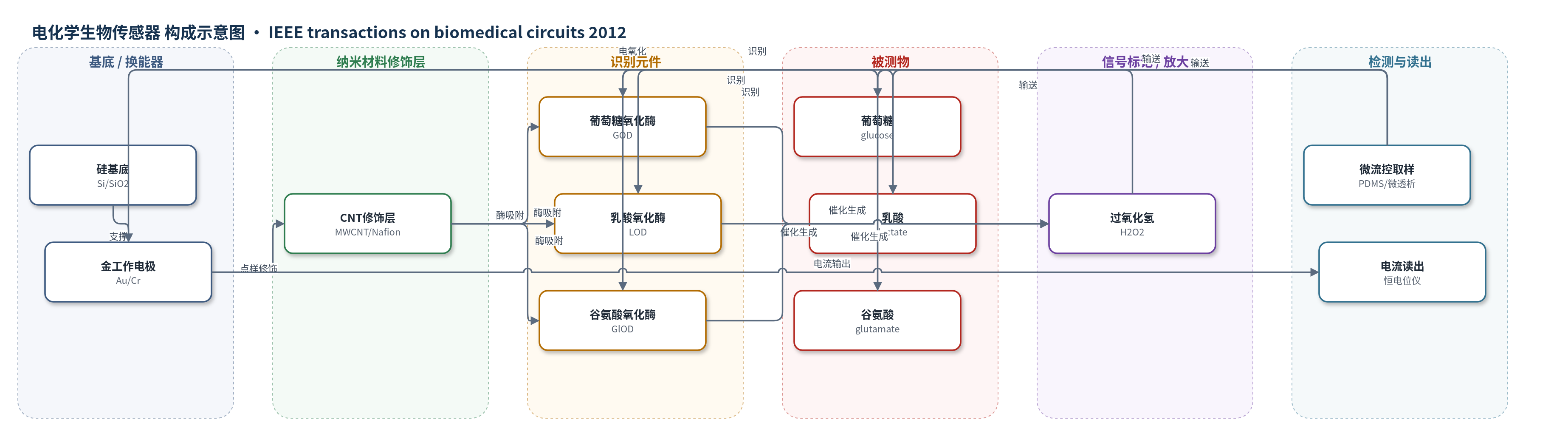
点击图片查看大图 · 依据论文自动绘制
传感器类型
电化学生物传感器
检测对象
葡萄糖(glucose)、乳酸(lactate)、谷氨酸(glutamate);样品基质:PBS缓冲液、NG-108神经母细胞培养上清条件培养基(DMEM)
检测原理
传感器采用多工作电极电化学安培检测。不同氧化酶(GOD、LOD、GlOD)分别选择性催化葡萄糖、乳酸和谷氨酸,生成H2O2。在Au工作电极与Pt参比电极之间施加+650 mV恒电位,H2O2在电极表面发生电氧化,产生与底物浓度成正比的电流。MWCNT/Nafion修饰层提高电极导电性和电子转移速率,降低检测限。PDMS微流控腔室或6 kDa微透析探针提供连续新鲜溶液并作为扩散屏障,使界面浓度与体相一致。通过切换不同工作电极,可在同一芯片上分别读出多种代谢物信号。
检测灵敏度
线性范围: 0–1 mM(乳酸,PBS计时安培法)
效应效果
五个微工作电极循环伏安曲线重叠,峰形良好,电极间差异低于10%;与商用丝网印刷电极相比,氧化峰仅正移约20 mV,面积归一化校准线几乎重合。酶功能化后,流动条件下计时安培法呈清晰台阶,可分别检测葡萄糖、乳酸和谷氨酸。细胞培养实验中,6 kDa微透析探针可灭菌并作为扩散屏障;NG-108培养72 h后,上清中乳酸升高,葡萄糖降至初始22.5 mM的一半以下,乳酸结果与文献相近。论文未报告RSD、回收率或标准方法对比,但展示了多纳米结构工作电极共享对/参比电极的在线细胞代谢监测潜力。
传感器的构成
- 微电极基底:Si/SiO2基底上PVD光刻制备Cr/Au/Cr工作电极、Cr/Au/Cr对电极和Cr/Pt/Cr参比电极,Au工作电极为换能器
- 纳米修饰层:MWCNT/Nafion溶液(MWCNT 1 mg/mL,Nafion 0.5 wt%)点样于Au工作电极,增强导电性与电子转移
- 识别元件:GOD、LOD、GlOD分别吸附于MWCNT表面,选择性识别葡萄糖、乳酸、谷氨酸
- 信号产物:H2O2由氧化酶催化底物生成,并在Au工作电极+650 mV下氧化产生安培电流
- 流体取样层:PDMS微流控腔室/通道与PMMA芯片座,配合蠕动泵提供连续流动;细胞培养样品使用6 kDa微透析探针作为扩散屏障
- 电子读出层:恒电位仪/控制放大器、跨阻放大器、微控制器与蓝牙模块,切换工作电极并输出电流信号
中文摘要
安培生物传感器是复杂系统,需要多种技术协同开发。本文提出一种新方法,用于开发纳米结构生物传感器,以实时检测细胞培养瓶中的多种代谢物。作者采用与CMOS兼容的微技术在硅基底上制备五个金工作电极,并利用源自微阵列和DNA打印的点样技术,对电极进行碳纳米管结构化和特定功能化。通过循环伏安法表征电极,并与商用丝网印刷电极比较。在流动条件下,开发简单流体系统以保证电极表面连续流动。工作电极分别用不同酶功能化,并针对葡萄糖、乳酸和谷氨酸进行校准,实现实时检测。最后,对培养72小时后的NG-108神经母细胞上清条件培养基进行检测,获得葡萄糖和乳酸浓度变化。所开发的生物传感器为细胞培养监测电路与系统提供了有前景的实时在线多代谢物检测方案。
英文摘要
Amperometric biosensors are complex systems and they require a combination of technologies for their development. The aim of the present work is to propose a new approach in order to develop nanostructured biosensors for the real-time detection of multiple metabolites in cell culture flasks. The fabrication of five Au working electrodes onto silicon substrate is achieved with CMOS compatible microtechnology. Each working electrode presents an area of 0.25 mm², so structuration with carbon nanotubes and specific functionalization are carried out by using spotting technology, originally developed for microarrays and DNA printing. The electrodes are characterized by cyclic voltammetry and compared with commercially available screen-printed electrodes. Measurements are carried out under flow conditions, so a simple fluidic system is developed to guarantee a continuous flow next to the electrodes. The working electrodes are functionalized with different enzymes and calibrated for the real-time detection of glucose, lactate, and glutamate. Finally, some tests are performed on surnatant conditioned medium sampled from neuroblastoma cells (NG-108 cell line) to detect glucose and lactate concentration after 72 hours of cultivation. The developed biosensor for real-time and online detection of multiple metabolites shows very promising results towards circuits and systems for cell culture monitoring.