组成图示
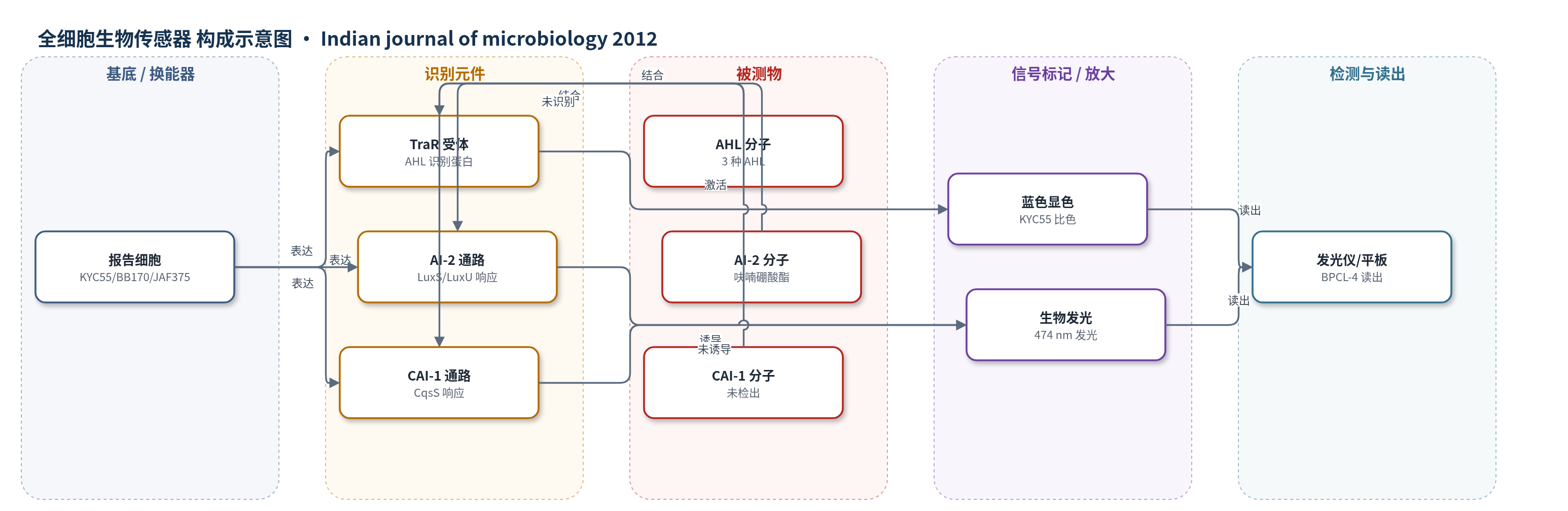
点击图片查看大图 · 依据论文自动绘制
传感器类型
全细胞生物传感器
检测对象
N-酰基高丝氨酸内酯(AHLs)、自诱导物-2(AI-2)、霍乱弧菌自诱导物-1(CAI-1);样品基质为 Edwardsiella ictaluri Ei-151 无细胞培养上清(BHI 培养液)
检测原理
该检测基于全细胞生物传感器菌株的群体感应响应。待测无细胞培养上清中的 AHL 与 A. tumefaciens KYC55 中的 AHL 受体 TraR 结合,形成 AHL–TraR 复合物并激活报告基因表达,使平板出现蓝色显色或液体系统产生可测信号;C. violaceum CV026 则通过 AHL 诱导紫色色素形成作为辅助确认。AI-2 进入 V. harveyi BB170 后激活 LuxS/LuxU 相关群体感应通路,诱导 lux 基因表达,产生 474 nm 生物发光,发光强度随 AI-2 浓度升高而增强。CAI-1 类似物则通过 V. harveyi JAF375 的 CqsS 通路诱导发光;本研究中未检出该活性。信号放大主要依赖细菌基因表达与酶促发光/显色反应,而非体外核酸或酶催化沉积。
检测灵敏度
原文未报告 LOD、线性范围、灵敏度斜率或相关系数。
效应效果
Ei-151 被 KYC55 和 CV026 检出产生 AHL,TLC 显示至少三种 AHL,指纹与 Edw. tarda 相似,两个斑点 Rf 接近 3-oxo-C6-HSL(0.702)和 C4-HSL(0.585)。AI-2 在 6 h(OD600 0.5)快速上升,15 h(OD600 1.8)达峰,之后维持约低 2.4 倍水平;AHL 与 AI-2 均在稳定期达峰。阴性对照 E. coli DH5a 无诱导,阳性对照 OOHL、BB152、BB120 有效,未检出 CAI-1。Ei-151 对条纹鲶 LD50 为 8.3×10^2 CFU g^-1(2.5×10^4 CFU/鱼),8×10^6 CFU 致死 100%,10^1、10^2、10^3 倍稀释致死率 93%、73%、32%。作者认为首次证明 Edw. ictaluri 产生 AHL 和 AI-2,可能参与稳定期致病调控。
传感器的构成
- 报告细胞层:A. tumefaciens KYC55,作为 AHL 全细胞生物传感器,含 AHL 响应受体 TraR,用于识别 AHL 并产生蓝色显色/液体激活信号
- 识别元件:TraR 转录调控蛋白,特异性结合 AHL 信号分子,触发报告信号
- 辅助识别菌株:C. violaceum CV026,通过 AHL 诱导紫色色素形成,辅助确认 AHL 产生
- AI-2 报告细胞:V. harveyi BB170,含 AI-2 响应 LuxS/LuxU 通路,受 AI-2 诱导产生生物发光
- CAI-1 报告细胞:V. harveyi JAF375,含 CAI-1 响应 CqsS 通路,受 CAI-1 诱导产生生物发光
- 样品基质:Ei-151 无细胞培养上清(BHI 培养液离心过滤后),提供待测 AHL/AI-2/CAI-1
- 对照物:OOHL(oxo-C8-HSL)作为 AHL 阳性对照,BHI 培养基/大肠杆菌 DH5a 作为阴性对照
中文摘要
爱德华菌(Edwardsiella ictaluri)是肠杆菌科革兰氏阴性病原菌,可引起鲶鱼肠型败血症,已成为越南条纹鲶养殖的重要问题。本研究从患病条纹鲶中分离到一株细菌 Ei-151,并证实其具有致病性。基于 16S rDNA 测序和表型试验,该病原菌被鉴定为 Edw. ictaluri。利用不同生物传感器菌株检测 Edw. ictaluri Ei-151 中群体感应信号分子的存在。结果显示,Ei-151 至少产生三种 N-酰基高丝氨酸内酯(AHL)信号分子,该结果由生物传感器根癌农杆菌 KYC55 检出,其 AHL 指纹与迟缓爱德华菌相似。在整个生长过程中,Ei-151 产生的 AHL 和自诱导物-2(AI-2)水平在稳定期(OD600 1.8)达到峰值,提示二者可能在稳定期发挥作用。未检测到霍乱弧菌自诱导物-1(CAI-1)样活性(包括 Edw. ictaluri LMG7860T)。
英文摘要
Edwardsiella ictaluri is a Gram-negative pathogenic bacterium in the family Enterobacteriaceae that causes enteric septicemia of catfish, which has become a significant problem in the aquaculture of striped catfish (Pangasianodon hypophthalmus) in Vietnam. In this study, a bacterium designated as Ei-151 was isolated from diseased striped catfish and proved to be virulent. Based on 16S rDNA sequencing and phenotypic tests, the pathogenic bacterium was identified as Edw. ictaluri. The presence of quorum sensing signal molecules in Edw. ictaluri Ei-151 was detected with different biosensor strains. The results showed that Ei-151 produced at least three kinds of acylated homoserine lactone (AHL) signal molecules as detected with the biosensor Agrobacterium tumefaciens KYC55, and the AHLs fingerprint was similar to that of Edw. tarda. During its entire growth, the levels of AHLs and autoinducer-2 produced by Ei-151 peaked at the stationary phase (OD600 1.8), which suggested that both of them may function at the stationary phase. No Cholerae autoinducer-1-like activity (including Edw. ictaluri LMG7860(T)) was detected.