组成图示
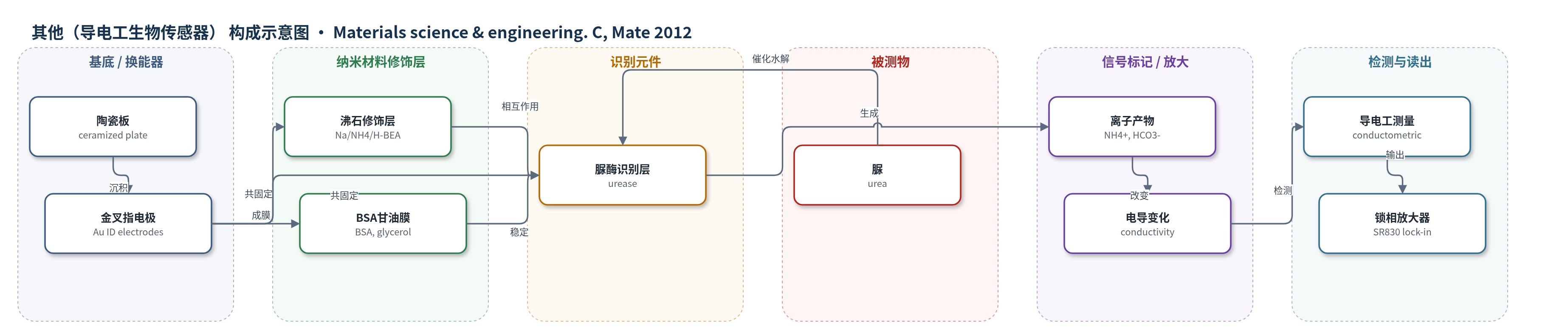
点击图片查看大图 · 依据论文自动绘制
传感器类型
其他(导电工生物传感器)
检测对象
脲(urea),样品基质为5 mM磷酸盐缓冲液(pH 7.2)
检测原理
该传感器以脲酶为识别元件,脲进入生物选择性膜后被脲酶催化水解,反应式为 Urea + 2H2O + H+ → 2NH4+ + HCO3-。反应生成 NH4+ 和 HCO3-,使膜内离子浓度和离子迁移率发生变化,从而改变金叉指电极间介质的电导。导电工换能器将电导变化转换为电信号,经锁相放大器差分读出。脲浓度越高,单位时间内生成的离子产物越多,电导变化越大,信号随浓度增加而增大。沸石 BEA 的酸性位点(尤其 NH4+-BEA 和 H+-BEA)可提供质子并改善酶-沸石界面相互作用,增强脲酶催化效率,实现信号增强;不同 Si/Al 比通过改变沸石疏水性影响脲酶固定与活性。
检测灵敏度
原文未报告LOD、线性范围、灵敏度斜率或相关系数。
效应效果
传感器采用差分测量,可抑制温度、pH波动和电噪声引起的非特异信号。工作日内以20 min间隔对6 mM脲重复测量,含/不含沸石传感器的测量误差Sd均约2%。批间重现性方面,5% NH4+-BEA 30使Sd由无沸石时的21.6%降至13.5%,5% H+-BEA 30为21.9%,15% NH4+-BEA 30升至28.9%。灵敏度优化显示,NH4+-BEA 30在15%、H+-BEA 30在7.5%时响应最高。较高Si/Al比沸石活性更高;甲基紫精修饰无增益,银离子/银纳米粒子沸石因脲酶抑制在5 mM脲下无响应。作者认为可通过沸石修饰与浓度调控传感器性能。
传感器的构成
- 换能器基底:陶瓷板(ceramized plate),提供机械支撑与绝缘基底。
- 导电工电极:金叉指电极(gold interdigitated electrodes),沉积于陶瓷板,用于检测膜层电导变化。
- 生物选择性膜:脲酶(urease)与不同BEA沸石(Na+-BEA、NH4+-BEA、H+-BEA等)共固定,提供脲识别与催化水解。
- 膜基质/稳定剂:牛血清白蛋白(BSA)和甘油(glycerol),辅助固定、稳定酶并维持膜结构。
- 交联固定剂:戊二醛(glutaraldehyde, GA)蒸汽,交联脲酶、BSA及沸石形成稳定膜。
- 工作介质:5 mM磷酸盐缓冲液(pH 7.2),维持酶活性并传导离子信号。
- 参考膜:BSA与甘油膜,用于差分测量消除温度、pH和电噪声干扰。
中文摘要
本研究考察不同修饰的Na+型BEA沸石对基于脲酶的导电工生物传感器工作特性的影响。以脲酶、不同沸石及牛血清白蛋白(BSA)固定在导电工换能器表面构成生物选择性膜作为敏感元件,研究沸石种类对脲生物传感器灵敏度的影响,以及不同脲酶固定方式下传感器信号重现性和生物选择性元件活性重现性。结果表明,含NH4+-BEA 30和H+-BEA 30沸石的传感器灵敏度最高,并优化了生物选择性膜中沸石浓度。甲基紫精(MV)和银修饰沸石对脲导电工生物传感器无应用前景。研究证明,通过改变沸石离子修饰、Si/Al比及其在生物膜中的浓度,可调控脲生物传感器的灵敏度、重现性和工作特性,为沸石材料在酶生物传感器中的应用提供依据。
英文摘要
Effect of different modifications of zeolite Na(+)-BEA on working characteristics of urease-based conductometric biosensor was studied. As the biosensor sensitive elements were used bioselective membranes based on urease and various zeolites immobilised with bovine serum albumin on the surface of conductometric transducers. Influence of zeolites on sensitivity of urea biosensor was investigated as well as reproducibility of biosensor signal and reproducibility of activity of the bioselective element after different variants of urease immobilisation on the surface of conductometric transducer. The biosensors based on zeolites (NH4(+)-BEA 30 and H(+)-BEA 30) were shown to be the most sensitive. Concentration of these zeolites in the bioselective membrane was optimized. Use of zeolites modified with methyl viologen and silver was ascertained to be of no prospect for urea conductometric biosensors. It was demonstrated that characteristics of urea biosensors can be regulated, varying zeolites modifications and their concentrations in bioselective membranes.