组成图示
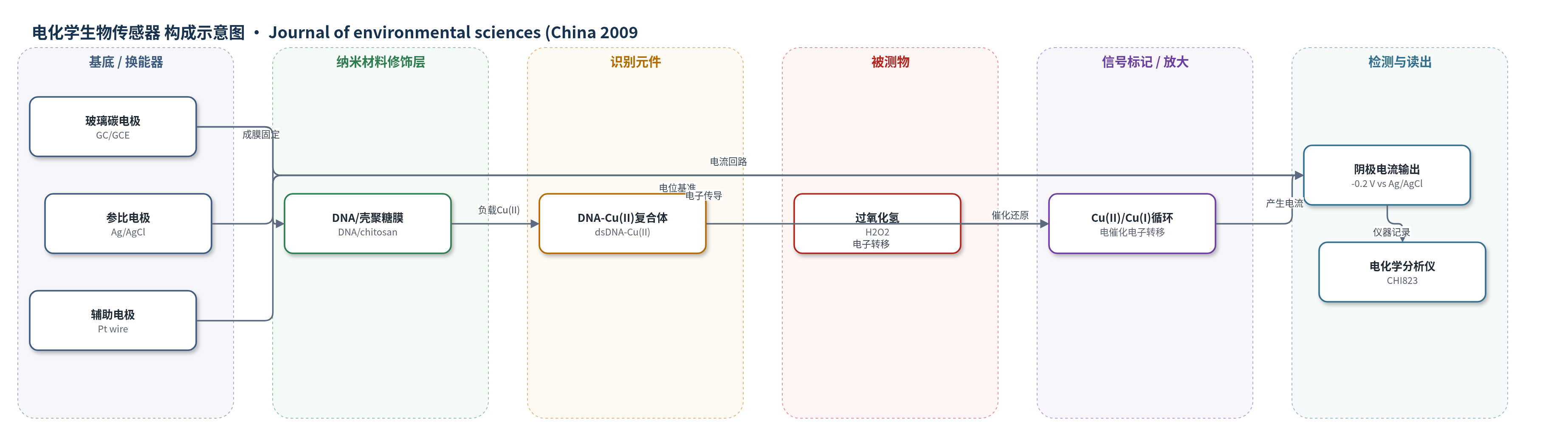
点击图片查看大图 · 依据论文自动绘制
传感器类型
电化学生物传感器
检测对象
过氧化氢(hydrogen peroxide, H2O2);样品基质:空气饱和100 mmol/L磷酸盐缓冲液(PBS,pH 5.0)
检测原理
DNA-Cu(II)/壳聚糖膜修饰GCE,Cu(II)与dsDNA配位形成模拟酶催化中心。在-0.2 V下,DNA-Cu(II)接受电子生成DNA-Cu(I);DNA-Cu(I)催化H2O2还原为OH-,自身被氧化回DNA-Cu(II),形成循环电子转移。该催化循环使电子从电极经Cu中心传递至H2O2,产生与H2O2浓度相关的稳态阴极电流。H2O2浓度升高,催化还原速率增加,电流线性增大。无额外酶或标记物,依靠DNA-Cu电催化实现信号放大。
检测灵敏度
LOD: 3 μmol/L;线性范围: 10 μmol/L–10 mmol/L
效应效果
传感器在空气饱和PBS中响应快速,响应时间约6 s,且溶解氧存在下仍保持高灵敏。抗干扰方面,葡萄糖和抗坏血酸对H2O2测定几乎无干扰,说明选择性较好。稳定性方面,对10 μmol/L H2O2重复测量20次,电流响应保留初始响应的90%以上,表明操作稳定性良好;作者同时指出传感器重现性良好。该传感器以DNA-Cu(II)/壳聚糖多离子复合膜为传感层,无需天然酶,结构相对简单,适用于食品、化学、医药、临床和环境分析中H2O2的快速检测。
传感器的构成
- 基底/换能器电极:玻璃碳电极(GC/GCE),作为工作电极和电子传导基底
- 修饰/固定化膜:DNA/壳聚糖多离子复合膜(DNA/chitosan),固定DNA-Cu(II)催化层
- 识别/催化元件:双链DNA(dsDNA)与Cu(II)形成的DNA-Cu(II)复合体,铜离子结合dsDNA并催化H2O2还原
- 信号换能元件:DNA-Cu(II)/Cu(I)氧化还原对,H2O2还原再生Cu(II)并产生阴极电流
- 电解液介质:100 mmol/L磷酸盐缓冲液(PBS,pH 5.0),提供离子传导和反应环境
中文摘要
本研究以DNA/壳聚糖多离子复合膜作为固定化载体,将电催化物种铜离子固定于双链DNA上,用于过氧化氢还原。将DNA-Cu(II)复合体与壳聚糖在玻璃碳电极表面制备成DNA-Cu(II)/壳聚糖/GC电极。循环伏安和恒电位安培测试表明,嵌入DNA/壳聚糖层中的铜离子具有良好电化学行为,并对H2O2还原表现出优异电催化活性。即使在溶解氧存在下,传感器对H2O2响应灵敏、快速,响应时间约6 s。在空气饱和100 mmol/L磷酸盐缓冲液(pH 5.0)、-0.2 V(vs Ag/AgCl)下,稳态阴极电流随H2O2浓度线性增加至10 mmol/L,检出限为3 μmol/L。研究考察了施加电位和缓冲液pH对响应电流的影响,确定最佳分析条件。葡萄糖和抗坏血酸对H2O2测定几乎无干扰,传感器重现性良好。
英文摘要
DNA/chitosan polyion complex membrane was used as a support for immobilization of electrocatalytic species-copper ions, which specifically bound to dsDNA and catalyzed the hydrogen peroxide reduction. The polyion complex membrane consisted with DNA-Cu(II) complex and chitosan was prepared on a glassy carbon electrode (GCE). Electrochemical measurements of the DNA-Cu(II)/chitosan membrane-modified GCE revealed that the copper ion embedded in the DNA/chitosan layer exhibited good electrochemical behaviors. The DNA-Cu(II)/chitosan/GC electrode showed an excellent electrocatalytic activity for the H2O2 reduction. Even in the presence of dissolved oxygen, the sensor exhibited highly sensitive and rapid (response time, about 6 s) response to H2O2. The steady-state cathodic current responses of the sensor obtained at -0.2 V versus Ag/AgCl in air-saturated 100 mmol/L phosphate buffer (pH 5.0) increased linearly up to 10 mmol/L with the detection limit of 3 μmol/L. Effects of applied potential and buffer pH upon the response currents of the sensor were investigated for an optimum analytical performance. Ascorbic acid and glucose almost have no interference to measurement of H2O2. In addition, the sensor exhibited good reproducibility.