组成图示
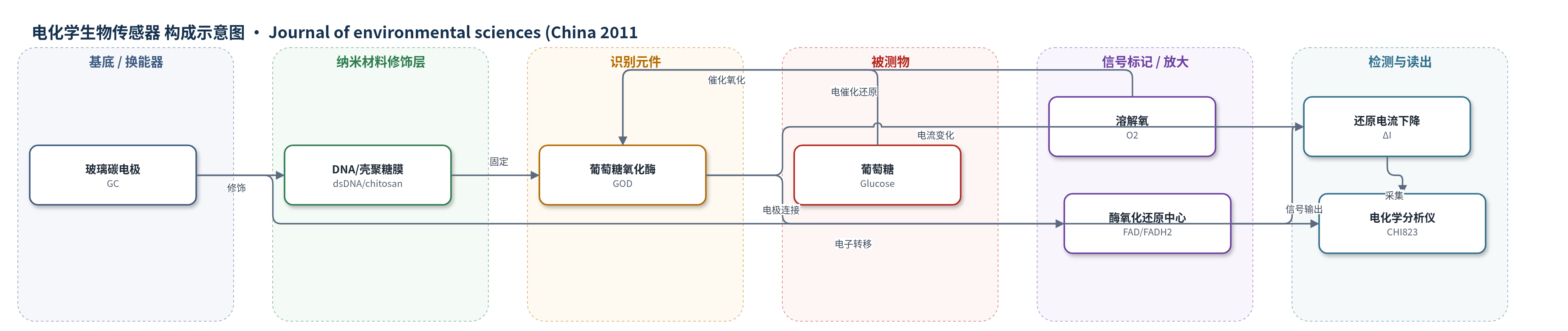
点击图片查看大图 · 依据论文自动绘制
传感器类型
电化学生物传感器
检测对象
葡萄糖(Glucose);样品基质:磷酸盐缓冲液(PBS,空气饱和)
检测原理
该传感器以玻璃碳电极为基底,dsDNA/壳聚糖膜固定葡萄糖氧化酶(GOD)。膜环境使GOD的FAD氧化还原中心与电极发生直接电子转移,循环伏安中呈现准可逆氧化还原峰。在空气饱和磷酸盐缓冲液中,GOD可电催化溶解氧还原,产生较强的还原电流。加入葡萄糖后,GOD催化葡萄糖氧化生成葡萄糖内酯和GOD-FADH2,随后GOD-FADH2将电子传递给O2再生GOD-FAD并生成H2O2;葡萄糖消耗溶解氧并抑制氧的电催化还原,使还原峰电流下降。恒电位-0.45 V下,电流下降量随葡萄糖浓度增加而增大,从而实现安培检测。
检测灵敏度
LOD: 0.04 mmol/L;线性范围: 0.04–2.28 mmol/L(摘要)/0.04–0.228 mmol/L(正文);灵敏度: 0.48 μA/(mmol/L);R^2 = 0.997
效应效果
该传感器响应时间约10 s,对葡萄糖具有快速且稳定的安培响应。选择性方面,0.1 mmol/L尿酸和0.1 mmol/L抗坏血酸对0.4 mmol/L葡萄糖响应无明显干扰,表明抗干扰能力较好。重现性方面,连续10次检测0.1 mmol/L葡萄糖的相对标准偏差为3.61%。动力学上,葡萄糖浓度高于10 mmol/L时出现平台,米氏常数KM为6.91 mmol/L,校准范围可达0.04–15 mmol/L。论文未报告实际样品加标回收率及与ELISA、HPLC或qPCR等方法的对比,但作者认为该DNA/GOD/壳聚糖/GC电极具有良好稳定性、选择性和葡萄糖检测应用潜力。
传感器的构成
- 基底电极:玻璃碳电极(GC),抛光后作为工作电极与电子转导基底。
- 修饰膜:双链DNA(dsDNA)/壳聚糖(chitosan)聚离子复合膜,通过静电复合固定酶并促进GOD直接电子转移。
- 识别/催化元件:葡萄糖氧化酶(GOD),固定于膜中,催化葡萄糖氧化并实现FAD中心与电极的直接电子转移。
- 信号介质:溶解氧(O2),在GOD作用下发生电催化还原,形成还原电流;葡萄糖加入后消耗O2使电流下降。
- 电解质:磷酸盐缓冲液(PBS),提供离子导电与稳定pH环境。
中文摘要
葡萄糖氧化酶(GOD)被广泛用于葡萄糖生物传感器。本文报道将GOD通过双链DNA/壳聚糖生物材料膜固定在玻璃碳电极上,并研究GOD在DNA/壳聚糖膜中的直接电子转移(DET)。循环伏安结果表明,固定于DNA/壳聚糖膜中的GOD发生DET反应,在pH 5.5下呈现一对定义良好的氧化还原峰,形式电位约为-0.45 V(vs. Ag/AgCl)。该响应表现为表面控制电极过程,在10–100 mV/s扫描速率范围内电子转移速率常数为0.91 s^-1。固定后的GOD保留生物催化活性和稳定性,可电催化溶解氧还原,使还原峰电流显著增大;加入葡萄糖后还原峰电流下降,可用于葡萄糖检测。传感器灵敏度为0.48 μA/(mmol/L),线性范围为0.04–2.28 mmol/L,检出限为0.04 mmol/L(信噪比3),并能排除尿酸和抗坏血酸的干扰。
英文摘要
Glucose oxidase (GOD) is widely used in the glucose biosensor industry. The amperometric biosensors based on directly electron transfer (DET) between an electrode and immobilized GOD are especially promising. In this article, GOD was immobilized with a DNA/chitosan bio-material film on GC electrode, and the DET of GOD on DNA/chitosan was studied. The cyclic voltammetric results indicated that the GOD immobilized in the DNA/chitosan film underwent DET reaction, and the cyclic voltammogram displayed a pair of well-defined redox peaks with a formal potential of -0.45 V (vs. Ag/AgCl) at pH 5.5. The response showed a surface-controlled electrode process with an electron transfer rate constant of 0.91 sec(-1) determined in the scan rate range from 10 to 100 mV/sec. The GOD immobilized in DNA/chitosan membrane retained its biocatalytic activity and stability. The immobilized GOD could electrocatalyze the reduction of dissolved oxygen and resulted in a great increase of the reduction peak current. Upon the addition of glucose, the reduction peak current decreased, which could be used for glucose detection with a sensitivity of 0.48 μA/(mmol/L), a linear range from 0.04 to 2.28 mmol/L and a detection limit of 0.04 mmol/L at a signal-to-noise ratio of 3. The sensor could exclude the interference of commonly coexisted uricacid and ascorbic acid.