组成图示
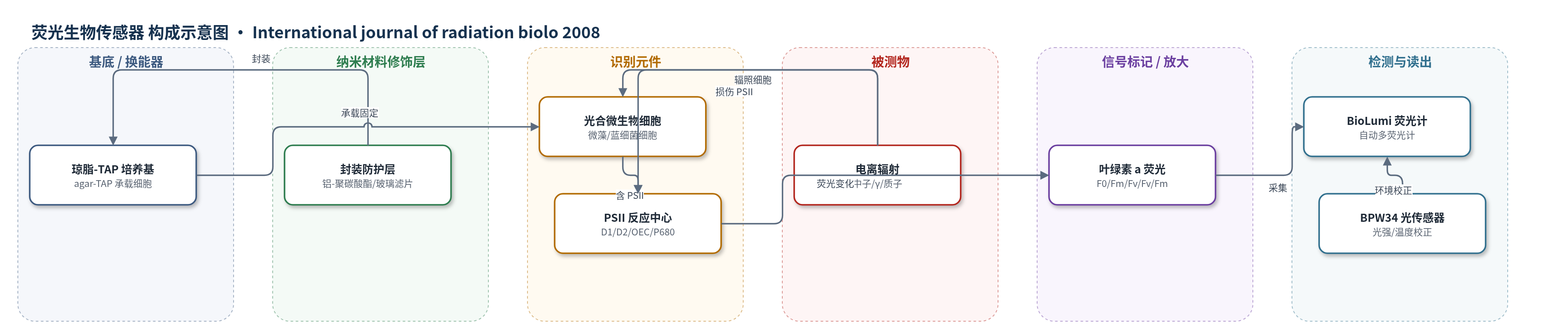
点击图片查看大图 · 依据论文自动绘制
传感器类型
荧光生物传感器
检测对象
PSII 光化学量子产率/光合电子传递活性(Fv/Fm,chlorophyll fluorescence);样品基质:琼脂-TAP 培养基中的微藻/蓝细菌细胞(Chlorella、Chlamydomonas、Arthrospira 等)
检测原理
该装置以完整光合微生物细胞为响应元件,细胞内 PSII 在光照下完成 P680 电荷分离,电子由水经 OEC 传递至 Pheo−、QA/QB,并伴随叶绿素 a 荧光发射。电离辐射或强光可损伤 OEC 外源蛋白和 D1/D2,改变开放 PSII 反应中心比例,使 F0、Fm、Fv 及 Fv/Fm 发生变化。BioLumi 自动多荧光计提供激发光并采集荧光曲线,通过算法计算 F0/Fm/Fv/Fv/Fm,从而读出 PSII 最大光化学量子产率;辐射剂量或光照条件变化越大,Fv/Fm 偏离对照越明显。BPW34 同步记录光强和温度,用于环境校正。该过程无化学放大,信号直接来自 PSII 光化学状态。
检测灵敏度
—
效应效果
该荧光生物传感器在平流层气球飞行中实时监测多种微藻/蓝细菌 PSII 荧光,实验重复 5 次并报告 SD,未报告 RSD、加标回收率及与常规方法对比。不同物种响应差异明显:Monodus subterraneus 抑制最低,Chlorella sorokiniana 最高。地面 4.8 mSv 快中子下,黑暗使 Fv/Fm 降低 40%,70 μmol m-2 s-1 光下反升 18%;8.4 Sv γ 辐照后 Fv/Fm 为对照 90–96%,O2 释放为 101–122%。Foton 飞行后存活率 0.001%–0.01%,O2 释放较地面对照提高 3%–22%,生长率降至 80%–82%。作者认为该装置可评估空间辐射下光合微生物作为生命支持系统的潜力。
传感器的构成
- 样品承载层:琼脂-TAP 培养基(agar-TAP),承载并固定微藻/蓝细菌细胞
- 识别元件:完整光合微生物细胞(Chlorella sorokiniana、Chlamydomonas reinhardtii、Arthrospira platensis 等)及其 PSII 反应中心(D1/D2、OEC、LHCII、P680)
- 信号标记物:叶绿素 a 荧光(Chl a fluorescence),以 F0、Fm、Fv、Fv/Fm 表征 PSII 光化学量子产率
- 换能器/光学模块:BioLumi 自动多荧光计(automatic multi-fluorimeter),提供激发光并采集荧光曲线
- 环境传感模块:BPW34 光强传感器与温度记录,用于校正光照和温度条件
- 封装防护层:铝-聚碳酸酯壁(aluminium-polycarbonate)、钢架(steel frame)、黑色遮光罩及玻璃/石英滤光片(glass/quartz filters),维持压力/温度并过滤可见/紫外光
中文摘要
长期太空探索需要能够耐受空间环境的生物生命支持系统,产氧光合微生物因可生产食物和氧气而备受关注。本研究评估空间电离辐射对多种光合微生物光合活性的影响。地面实验采用快中子和γ射线,在不同光照条件下辐照微藻和蓝细菌;平流层气球和欧洲空间局(ESA)飞行装置分别将微生物送至38 km和300 km高度。气球飞行期间,使用专用荧光生物传感器实时监测细胞荧光活性。结果显示,光系统II(PSII)量子产率在飞行中直接测量,并随光照条件变化:黑暗以及120和180 μmol m-2 s-1光照增强辐射诱导的光合抑制,而20和70 μmol m-2 s-1弱光可保护细胞。空间停留降低光合生长,但飞行后细胞释氧能力增强。作者推测PSII可能具有捕获并利用电离辐射能量的潜在作用。
英文摘要
PURPOSE: Long-term space exploration requires biological life support systems capable of coping with the deleterious space environment. The use of oxygenic photosynthetic microorganisms represents an intriguing topic in this context, mainly from the point of view of food and O2 production. The aim of the present study was to assess the effects of space ionizing radiation exposure on the photosynthetic activity of various microorganisms.
MATERIALS AND METHODS: Ground-based irradiation experiments were performed using fast neutrons and gamma rays on microorganisms maintained at various light conditions. A stratospheric balloon and a European Space Agency (ESA) flight facility were used to deliver organisms to space at the altitude of 38 and 300 km, respectively. During the balloon flight, the fluorescence activity of the organisms was real-time monitored by means of a special biosensor.
RESULTS: The quantum yield of Photosystem II (PSII), measured directly in flight, varied among the microorganisms depending on the light conditions. Darkness and irradiation of cells at 120 and 180 micromol m(-2) s(-1) enhanced the radiation-induced inhibition of photosynthetic activity, while exposure to weaker light irradiance of 20 and 70 micromol m(-2) s(-1) protected the cells against damage. Cell permanence in space reduced the photosynthetic growth while the oxygen evolution capacity of the cells after the flight was enhanced.
CONCLUSIONS: A potential role of PSII in capturing and utilizing ionizing radiation energy is postulated.