组成图示
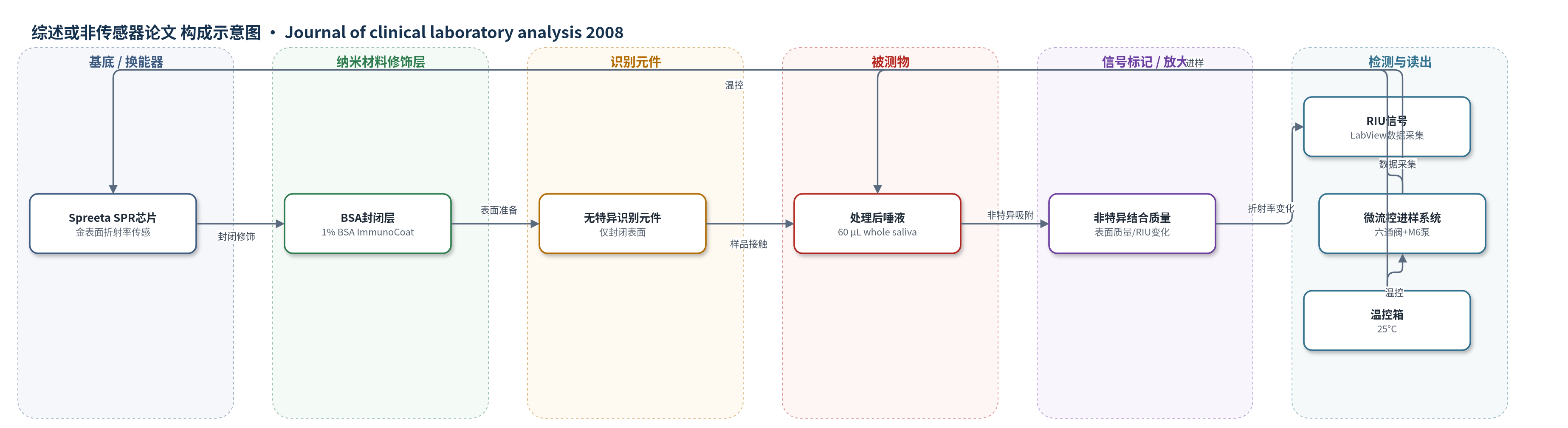
点击图片查看大图 · 依据论文自动绘制
传感器类型
综述或非传感器论文
检测对象
皮质醇(cortisol)、睾酮(testosterone)、脱氢表雄酮(DHEA)、总蛋白(total protein);样品基质:全唾液(whole saliva,经 FTC、离心、PES 过滤、棉质 Salivettes 或泡沫 Oracol 前处理)
检测原理
本文并非特异激素传感方法,而是用 SPR 生物传感器评估唾液前处理造成的非特异性结合。SPR 芯片金表面经 1% BSA 封闭后,注入 60 µL 处理后唾液;唾液中的蛋白、黏性成分等与封闭表面发生非特异吸附,使界面质量增加,局部折射率改变,仪器以折射率单位(RIU)记录基线变化,NSB 用注入前后基线 RIU 差表示。样品间用 200 mM NaOH 再生。目标激素浓度则分别用放射免疫分析(RIA)和酶免疫分析(EIA)测定,蛋白用 CBQCA 荧光法测定;SPR 信号不直接随皮质醇、睾酮或 DHEA 浓度变化,而随非特异结合物质量增加而增大。
检测灵敏度
皮质醇 RIA limit of assay detection: 0.059 ng/mL;睾酮 RIA limit of assay detection: 0.1 pg/mL;DHEA EIA limit of assay detection: 6.3 pg/mL;蛋白 standard curve: 74 ng/mL to 74 mg/mL;SPR baseline noise: 5 response units (5 × 10⁻⁶ RIU);SPR refractive index range: 1.33–1.40。
效应效果
研究纳入 13 名男性,比较 5 种前处理。与 FTC 相比,单独离心无显著差异;Mini-UniPrep 使皮质醇升高 40%、睾酮降低 45%、DHEA 降低 66%,蛋白趋势降低 14%(P=0.09),NSB 降低 4%(不显著);Salivettes 使皮质醇升高 64%、睾酮升高 126%、DHEA 超出量程,蛋白降低 21%,NSB 降低 75%;Oracol 使 DHEA 降低 28%,NSB 降低 12%(n=4)。皮质醇、睾酮、DHEA 测定批内 CV 分别为 5.1–7.1%、5.5–8.0%、1.6–2.0%。作者认为没有通用最优前处理,需按分析物验证。
传感器的构成
- 基底/换能器:Spreetas SPR 芯片(Texas Instruments),金表面折射率传感,用于检测表面质量变化
- 封闭层:1% BSA(ImmunoCoat,ImmSolv),封闭传感表面,降低非特异结合
- 流体接口:Spreeta 芯片流体接口与 HPLC 级 0.25 mm PTFE/不锈钢管(Upchurch Scientific),连接样品流路
- 进样/泵送:六通双向 HPLC 进样阀(Rheodyne)与 M6 泵(VICI Valco),控制 60 µL 唾液与 PBS 注入
- 温控模块:温控箱,25°C,稳定 SPR 测量
- 读出模块:LabView 自定义数据采集接口(National Instruments),记录 RIU 输出
- 再生/清洗液:200 mM NaOH,60 µL,样品间表面再生
中文摘要
唾液用于即时检测(POC)具有评估全身健康与状态的潜力,但黏度和污染物会影响分析。作者寻找适用于生物传感器等 POC 技术的便携式全唾液前处理方法。将 13 名男性受试者的全唾液各分为 5 份,分别采用冻融离心(FTC)、单独离心、Mini-UniPrep 聚醚砜(PES)滤器、棉质 Salivettes 或泡沫 Oracol 装置处理。处理后测定皮质醇、睾酮、脱氢表雄酮(DHEA)和蛋白浓度,并评估生物传感器中的非特异性结合(NSB)。与 FTC 相比,单独离心未影响任何分析物;棉质 Salivettes 显著改变所有分析物,皮质醇升高 64%、睾酮升高 126%、DHEA 超出量程,蛋白降低 21%,NSB 降低 75%;Oracol 使 DHEA 降低 28%;Mini-UniPrep 使睾酮降低 45%、DHEA 降低 66%,皮质醇升高 40%。结论:没有一种方法对所有分析物均最优,提示在快速 POC 分析中采用唾液处理方法前必须验证。
英文摘要
INTRODUCTION: Point-of-care (POC) measurements using saliva samples have immense potential to assess systemic health and wellbeing, but sample viscosity and contaminants can affect analyses. We sought a portable clean-up method for whole saliva appropriate for use with POC measurement techniques such as biosensors.
METHODS: Whole saliva from each of 13 male subjects was split into 5 fractions. Each fraction was treated with a different clean-up process: a freeze-thaw-centrifuge (FTC) step; centrifugation alone; or passage through a Mini-UniPrep polyethersulfone filter, cotton Salivette, or foam Oracol device. Following clean-up, each subject's treated saliva fractions were assayed for cortisol, testosterone, dehydroepiandrosterone (DHEA), and protein concentrations. The effects of clean-up methods on nonspecific binding (NSB) in a biosensor were also assessed.
RESULTS: Compared with FTC, no analytes were affected by centrifugation alone. Cotton Salivettes significantly altered all analytes, with increases in cortisol (+64%), testosterone (+126%), and DHEA (off-scale) levels, and decreased protein (-21%) and biosensor NSB (-75%). Oracol foam devices decreased DHEA levels by 28%. Mini-UniPrep filtration decreased testosterone (-45%) and DHEA (-66%) concentrations while increasing cortisol (+40%).
CONCLUSION: No method was optimal for all analytes, highlighting the need for validation of saliva treatment methods before their adoption in rapid POC analyses.