组成图示
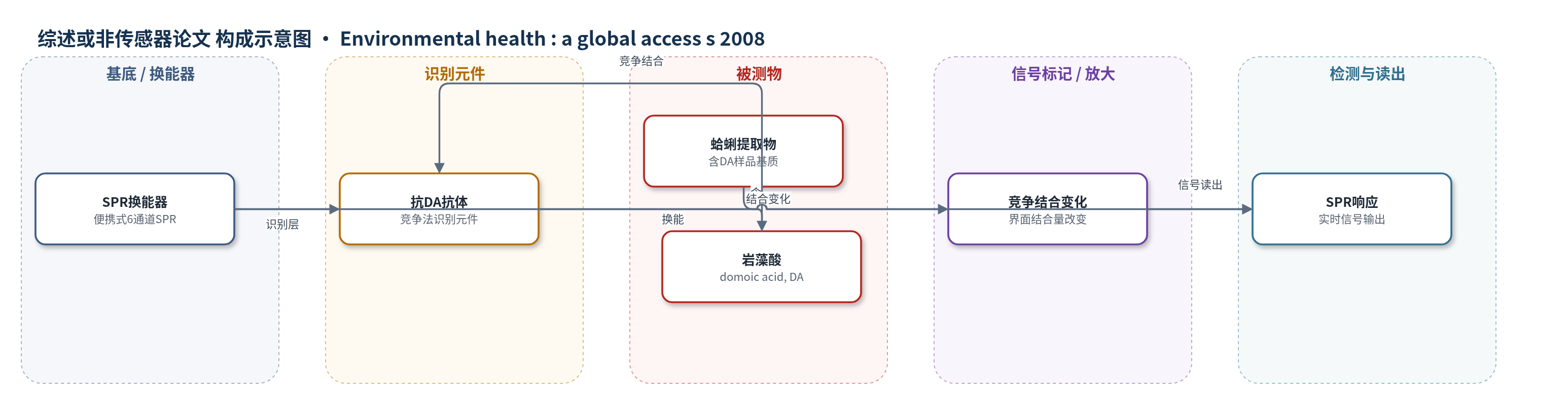
点击图片查看大图 · 依据论文自动绘制
传感器类型
综述或非传感器论文
检测对象
岩藻酸(domoic acid, DA);样品基质:蛤蜊提取物(文中引用研究),亦面向环境水样/HAB监测
检测原理
文中所述岩藻酸(domoic acid, DA)传感器基于便携式表面等离子共振(SPR)免疫分析。中心科学家制备抗DA抗体,并建立竞争法检测方案。样品中的DA与检测体系中的DA竞争结合抗体,使SPR芯片表面结合状态或界面质量/折射率发生变化。SPR通过监测表面等离子体共振条件变化,将结合变化转换为实时光学响应。DA浓度改变时,竞争结合程度改变,SPR响应随之变化,从而实现定量检测。该系统为6通道,可同时检测多种小分子、蛋白和微生物目标。原文未报告具体信号放大策略、固定化材料或定量参数。
检测灵敏度
原文未报告LOD、线性范围、灵敏度斜率或相关系数。
效应效果
原文未报告该SPR传感器的检出限、线性范围、重现性(RSD)、稳定性、实际样品加标回收率或与ELISA/HPLC/qPCR等方法的定量对比。作者指出,便携式6通道SPR系统可同时检测多达24种小分子、蛋白和微生物目标,有望同时监测多种HAB毒素和藻类物种。若与ARISA基因指纹方法结合,可在现场鉴定Pseudo-nitzschia物种并测定DA水平,从而支持HAB事件的现场表征。当前主要挑战是缺乏简单、快速、高灵敏的藻细胞和毒素检测方法,传感器灵敏度仍需提高。作者强调长期现场数据、基础生物学信息和跨学科合作对HAB监测与公共卫生预警的价值。
传感器的构成
- 换能器/基底:便携式6通道表面等离子共振(SPR)系统,用于实时检测(芯片材料原文未说明)
- 识别元件:抗岩藻酸(domoic acid, DA)抗体,采用竞争法识别DA
- 信号读出:SPR响应变化,反映DA竞争结合状态(具体信号参数原文未报告)
中文摘要
有害藻华(HABs)是美国国家海洋与大气温带管理局(NOAA)、国家卫生研究院环境健康科学研究所(NIEHS)和国家科学基金会(NSF)“海洋与健康”(OHH)国家研究计划的重点。从东海岸到夏威夷的各OHH中心均设有研究HAB及其与人类健康关系的项目。研究共同目标包括:理解藻类基础生物学;阐明化学、水文和遗传多样性对藻华的影响;开发细胞和毒素的分析方法与传感器;理解毒素暴露的健康效应;建立藻华动力学的概念、经验和数值模型。近年来,各中心在环境条件与遗传异质性影响藻华、开发Pseudo-nitzschia和Microcystis基因检测方法及岩藻酸生物传感器、改进Alexandrium和Karenia预测模型,以及评估气候变化和新兴毒素(如BMAA)风险方面取得进展。长期现场数据和基础生物学信息仍不足,传感器开发受限于缺乏简单快速的藻细胞和毒素检测方法,慢性低剂量暴露健康效应也需深入研究。OHH计划促进了跨学科合作,对推进HAB研究具有重要价值。
英文摘要
BACKGROUND: Harmful algal blooms (HABs) are one focus of the national research initiatives on Oceans and Human Health (OHH) at NIEHS, NOAA and NSF. All of the OHH Centers, from the east coast to Hawaii, include one or more research projects devoted to studying HAB problems and their relationship to human health. The research shares common goals for understanding, monitoring and predicting HAB events to protect and improve human health: understanding the basic biology of the organisms; identifying how chemistry, hydrography and genetic diversity influence blooms; developing analytical methods and sensors for cells and toxins; understanding health effects of toxin exposure; and developing conceptual, empirical and numerical models of bloom dynamics.
RESULTS: In the past several years, there has been significant progress toward all of the common goals. Several studies have elucidated the effects of environmental conditions and genetic heterogeneity on bloom dynamics. New methods have been developed or implemented for the detection of HAB cells and toxins, including genetic assays for Pseudo-nitzschia and Microcystis, and a biosensor for domoic acid. There have been advances in predictive models of blooms, most notably for the toxic dinoflagellates Alexandrium and Karenia. Other work is focused on the future, studying the ways in which climate change may affect HAB incidence, and assessing the threat from emerging HABs and toxins, such as the cyanobacterial neurotoxin beta-N-methylamino-L-alanine.
CONCLUSION: Along the way, many challenges have been encountered that are common to the OHH Centers and also echo those of the wider HAB community. Long-term field data and basic biological information are needed to develop accurate models. Sensor development is hindered by the lack of simple and rapid assays for algal cells and especially toxins. It is also critical to adequately understand the human health effects of HAB toxins. Currently, we understand best the effects of acute toxicity, but almost nothing is known about the effects of chronic, subacute toxin exposure. The OHH initiatives have brought scientists together to work collectively on HAB issues, within and across regions. The successes that have been achieved highlight the value of collaboration and cooperation across disciplines, if we are to continue to advance our understanding of HABs and their relationship to human health.