组成图示
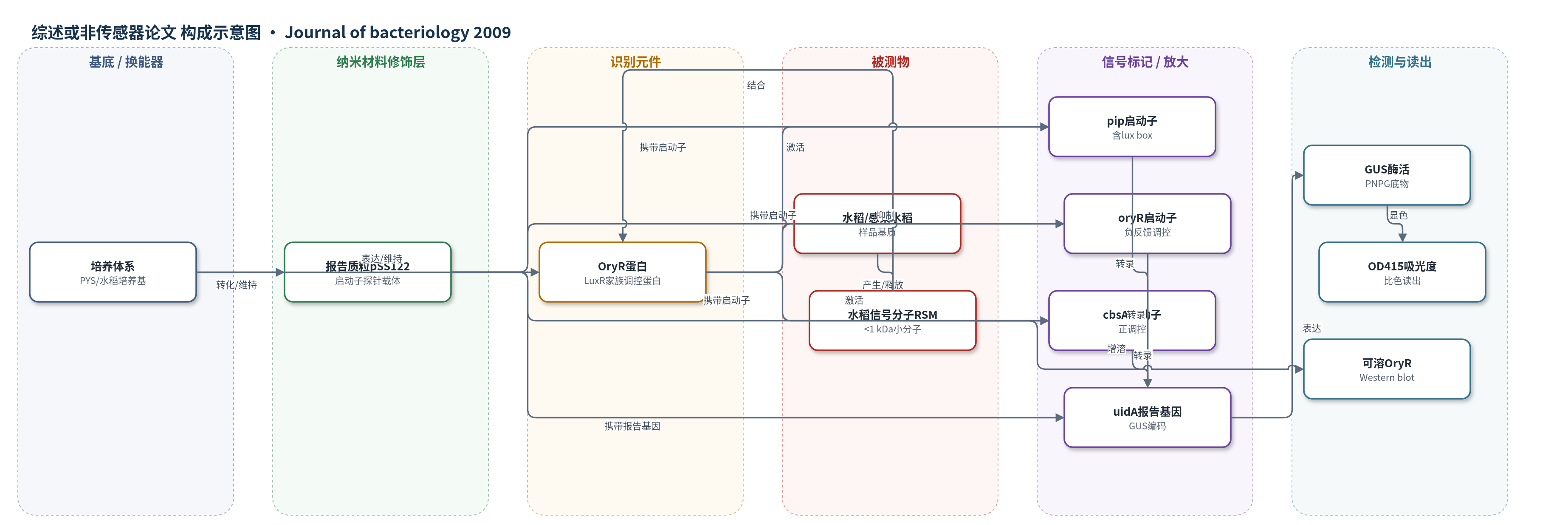
点击图片查看大图 · 依据论文自动绘制
传感器类型
综述或非传感器论文
检测对象
水稻信号分子(RSM,rice signal molecule);样品基质:感染/未感染水稻、水稻木质部汁液、破碎水稻/感染水稻培养基
检测原理
本文并非传感器,但实验检测逻辑为:水稻(尤其感染水稻)释放小分子 RSM,RSM 与 X. oryzae pv. oryzae 的 LuxR 家族蛋白 OryR 结合,使原本不溶的 OryR 增溶,并激活含 lux box 的 pip 启动子。启动子驱动 uidA 报告基因表达 β-葡萄糖醛酸苷酶(GUS),GUS 催化 PNPG 生成黄色产物,OD415 吸光度随 RSM 浓度/感染程度升高而升高。感染 10 天水稻木质部汁液使 OryR 可溶性和 pip 启动子活性最高。oryR 启动子受 OryR 负反馈抑制,cbsA 启动子受 OryR 正调控但不依赖 RSM。AHL 竞争实验表明 RSM 不通过 AHL 通路作用。
检测灵敏度
原文未报告LOD、线性范围、灵敏度斜率或R^2。
效应效果
选择性方面,15 种结构不同的 AHL(2 μM)均不能诱导 pip 启动子,也不与 RSM 竞争 OryR 结合,提示 RSM 非 AHL 模拟物;RSM 经超滤定位于 <1 kDa 组分。广谱 AHL 生物传感器 A. tumefaciens NT1(pZLQR) 对 RSM 未见显著激活,进一步支持其非典型 AHL 信号。感染水稻中 RSM/OryR 水平在感染后约 10 天最高,pip 启动子活性较对照约升高 10 倍,未感染破碎水稻约 5 倍。实验以 n=3 重复,报告均值±标准差,多组比较 P<0.002 或更低。OryR 突变体致病力降低(先前报道),且 OryR 不调控 DSF,说明其独立于黄单菌属 DSF 群体感应,是宿主-病原跨王国信号调控致病性的关键因子。
传感器的构成
- 基底/换能器:不适用,非传感器论文;文中蛋白检测使用PVDF膜(Immobilon-P)
- 纳米修饰层:不适用,未使用纳米材料修饰
- 识别元件:不适用,非传感识别层;文中关键识别蛋白为OryR
- 信号标记物:不适用,非传感标记;报告系统为uidA/GUS,底物为PNPG
- 封闭剂/电子供体:不适用,未涉及
- 读出装置:不适用,非传感器读出;实验读出为OD415吸光度与Western blot
中文摘要
稻白叶枯病致病菌 Xanthomonas oryzae pv. oryzae 基因组编码 LuxR 家族调控蛋白 OryR。既往研究表明该菌不产生 N-酰基高丝氨酸内酯(AHL),也无 LuxI 家族 AHL 合成酶,而 OryR 可被水稻中某化合物增溶。本研究进一步证明 OryR 与水稻信号分子(RSM)相互作用,且水稻感染后 OryR 水平升高。作者鉴定出三个受 OryR 调控的靶启动子:邻近的脯氨酸氨肽酶基因 pip 在 RSM 存在时被 OryR 正调控;oryR 启动子不依赖 RSM 发生负向自调控;1,4-β-纤维二糖苷酶基因 cbsA 不依赖 RSM 被 OryR 正调控。RSM 为小分子,与 AHL 无结构关联,不能激活广谱 AHL 生物传感器 Agrobacterium tumefaciens NT1(pZLQR)。OryR 也不调控黄单菌属中可扩散信号因子 DSF 的产生。因此,OryR 具有独特功能,是宿主与病原菌之间跨王国信号交流的重要调控因子。
英文摘要
Xanthomonas oryzae pv. oryzae, the causal agent of bacterial leaf blight in rice, contains a regulator that is encoded in the genome, designated OryR, which belongs to the N-acyl homoserine lactone (AHL)-dependent quorum-sensing LuxR subfamily of proteins. However, we previously reported that X. oryzae pv. oryzae does not make AHLs and does not possess a LuxI-family AHL synthase and that the OryR protein is solubilized by a compound present in rice. In this study we obtained further evidence that OryR interacts with a rice signal molecule (RSM) and that the OryR concentration increases when rice is infected with X. oryzae pv. oryzae. We also describe three OryR target promoters which are regulated differently: (i) the neighboring proline iminopeptidase (pip) virulence gene, which is positively regulated by OryR in the presence of the RSM; (ii) the oryR promoter, which is negatively autoregulated independent of the RSM; and (iii) the 1,4-beta-cellobiosidase cbsA gene, which is positively regulated by OryR independent of the RSM. We also found that the RSM for OryR is small, is not related to AHLs, and is not able to activate the broad-range AHL biosensor Agrobacterium tumefaciens NT1(pZLQR). Furthermore, OryR does not regulate production of the quorum-sensing diffusible signal factor present in the genus Xanthomonas. Therefore, OryR has unique features and is an important regulator involved in interkingdom communication between the host and the pathogen.