组成图示
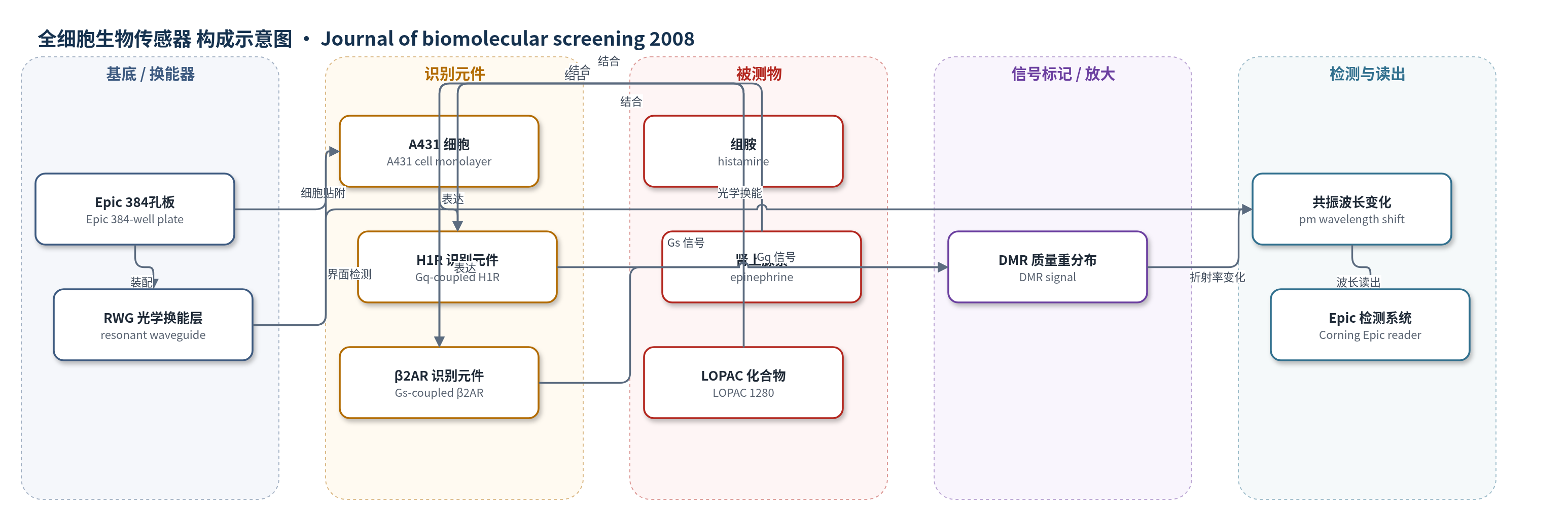
点击图片查看大图 · 依据论文自动绘制
传感器类型
全细胞生物传感器
检测对象
组胺(histamine,H1R 激动剂)、肾上腺素(epinephrine,β2AR 激动剂)、LOPAC 1280 化合物库中的 GPCR 配体(激动剂/拮抗剂);样品基质为 A431 细胞贴附于 Epic 384 孔板中的 HBSS(含 1% DMSO)细胞检测液。
检测原理
该检测基于无标记共振波导光栅(RWG)全细胞光学传感。A431 细胞贴附于 Epic 384 孔板,其内源 H1R 和 β2AR 作为识别元件。当组胺或肾上腺素等配体结合受体后,分别激活 Gq 或 Gs 通路,引起细胞内第二信使变化及细胞底部生物量动态重分布(DMR),改变细胞-传感器界面局部折射率。RWG 将折射率变化转换为共振波长位移(pm),系统以约 15 s 时间分辨连续记录。激动剂筛选中,LOPAC 化合物以 1 μM 处理,通过刺激后 2 min 与 50 min 的波长差区分 Gq 型负向/正向响应和 Gs 型持续响应;拮抗剂筛选中,先加化合物,再用组胺和肾上腺素共刺激,若化合物抑制相应波长响应则判定为拮抗剂。共刺激响应近似相加,使单一检测可双联区分两个受体。
检测灵敏度
原文未报告 LOD、线性范围、灵敏度斜率或 R^2。
效应效果
方法稳健且选择性良好:实验变异系数<10%,激动剂筛选 Z′=0.73;阴性对照 8±7 pm(n=128),肾上腺素阳性对照 230±12 pm(n=32)。肾上腺素 EC50 0.28±0.07 nM,组胺 EC50 687±34 nM(Hill 1.87),重复剂量 EC50 分别为 0.20、0.45、0.24 nM 和 658、889、638 nM。H1 拮抗剂完全抑制组胺响应,H2/H3 拮抗剂无明显影响;β 阻滞剂抑制肾上腺素响应。作者认为该无标记、通路无偏全细胞检测适合高通量筛选 GPCR 激动剂、拮抗剂及通路偏向配体。
传感器的构成
- 换能器基底:Corning Epic® 384孔组织培养微孔板(Epic® 384-well cell assay microplates),提供细胞贴附与光学检测界面
- 光学换能层:共振波导光栅(RWG)与集成光纤(integrated fiber optics),将细胞-传感器界面局部折射率变化转换为共振波长变化(pm)
- 识别元件:A431 人表皮样癌细胞内源组胺 H1 受体(H1R,Gq 偶联)与 β2 肾上腺素受体(β2AR,Gs 偶联),负责配体识别与信号转导
- 样品介质:HBSS(1× Hanks' balanced salt solution,20 mM Hepes,pH 7.1)含 1% DMSO,用于稀释化合物并维持细胞
- 信号标记物:无标记(label-free),不添加荧光、酶或纳米标记物;信号来自配体诱导的动态质量重分布(DMR)
- 检测配体:Sigma LOPAC 1280 化合物库、组胺(histamine)和肾上腺素(epinephrine),作为激动剂/拮抗剂筛选对象
中文摘要
本文报道了一种双联无标记光学生物传感器细胞检测法,用于在 A431 细胞中同时检测两个内源 G 蛋白偶联受体:Gq 偶联的组胺 H1 受体(H1R)和 Gs 偶联的 β2 肾上腺素受体(β2AR)。检测分为两步:首先使用 Sigma LOPAC 化合物库进行激动剂筛选,随后用含 H1R 激动剂组胺和 β2AR 激动剂肾上腺素的混合溶液进行拮抗剂筛选。结果表明,组胺与肾上腺素共刺激 A431 细胞所产生的光学响应近似等于两者单独响应之和。激动剂筛选不仅识别出 H1R 和 β2AR 的全部全激动剂,还检测到 β2AR 的通路偏向性配体;随后的拮抗剂筛选则记录了化合物库中所有已知的 H1R 或 β2AR 拮抗剂。这是首次证明单一细胞检测能够同时筛选偶联不同 G 蛋白的两种 GPCR,并凸显了通路无偏、无标记生物传感器细胞检测在 GPCR 高通量筛选中的价值。
英文摘要
This article describes duplexed label-free optical biosensor cellular assays for simultaneously assaying 2 endogenous receptors, the G(q)-coupled histamine receptor (H( 1)) and the G(s)-coupled beta(2)-adrenergic receptor (beta(2)AR), in A431 cells. The biosensor cellular assays consist of 2 sequential steps-an initial agonist screening using Sigma LOPAC (Library of Pharmaceutically Active Compounds) and a subsequent antagonist screening using a solution mixture containing the H(1) agonist histamine and the beta(2)AR agonist epinephrine. Results showed that costimulating A431 cells with histamine and epinephrine led to an optical response additive to individual responses. The agonist screening not only identified all full agonists for both the H(1) and beta(2) receptors, but also detected pathway-biased ligands for the beta(2)AR. Furthermore, the succeeding antagonist screening documented all known antagonists in the library for either the H(1) or beta(2) receptors. This is the 1st demonstration of a single cellular assay that is capable of screening ligands against 2 GPCRs coupled to distinct G proteins, and highlights the power of pathway-unbiased and label-free biosensor cellular assays for GPCR screens.