组成图示
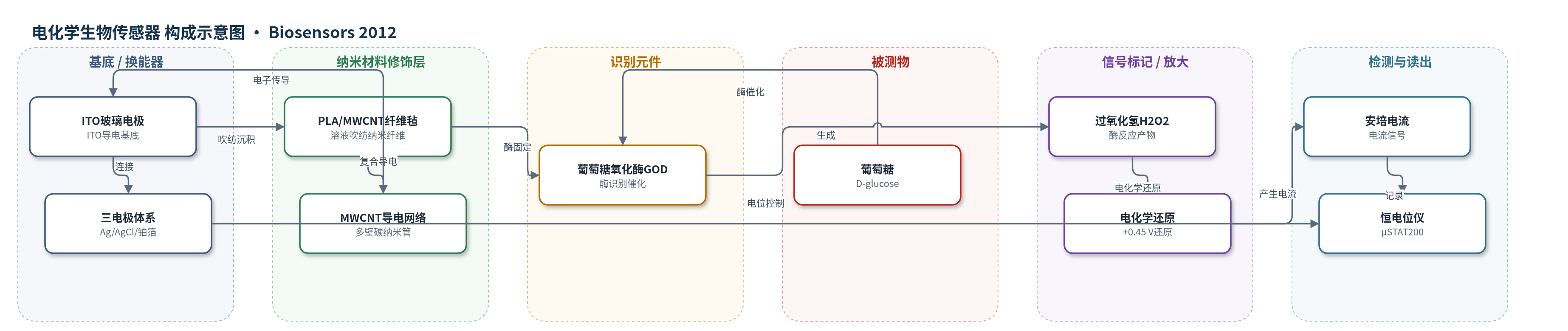
点击图片查看大图 · 依据论文自动绘制
传感器类型
电化学生物传感器
检测对象
葡萄糖(glucose, D-glucose),样品基质为磷酸盐缓冲液(PBS);文中亦以过氧化氢(hydrogen peroxide, H2O2)作为电极性能评价对象。
检测原理
葡萄糖氧化酶(GOD)催化 β-D-葡萄糖氧化为葡萄糖酸-δ-内酯,同时以 O2 为电子受体生成过氧化氢(H2O2),酶中 FAD 被还原后再被 O2 再氧化。生成的 H2O2 在 +0.45 V 于 ITO/PLA-MWCNT 电极发生电化学还原,产生还原电流;由于 H2O2 生成速率与葡萄糖浓度相关,稳态电流随葡萄糖浓度增加而增大,直至酶饱和。PLA/MWCNT 纳米纤维毡具有高孔隙、高比表面积和 MWCNT 导电网络,可降低扩散限制并促进电子转移,从而提高灵敏度。最终由恒电位仪以安培法读出电流信号。
检测灵敏度
LOD: 1.7 ± 0.3 mM;线性范围: 2–800 mM;灵敏度: 488 ± 8 nA·mM−1;R = 0.99;摘要/结论另报告灵敏度: 358 nA·mM−1、LOD: 0.08 mM、线性至 800 mM
效应效果
文中未报告选择性、抗干扰、长期稳定性、实际样品加标回收率或与 ELISA/HPLC/qPCR 的对比。重现性方面,H2O2 传感器和葡萄糖生物传感器均用 3 个独立传感器重复测量;优化 H2O2 电极(1 wt% MWCNT、1 min 沉积)灵敏度 213±4 nA·mM−1、LOD 0.3±0.1 mM。优化葡萄糖生物传感器灵敏度 488±8 nA·mM−1、LOD 1.7±0.3 mM,线性 2–800 mM,R=0.99,KM 4.3 mM;摘要/结论另报告灵敏度 358 nA·mM−1、LOD 0.08 mM。作者认为该纤维平台因高孔隙和通透性可提升葡萄糖安培检测性能。
传感器的构成
- 基底电极:ITO 玻璃片(indium tin oxide, ITO),导电工作电极,提供电子转导界面。
- 纳米纤维修饰层:PLA/MWCNT 纳米复合纤维毡(poly(lactic acid)/multi-walled carbon nanotube, PLA/MWCNT),溶液吹纺 1 min、MWCNT 1 wt%,提供高孔隙与导电网络。
- 识别元件:葡萄糖氧化酶(glucose oxidase, GOD),滴涂于纤维毡,催化葡萄糖氧化。
- 交联固定剂:戊二醛(glutaraldehyde, GA),0.25% v/v,交联 GOD 并稳定固定。
- 信号中间物:过氧化氢(hydrogen peroxide, H2O2),GOD 催化产物,在 +0.45 V 被电化学还原产生电流。
- 电解液:磷酸盐缓冲液(phosphate buffer, PBS),维持酶反应 pH 与离子强度。
- 三电极体系:Ag/AgCl 参比电极与铂箔对电极,配合 µSTAT200 恒电位仪进行安培检测。
中文摘要
本文聚焦开发并研究用于生物传感器的新型纳米结构。通过溶液吹纺在氧化铟锡(ITO)电极上制备高孔隙聚乳酸/多壁碳纳米管(PLA/MWCNT)纳米复合纤维,作为生物传感器活性材料。研究纳米复合修饰 ITO 电极对过氧化氢(H2O2)的电催化性能,考察碳纳米管浓度和纤维沉积时间对灵敏度与检出限的影响。循环伏安实验表明,修饰电极对 H2O2 的电化学还原活性增强,为开发安培生物传感器提供优势。随后将葡萄糖氧化酶(GOD)滴涂固定于优化 ITO 电极表面的 PLA/CNT 纳米纤维毡上。最佳生物传感器对葡萄糖的响应线性至 800 mM,灵敏度为 358 nA·mM−1,米氏常数(KM)为 4.3 mM。结果表明,溶液吹纺纳米复合纤维因高比表面积、高孔隙率和通透性,在葡萄糖生物传感器领域具有应用潜力。
英文摘要
The focus of this paper is the development and investigation of properties of new nanostructured architecture for biosensors applications. Highly porous nanocomposite fibers were developed for use as active materials in biosensors. The nanocomposites comprised poly(lactic acid)(PLA)/multi-walled carbon nanotube (MWCNT) fibers obtained via solution-blow spinning onto indium tin oxide (ITO) electrodes. The electrocatalytic properties of nanocomposite-modified ITO electrodes were investigated toward hydrogen peroxide (H2O2) detection. We investigated the effect of carbon nanotube concentration and the time deposition of fibers on the sensors properties, viz., sensitivity and limit of detection. Cyclic voltammetry experiments revealed that the nanocomposite-modified electrodes displayed enhanced activity in the electrochemical reduction of H2O2, which offers a number of attractive features to be explored in development of an amperometric biosensor. Glucose oxidase (GOD) was further immobilized by drop coating on an optimized ITO electrode covered by poly(lactic acid)/carbon nanotube nanofibrous mats. The optimum biosensor response was linear up to 800 mM of glucose with a sensitivity of 358 nA·mM-1 and a Michaelis-Menten constant (KM) of 4.3 mM. These results demonstrate that the solution blow spun nanocomposite fibers have great potential for application as amperometric biosensors due to their high surface to volume ratio, high porosity and permeability of the substrate. The latter features may significantly enhance the field of glucose biosensors.