组成图示
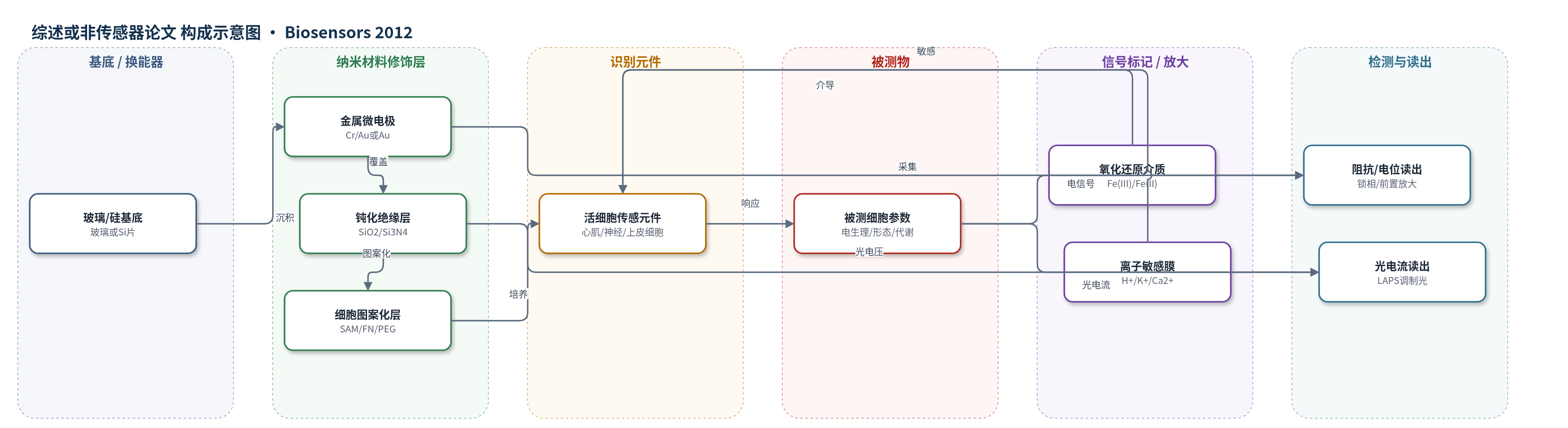
点击图片查看大图 · 依据论文自动绘制
传感器类型
综述或非传感器论文
检测对象
体外培养活细胞(living cells)及其胞外微环境参数:动作电位(AP)、细胞黏附/迁移/增殖(adhesion/migration/proliferation)、胞外酸化率(ECAR)、氧化还原电位(redox potential)、细胞毒性/药物响应(cytotoxicity/drug response);样品基质为细胞培养液、组织切片或微流控培养腔。
检测原理
微加工电化学细胞基传感器通过活细胞与微电极/半导体界面耦合实现检测。MEA 中,细胞膜电位变化产生跨膜电流,经细胞-电极密封电阻和双电层耦合到 Cr/Au 微电极,记录胞外场电位;ECIS 向互指或单极电极施加交流电流,细胞黏附、铺展、迁移或凋亡改变细胞-基底间隙阻抗,阻抗变化反映形态与屏障完整性;LAPS 以调制光激发 Si/SiO2/Si3N4,表面 H+ 或氧化还原电位改变表面势,光电流幅值随之变化。氧化还原介质如 Fe(III)/Fe(II)、甲萘醌/甲萘酚可加速电子传递,将胞内/胞外氧化还原状态转为电位或光电流;CNT 等纳米修饰和多通道集成可增强信号。
检测灵敏度
灵敏度斜率: 约41.6 mV/pH;氧化还原灵敏度: 53.2 mV/log[Fe(III)/Fe(II)];线性范围: pH 2–11;CNT-ITO 修饰灵敏度提高: 2.5–3个数量级
效应效果
综述指出,微加工电化学细胞基传感器可实现实时、无标记、非侵入活细胞监测。MEA 可记录心肌、神经、视网膜电生理,报道图案化心肌细胞传导速度0.190–0.025 m/s;ECIS 可监测黏附、迁移、增殖、凋亡和屏障完整性,适用于高通量细胞毒性筛选;LAPS 可检测胞外酸化率、pH 和氧化还原电位,pH 2–11 呈 Nernstian 线性,集成传感器 pH 灵敏度约41.6 mV/pH、氧化还原53.2 mV/log[Fe(III)/Fe(II)];CNT 修饰 ITO 单细胞传感器灵敏度提高2.5–3个数量级。作者认为集成化、微流控和纳米技术将推动多参数高通量细胞分析。
传感器的构成
- 基底/换能器:玻璃或硅片,承载微电极并作为绝缘或半导体基底
- 金属电极层:Cr/Au 或 Au 薄膜,形成微电极、互指电极或 LAPS 金属层,用于采集电信号
- 钝化/绝缘层:SiO2 或 Si3N4,覆盖电极并暴露传感区;LAPS 中 Si3N4 作为敏感绝缘层
- 表面修饰/细胞图案化层:SAM、纤维连接蛋白(FN)、聚乙二醇(PEG)、聚-L-赖氨酸(PLL)等,控制细胞黏附与定位
- 识别元件:体外培养活细胞(心肌细胞、神经元、上皮/内皮细胞等),作为传感元件响应电生理、形态、代谢或毒性刺激
- 信号介质/敏感膜:Fe(III)/Fe(II)、4-PySH、双(4-吡啶基)二硫化物、甲萘醌/甲萘酚或 H+/K+/Ca2+ 敏感膜,用于氧化还原电位或离子信号转换
- 读出接触/电极:背面 Al 欧姆接触、Ag/AgCl 参比电极、Pt 对电极,输出光电流、阻抗或场电位
中文摘要
细胞生化参数可揭示不同细胞的生理与功能信息。由于电化学检测方法具有高精度和非侵入性,已被用于细胞研究;结合改进的生物传感器设计与先进测量系统,体外活细胞的在线生化分析已应用于生物机制研究、药物筛选和环境监测。近几十年来,随着微加工技术发展,新型微型化电化学生物传感器不断涌现。本文综述微加工电化学细胞基生物传感器,包括微电极阵列(MEA)、电细胞-基底阻抗传感(ECIS)和光寻址电位传感器(LAPS),详细介绍其工作原理、测量系统及在细胞监测中的应用。面向生物医学对高通量和多参数检测的需求,文章还介绍了电化学细胞基生物传感器的发展趋势,包括新型集成生物传感器以及纳米技术和微流控技术的应用。
英文摘要
Cellular biochemical parameters can be used to reveal the physiological and functional information of various cells. Due to demonstrated high accuracy and non-invasiveness, electrochemical detection methods have been used for cell-based investigation. When combined with improved biosensor design and advanced measurement systems, the on-line biochemical analysis of living cells in vitro has been applied for biological mechanism study, drug screening and even environmental monitoring. In recent decades, new types of miniaturized electrochemical biosensor are emerging with the development of microfabrication technology. This review aims to give an overview of the microfabricated electrochemical cell-based biosensors, such as microelectrode arrays (MEA), the electric cell-substrate impedance sensing (ECIS) technique, and the light addressable potentiometric sensor (LAPS). The details in their working principles, measurement systems, and applications in cell monitoring are covered. Driven by the need for high throughput and multi-parameter detection proposed by biomedicine, the development trends of electrochemical cell-based biosensors are also introduced, including newly developed integrated biosensors, and the application of nanotechnology and microfluidic technology.