组成图示
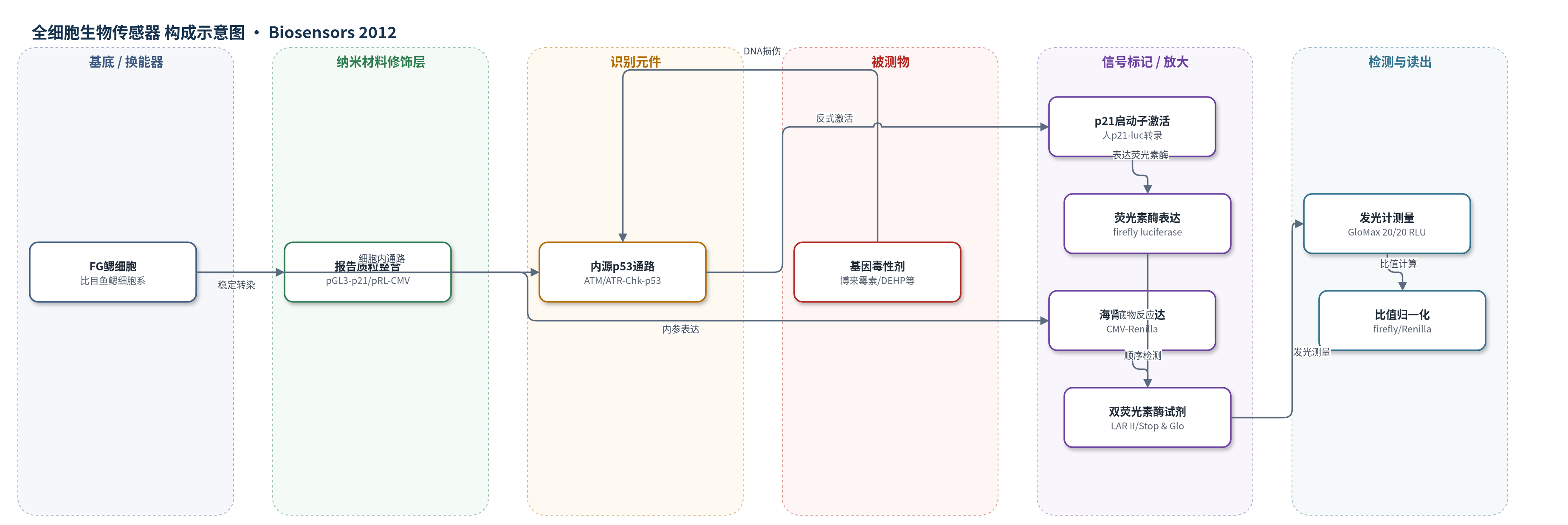
点击图片查看大图 · 依据论文自动绘制
传感器类型
全细胞生物传感器
检测对象
基因毒性化合物(博来霉素 bleomycin、丝裂霉素 C mitomycin C、环磷酰胺 cyclophosphamide、邻苯二甲酸二(2-乙基己基)酯 DEHP、乙醇 ethanol、D-甘露醇 D-mannitol、丁酸钠 sodium butyrate);样品基质为体外细胞培养液/细胞暴露体系
检测原理
基因毒性剂进入FG细胞后造成DNA单链或双链断裂;直接剂如博来霉素、丝裂霉素C直接损伤DNA,间接剂环磷酰胺需经大鼠肝S9代谢活化后形成活性代谢物。DNA损伤被ATM/ATR激酶识别,磷酸化激活Chk1/Chk2,使p53稳定并活化。活化的p53结合人p21启动子,反式激活pGL3-p21-luc,表达荧光素酶;pRL-CMV同时表达海肾荧光素酶作为内参。细胞裂解后,LAR II提供荧光素底物产生化学发光,Stop & Glo淬灭并启动海肾反应。发光计测量RLU,以firefly/Renilla比值表示响应。比值随基因毒性剂浓度升高而升高,高浓度时细胞毒性可能抵消信号。
检测灵敏度
原文未报告LOD、线性范围、灵敏度斜率或相关系数。
效应效果
系统对博来霉素、丝裂霉素C及经S9活化的环磷酰胺呈剂量依赖阳性,对未活化环磷酰胺、乙醇和D-甘露醇阴性,显示较高选择性。响应快:博来霉素暴露1 h可检出,4 h达峰;丝裂霉素C 30 min可检出。DEHP在环境剂量0.005 μg/mL即诱导明显荧光素酶上调,50 μg/mL达峰值,作者认为比多数非哺乳动物体外突变试验更敏感。稳定转染细胞经G418维持一年仍保持恒定基础报告信号,15 °C可存活1个月以上。局限:丁酸钠等p53非依赖激活p21的试剂可致假阳性。
传感器的构成
- 细胞基底:海洋比目鱼鳃细胞系FG(Paralichthys olivaceus gill cells),在MEM+10% BCS中培养,作为基因毒性响应与信号产生基质
- 报告基因层:pGL3-p21-luc质粒,人p21启动子驱动荧光素酶(firefly luciferase),响应DNA损伤/p53通路
- 内参基因层:pRL-CMV-luc质粒,CMV启动子驱动海肾荧光素酶(Renilla luciferase),用于归一化细胞活力与裂解差异
- 选择标记层:pcDNA3.1/V5A-His载体,含新霉素抗性基因,提供G418抗性以筛选稳定转化细胞
- 识别元件:FG细胞内源野生型p53信号通路(ATM/ATR-Chk1/Chk2-p53-p21),识别DNA单/双链断裂
- 代谢活化层:诱导大鼠肝S9混合物,用于环磷酰胺等间接基因毒性剂的代谢活化
- 信号底物:双荧光素酶检测试剂LAR II与Stop & Glo Reagent,提供荧光素酶底物并顺序产生化学发光
- 读出层:GloMax 20/20发光计,测量RLU并计算firefly/Renilla比值
中文摘要
本文报道了一种用于高通量基因毒性检测的鱼细胞生物传感器系统。作者将人p21启动子驱动的荧光素酶报告质粒pGL3-p21-luc和CMV启动子驱动的海肾荧光素酶内参质粒pRL-CMV-luc稳定整合到海洋比目鱼鳃细胞FG中,构建p21FGLuc细胞。验证表明,p21FGLuc细胞保留野生型p53信号通路,对直接基因毒性剂博来霉素和丝裂霉素C,以及经代谢活化的间接基因毒性剂环磷酰胺呈阳性响应;对未活化的环磷酰胺、乙醇和D-甘露醇呈阴性响应,显示较高特异性与敏感性,且响应快速稳定。该系统对啮齿类致癌物邻苯二甲酸二(2-乙基己基)酯DEHP给出强基因毒性指示,而DEHP在多数非哺乳动物体外突变试验中常为阴性。其局限是对丁酸钠等能以p53非依赖方式反式激活p21的试剂可能产生假阳性。
英文摘要
p21CIP1/WAF1 is a p53-target gene in response to cellular DNA damage. Here we report the development of a fish cell biosensor system for high throughput genotoxicity detection of new drugs, by stably integrating two reporter plasmids of pGL3-p21-luc (human p21 promoter linked to firefly luciferase) and pRL-CMV-luc (CMV promoter linked to Renilla luciferase) into marine flatfish flounder gill (FG) cells, referred to as p21FGLuc. Initial validation of this genotoxicity biosensor system showed that p21FGLuc cells had a wild-type p53 signaling pathway and responded positively to the challenge of both directly acting genotoxic agents (bleomycin and mitomycin C) and indirectly acting genotoxic agents (cyclophosphamide with metabolic activation), but negatively to cyclophosphamide without metabolic activation and the non-genotoxic agents ethanol and D-mannitol, thus confirming a high specificity and sensitivity, fast and stable response to genotoxic agents for this easily maintained fish cell biosensor system. This system was especially useful in the genotoxicity detection of Di(2-ethylhexyl) phthalate (DEHP), a rodent carcinogen, but negatively reported in most non-mammalian in vitro mutation assays, by providing a strong indication of genotoxicity for DEHP. A limitation for this biosensor system was that it might give false positive results in response to sodium butyrate and any other agents, which can trans-activate the p21 gene in a p53-independent manner.