组成图示
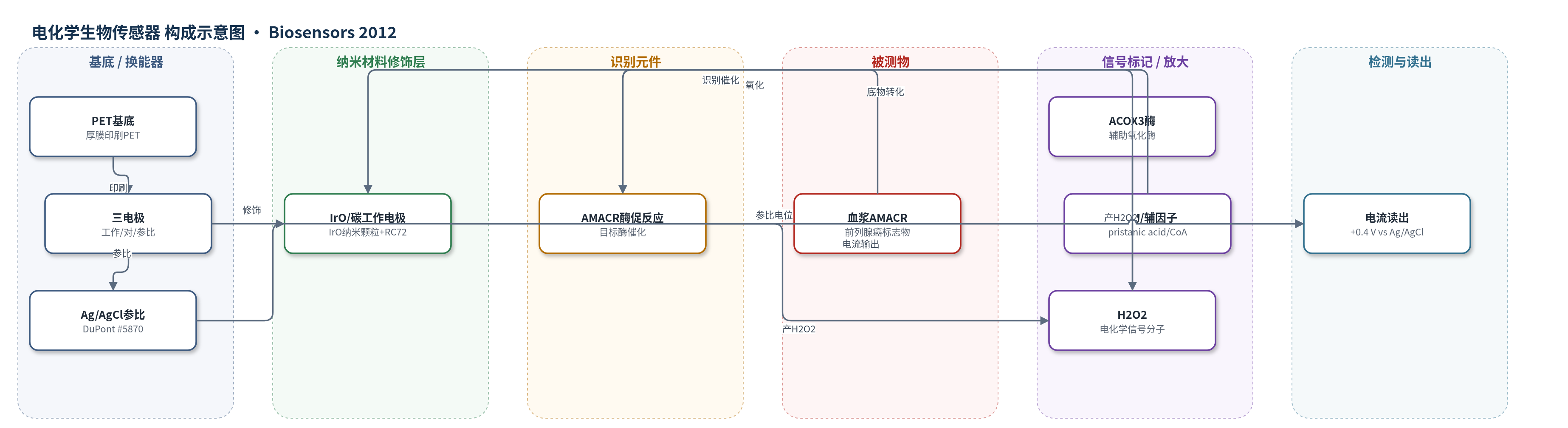
点击图片查看大图 · 依据论文自动绘制
传感器类型
电化学生物传感器
检测对象
α-甲基酰基辅酶A消旋酶(alpha-methylacyl-CoA racemase, AMACR),样品基质:人血浆(血液/血清)
检测原理
该传感器采用酶促电化学检测原理。血浆中的AMACR作为目标酶,在pristanic acid、CoA、ATP和Mg2+存在下,将(2R)-pristanoyl-CoA转化为(2S)-pristanoyl-CoA;随后ACOX3催化(2S)-pristanoyl-CoA发生β-氧化并产生H2O2。H2O2扩散至含IrO纳米颗粒的碳工作电极,在+0.4 V vs Ag/AgCl下被氧化,产生与H2O2量成正比的氧化电流。由于IrO纳米催化层降低H2O2氧化过电位,信号可被稳定读出。AMACR活性越高,生成的H2O2越多,电流越大,从而实现AMACR浓度的定量检测。
检测灵敏度
原文未报告LOD、线性范围、灵敏度斜率或相关系数。
效应效果
24例人血浆盲法检测中,前列腺癌组平均AMACR为0.077(0.10) µg/µL,健康对照0.005(0.001) µg/µL,HGPIN 0.004(0.0005) µg/µL;在0.08–0.90电流阈值下,区分前列腺癌与对照准确率为100%。循环伏安法显示pristanic acid和AMACR不贡献背景电流,加入ACOX3与AMACR后电流增加具特异性。该一次性厚膜印刷传感器成本低、样品量小,可区分前列腺癌与健康及HGPIN,作者认为其可用于前列腺癌筛查诊断;未报告RSD、回收率或与ELISA对比。
传感器的构成
- 基底/换能器:0.18 mm厚PET(Melinex 329, DuPont)厚膜印刷三电极,提供一次性载体与工作/对/参比电极。
- 工作电极修饰层:含IrO纳米颗粒的活性碳粉RC72厚膜油墨,催化H2O2氧化并降低过电位。
- 对电极:含IrO纳米颗粒的活性碳粉RC72厚膜油墨,完成电化学回路。
- 参比电极:DuPont #5870 Ag/AgCl厚膜油墨印刷Ag/AgCl电极,提供稳定参比电位。
- 绝缘层:Nazdar APL 34无硅介电油墨厚膜印刷,隔离电极并定义传感器尺寸。
- 识别/反应元件:血浆中AMACR酶与ACOX3、pristanic acid、CoA、ATP、Mg2+组成酶促反应,将(2R)-pristanoyl-CoA转化为(2S)-pristanoyl-CoA。
- 信号分子:H2O2由ACOX3催化β-氧化产生,在工作电极+0.4 V vs Ag/AgCl处氧化产生电流。
中文摘要
前列腺特异性抗原(PSA)虽常用于前列腺癌筛查,但特异性不足,且难以区分侵袭性与惰性癌。α-甲基酰基辅酶A消旋酶(AMACR)已被证明可高灵敏度、高特异性地区分前列腺癌细胞与正常或良性细胞,但尚缺乏准确且临床可用的检测方法。本研究开发了一种一次性、可丢弃的电化学生物传感器,用于检测人血样中的AMACR,并通过人类血浆样本验证其有效性、重现性和可靠性。研究检测了9名健康男性、10名高级别前列腺上皮内瘤变(HGPIN)患者和5名前列腺癌患者的血浆AMACR水平。前列腺癌患者平均AMACR水平为0.077(0.10) µg/µL,较健康对照0.005(0.001) µg/µL或HGPIN患者0.004(0.0005) µg/µL高约10倍。在0.08–0.90的电流阈值范围内,该传感器能以100%准确率将前列腺癌患者与对照区分开。结果表明,该生物传感器可作为前列腺癌检测与诊断的可靠分析工具。
英文摘要
Although still commonly used in clinical practice to screen and diagnose prostate cancer, there are numerous weaknesses of prostate-specific antigen (PSA) testing, including lack of specificity and the inability to distinguish between aggressive and indolent cancers. A promising prostate cancer biomarker, alpha-methylacyl-CoA racemase (AMACR), has been previously demonstrated to distinguish cancer from healthy and benign prostate cells with high sensitivity and specificity. However, no accurate clinically useful assay has been developed. This study reports the development of a single use, disposable biosensor for AMACR detection. Human blood samples were used to verify its validity, reproducibility and reliability. Plasma samples from 9 healthy males, 10 patients with high grade prostatic intraepithelial neoplasia (HGPIN), and 5 prostate cancer patients were measured for AMACR levels. The average AMACR levels in the prostate cancer patients was 10 fold higher (mean(SD) = 0.077 (0.10)) than either the controls (mean(SD) = 0.005 (0.001)) or HGPIN patients (mean(SD) = 0.004 (0.0005)). At a cutoff of between 0.08 and 0.9, we are able to achieve 100% accuracy in separating prostate cancer patients from controls. Our results provide strong evidence demonstrating that this biosensor can perform as a reliable assay for prostate cancer detection and diagnosis.