组成图示
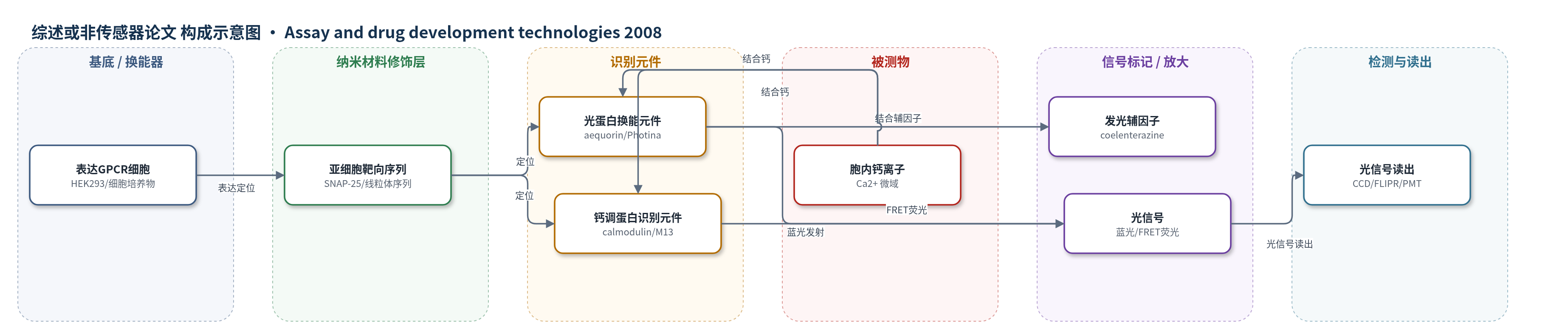
点击图片查看大图 · 依据论文自动绘制
传感器类型
综述或非传感器论文
检测对象
胞内钙离子(intracellular Ca2+,活细胞/细胞培养物;GPCR 激活后胞质、线粒体、质膜等微域);间接检测 GPCR 配体(agonist/antagonist,细胞培养物)
检测原理
GPCR 配体结合后,通过 Gq/11-PLC-IP3 途径促使内质网释放 Ca2+,或通过 Go 调节电压门控钙通道引起胞内 Ca2+ 升高。重组表达的 aequorin/Photina 先与 coelenterazine 结合形成活性光蛋白,其 Ca2+ 结合位点结合 Ca2+ 后诱导 coelenterazine 氧化为 coelenteramide,激发态弛豫发射 465/471 nm 蓝光;Ca2+ 浓度越高,发光越强。aequorin 结合 Ca2+ 后失活,适合单次事件检测;Photina 由 obelin 与 clytin 嵌合,信号更强、动力学更慢,适合 HTS。cameleons/camgaroos/pericams 中 Ca2+ 结合 calmodulin 引起构象变化,使 GFP 突变体靠近发生 FRET 或增强荧光,信号可逆。靶向序列将传感器定位到线粒体、质膜等微域,提高局部 Ca2+ 变化检测灵敏度,最终由 CCD、PMT 或 FLIPR 读出。
检测灵敏度
原文未报告 LOD、线性范围、灵敏度斜率或相关系数;仅报告 Photina 信号约为 aequorin 的 3 倍、灵敏度约为标准荧光钙染料 FLIPR 的 10 倍,最低约 100 cells/well。
效应效果
与荧光钙染料相比,光蛋白背景低、信噪比高、动态范围大,且化合物自荧光干扰少。aequorin 可稳定表达并靶向线粒体、质膜、内质网等区室,用于区分 GPCR/Gq-IP3 与 GPCR/Go 通道介导的钙信号;Photina 信号比 aequorin 高约 3 倍,灵敏度比 FLIPR 荧光钙染料高约 10 倍,最低约 100 cells/well,可适配 1536 孔 ultra-HTS。cameleons、camgaroos 和 pericams 可逆、适合单细胞与活体成像,但需光激发、背景较高,主要用于基础研究。作者主张其可用于 GPCR 激动剂、拮抗剂、变构调节剂筛选、孤儿受体配体发现、离子通道/转运体筛选及活体钙信号成像。
传感器的构成
- 细胞基底:表达 GPCR 的活细胞(如 HEK293 细胞)提供受体、G蛋白与钙信号通路,作为传感平台。
- 换能元件:重组光蛋白 aequorin 或 Photina,结合 Ca2+ 后催化 coelenterazine 氧化并发光。
- 识别元件:aequorin/Photina 的 Ca2+ 结合位点(EF-hand 结构)或 cameleons/camgaroos/pericams 中的 calmodulin,特异性识别 Ca2+。
- 信号标记物:coelenterazine 作为 aequorin/Photina 发光辅因子,被氧化为 coelenteramide 并释放蓝光;GFP 突变体作为 cameleons 等荧光信号团。
- 靶向定位序列:SNAP-25、adenylyl cyclase、cytochrome c oxidase 等序列,将光蛋白定位到质膜、线粒体等亚细胞区室。
- 读出装置:CCD 相机、photomultiplier tube 或 FLIPR,检测发光或荧光信号。
中文摘要
G蛋白偶联受体(GPCR)是药物发现的重要靶点,绝大多数 GPCR 均可耦联 Ca2+ 信号。因此,许多基于细胞的高通量筛选(HTS)方法通过检测胞内 Ca2+ 变化来评估 GPCR 激活。传统方法使用荧光染料,其发射光强度与胞内 Ca2+ 浓度相关。另一种策略是重组表达生物传感器光蛋白,典型代表为水母素(aequorin)。这类光蛋白在胞内 Ca2+ 升高时产生强发光信号,具有极高灵敏度、高信噪比,并可利用靶向序列定位到特定亚细胞区室,从而检测 Ca2+ 微域。这些优势使光蛋白成为多种 GPCR 药物发现项目的首选工具,并逐渐用于配体门控离子通道和转运体激活检测。本综述重点讨论钙光蛋白在 GPCR 药物发现和 HTS 中的应用。
英文摘要
The G protein-coupled receptor (GPCR) family is a major target for drug discovery, and most, if not all, GPCRs can couple to Ca2+ signaling. Consequently, there are a number of cellbased, primary, high-throughput screening (HTS) assays used for drug discovery that assess changes in intracellular Ca2+ as a functional readout of GPCR activation. Historically, changes in intracellular Ca2+ levels have been readily detected using fluorescent dyes that emit light in proportion to changes in intracellular Ca2+ concentration. An alternative approach to indirectly measure changes in Ca2+ concentrations involves the use of recombinantly expressed biosensor photoproteins, of which aequorin is a prototypic example. These biosensors have the advantage that they provide an intense luminescent signal in response to elevations in intracellular Ca2+. This exquisite sensitivity, the high signal-to-noise ratios, and the ability to target expression to discrete subcellular sites (in order to detect Ca2+ microdomains) have made photoproteins a principal choice in a wide range of GPCR drug discovery programs. Photoproteins are also finding increasing use in detecting activation of other molecular target classes such as ligand-gated ion channels and transporters. This review focuses upon the use of calcium photoproteins principally for use in GPCR drug discovery and HTS.