组成图示
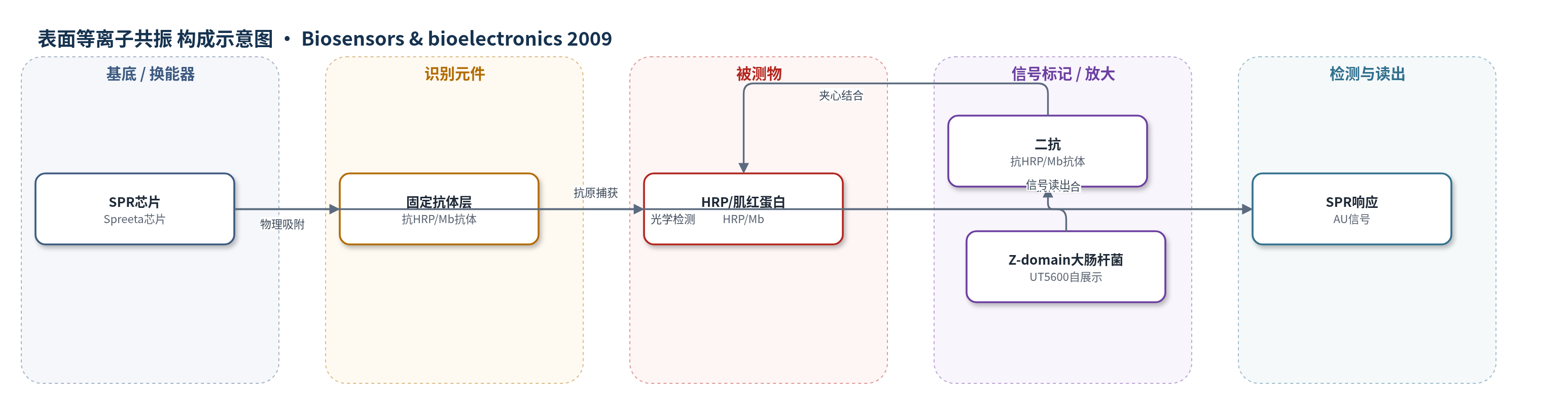
点击图片查看大图 · 依据论文自动绘制
传感器类型
表面等离子共振(SPR)生物传感器
检测对象
辣根过氧化物酶(HRP,缓冲液/溶液样品)、肌红蛋白(myoglobin, Mb,血液相关临床诊断样品;原文以溶液样品演示)
检测原理
SPR芯片表面物理吸附抗HRP或抗肌红蛋白抗体形成免疫亲和层。样品中的HRP或肌红蛋白与固定抗体特异性结合,使界面质量/折射率增加,引起SPR响应变化。随后注入与Z-domain展示大肠杆菌结合的抗HRP或抗肌红蛋白抗体;Z-domain与二抗结合,二抗再与已捕获抗原结合,形成夹心复合物。由于每个大肠杆菌外膜展示约2.8×10^5个Z-domain,可结合大量二抗并进一步捕获抗原,显著放大界面质量变化。抗原浓度越高,捕获量及夹心复合物越多,SPR响应越大,从而实现低浓度检测。
检测灵敏度
LOD: HRP 约1 μg/mL(未放大);HRP <10 ng/mL(仅二抗);HRP <1 ng/mL(大肠杆菌放大);肌红蛋白 10 ng/mL(未放大);肌红蛋白 <1 ng/mL(大肠杆菌放大);浓度范围: HRP 1 ng/mL–1 μg/mL(大肠杆菌放大)
效应效果
流式细胞术显示,展示Z-domain的大肠杆菌约90.8%结合DyLight 647标记IgG,无活性细胞<10%(n=10^4),结论称>99%具有结合活性。非特异结合实验中,未结合抗体的大肠杆菌在BSA表面响应约15 AU,约为特异结合150 AU的10%。HRP检测中,未放大LOD约1 μg/mL,仅二抗放大LOD<10 ng/mL,抗体–大肠杆菌放大LOD<1 ng/mL,信号放大比仅二抗高10倍以上。肌红蛋白检测LOD由10 ng/mL降至<1 ng/mL。作者认为该方法可用于心血管疾病标志物检测,正常肌红蛋白诊断切值约100 ng/mL。
传感器的构成
- 基底/换能器:Spreeta SPR芯片(Texas Instruments),提供表面等离子共振检测界面与5 μL流路
- 识别元件:抗HRP抗体或抗肌红蛋白抗体(anti-HRP/anti-myoglobin antibody),物理吸附于SPR芯片表面形成免疫亲和层(IA layer)
- 信号放大元件:自展示蛋白A Z-domain的大肠杆菌UT5600(质粒pJJ-AT-ZZ18-3),外膜展示约2.8×10^5个Z-domain/细胞
- 信号标记物:抗HRP抗体或抗肌红蛋白抗体与Z-domain结合,形成抗体–大肠杆菌复合物,用于夹心法结合已捕获抗原
- 洗涤液:0.5% Tween 20,用于去除非特异结合并稳定SPR基线
- 读出系统:自制SPR控制电路、注射阀与蠕动泵,37℃下记录SPR响应(AU)
中文摘要
免疫亲和SPR生物传感器通常依靠抗原–抗体相互作用选择性吸附目标分析物。为提高灵敏度,常采用夹心法向已结合的分析物添加标记颗粒。本研究通过“自展示”(Autodisplay)技术在大肠杆菌外膜表达蛋白A的IgG结合Z-domain,估算每个细胞表面展示约280,000个Z-domain分子,并用流式细胞术(FACS)表征其IgG结合活性。以辣根过氧化物酶(HRP)为模型,在SPR夹心检测中,将抗HRP抗体与展示Z-domain的大肠杆菌结合后注入传感器,使检出限由约1 μg/mL显著降低至<1 ng/mL。进一步以肌红蛋白(myoglobin, Mb)为心血管疾病诊断标志物,检出限由10 ng/mL提高至<1 ng/mL。结果表明,展示Z-domain的大肠杆菌可用于免疫亲和生物传感器的信号放大,从而提高灵敏度和检出限。
英文摘要
Generally, an immunoaffinity SPR biosensor detects a target analyte in a sample through highly selective adsorption by using the antigen-antibody interaction. For improving the sensitivity, various kinds of particles have been added to the already bound analytes on the SPR biosensor (sandwich assay). In this work, signal amplification was demonstrated by the expression of the IgG-binding Z-domain of protein A on the outer membrane of Escherichia coli via "Autodisplay". The amount of Z-domain of protein A expressed on the outer membrane was calculated to be 280,000 molecules per cell. In addition, the IgG-binding ability of the expressed protein was characterized using FACS analysis. The signal amplification of the SPR biosensor was performed in the sandwich assay format using a model of horseradish peroxidase (HRP); the limit of detection was determined to be significantly improved from 1 microg/ml to 1 ng/ml. Finally, myoglobin analysis was demonstrated for the medical diagnosis of cardiac diseases. The detection limit was estimated to be improved from 10 ng/ml to <1 ng/ml. These results show that Z-domain-displaying E. coli can be successfully used for the signal amplification of immunoaffinity biosensors, thereby improving the sensitivity and the limit of detection.