组成图示
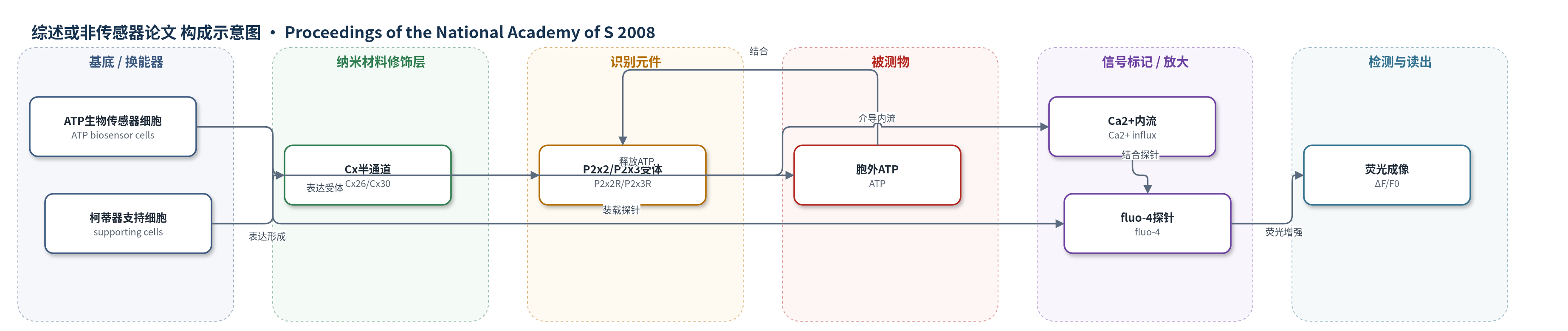
点击图片查看大图 · 依据论文自动绘制
传感器类型
综述或非传感器论文
检测对象
胞外ATP(ATP),样品基质为小鼠柯蒂器类器官培养细胞外液(ECM/EXM/DFM);另以钙指示剂监测细胞内Ca2+(Ca2+)信号
检测原理
在ATP生物传感器检测中,胞外ATP与传感器细胞表面P2x2/P2x3离子型嘌呤受体结合,受体孔道开放,Ca2+顺电化学梯度内流;细胞内预载的fluo-4AM被酯酶水解为fluo-4,Ca2+与探针结合引起荧光增强,显微镜记录ΔF/F0,信号随局部ATP浓度升高而增大。该传感器用于原位检测柯蒂器支持细胞经Cx26/Cx30半通道释放的ATP。论文同时利用fura-2/fura red和caged IP3光解研究ICS:ATP激活P2Y2/P2Y4受体,经PLC生成IP3,IP3从内质网释放Ca2+;Cx26/Cx30缝隙连接允许IP3等第二信使在耦联细胞间扩散,形成可传播的Ca2+波。
检测灵敏度
原文未报告LOD、线性范围、灵敏度斜率或R^2。
效应效果
在WT柯蒂器类器官中,局部ATP(50 ms、4 μM)或caged IP3光解引发Ca2+信号以约10–15 μm/s径向传播至多代未刺激细胞;Cx26或Cx30缺陷培养中传播失败,P2x7R或Px1缺陷培养与WT无差异。胞外La3+(100 μM)阻断半通道后传播仅达相邻细胞,CBX(100 μM)同时阻断半通道与缝隙连接使信号局限于光刺激区。ARL67156(100 μM)抑制外核苷酸酶可恢复高钙介质中的传播。ATP生物传感器在WT中可靠记录胞外ATP释放,在Cx26/Cx30 KO中未检测到类似信号。作者认为Cx26/Cx30通过半通道释放ATP并经缝隙连接传递第二信使,是内耳Ca2+信号传播的关键机制。
传感器的构成
- 换能器/细胞基底:ATP生物传感器细胞(ATP biosensor cells),表达P2x2/P2x3受体,将ATP结合转化为Ca2+荧光信号
- 识别元件:P2x2/P2x3离子型嘌呤受体(P2x2R/P2x3R),识别胞外ATP并介导Ca2+内流
- 信号标记物:钙荧光探针fluo-4AM(fluo-4 AM),胞内水解为fluo-4,Ca2+结合后荧光增强
- 样品接触方式:玻璃微管持握生物传感器细胞贴附于支持细胞外(pipette-held biosensor apposed to supporting cell)
- 读出装置:荧光显微镜/成像系统,记录ΔF/F0
中文摘要
胞外ATP调控多种信号系统,包括细胞间Ca2+信号(ICS)传播。Connexin半通道、P2x7受体(P2x7R)、pannexin通道、阴离子通道、囊泡和转运体均被认为是ATP释放的可能途径,但其在ICS中的作用存在争议。本研究在小鼠柯蒂器类器官培养中检测ICS,其中ATP作为IP3生成激动剂,引发与噪声性听力损失及毛细胞-传入突触发育相关的Ca2+反应。局部递送ATP或用caged IP3光刺激均可引发向多个未刺激细胞径向传播的Ca2+反应。在WT培养中,将ATP生物传感器贴附于光刺激区外的支持细胞,可记录到稳健的Ca2+信号。ICS在缺乏P2x7R或pannexin-1(Px1)的培养中正常传播,在暴露阴离子通道阻断剂的WT培养中也正常传播;相反,Cx26或Cx30表达缺陷的培养中Ca2+反应不能传播。伴随论文显示,若阻断Cx26或Cx30表达,另一个在外沟显著下调。镧(La3+)作为connexin半通道阻断剂,胞外应用不影响缝隙连接(GJ)通道,可将Ca2+反应传播限制在光刺激区相邻细胞。结果表明,这些connexins在内耳Ca2+信号中发挥双重关键作用:作为半通道促进ATP释放,维持长程ICS传播;作为GJ通道允许Ca2+动员第二信使在耦联细胞间扩散。
英文摘要
Extracellular ATP controls various signaling systems including propagation of intercellular Ca(2+) signals (ICS). Connexin hemichannels, P2x7 receptors (P2x7Rs), pannexin channels, anion channels, vesicles, and transporters are putative conduits for ATP release, but their involvement in ICS remains controversial. We investigated ICS in cochlear organotypic cultures, in which ATP acts as an IP(3)-generating agonist and evokes Ca(2+) responses that have been linked to noise-induced hearing loss and development of hair cell-afferent synapses. Focal delivery of ATP or photostimulation with caged IP(3) elicited Ca(2+) responses that spread radially to several orders of unstimulated cells. Furthermore, we recorded robust Ca(2+) signals from an ATP biosensor apposed to supporting cells outside the photostimulated area in WT cultures. ICS propagated normally in cultures lacking either P2x7R or pannexin-1 (Px1), as well as in WT cultures exposed to blockers of anion channels. By contrast, Ca(2+) responses failed to propagate in cultures with defective expression of connexin 26 (Cx26) or Cx30. A companion paper demonstrates that, if expression of either Cx26 or Cx30 is blocked, expression of the other is markedly down-regulated in the outer sulcus. Lanthanum, a connexin hemichannel blocker that does not affect gap junction (GJ) channels when applied extracellularly, limited the propagation of Ca(2+) responses to cells adjacent to the photostimulated area. Our results demonstrate that these connexins play a dual crucial role in inner ear Ca(2+) signaling: as hemichannels, they promote ATP release, sustaining long-range ICS propagation; as GJ channels, they allow diffusion of Ca(2+)-mobilizing second messengers across coupled cells.