组成图示
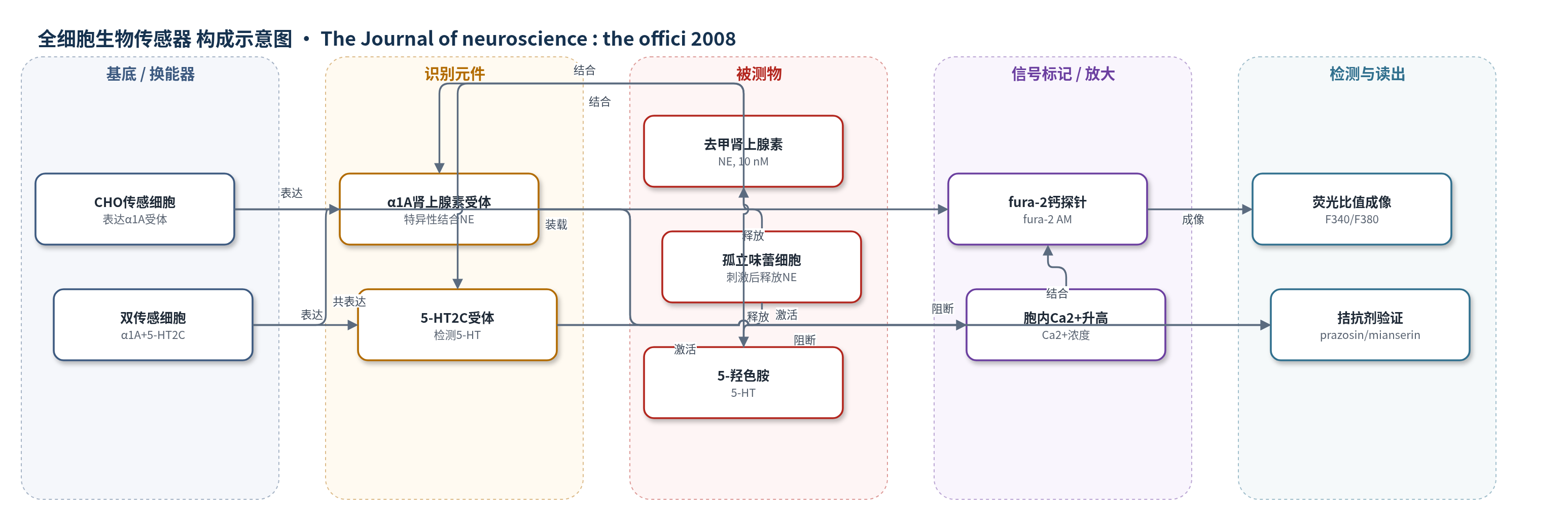
点击图片查看大图 · 依据论文自动绘制
传感器类型
全细胞生物传感器
检测对象
去甲肾上腺素(NE)、5-羟色胺(5-HT);样品基质为孤立小鼠味蕾/味觉细胞周围的 Tyrode 溶液(体外细胞/组织释放液)
检测原理
NE生物传感器为稳定表达α1A肾上腺素能受体的CHO细胞,并装载fura-2 AM。当被测物NE扩散至传感细胞表面并与α1A受体结合时,受体通过Gq/PLC通路激活磷脂酶C,产生IP3并诱导内质网Ca2+释放,使胞内Ca2+升高。fura-2在340 nm和380 nm激发下的荧光比值F340/F380随Ca2+浓度增加而改变,倒置显微镜记录该比值变化。NE浓度越高,受体激活和Ca2+信号越强;阈值约≥10 nM,EC50为117 nM。prazosin可逆阻断α1A受体,从而验证信号来自NE。双生物传感器共表达α1A和5-HT2C受体,NE与5-HT分别激活不同受体,prazosin和mianserin用于区分两种递质。
检测灵敏度
阈值: ≥10 nM NE;EC50: 117 nM
效应效果
NE生物传感器阈值≥10 nM,EC50 117 nM;prazosin选择性消除NE响应(p<0.0001)。传感细胞对50 mM KCl、10 mM乙酸及味觉化合物混合物无响应。孤立味蕾中,KCl诱导NE释放12%(6/49),低于5-HT的39%(213/540,p<0.0001)。突触前细胞中,KCl诱导5-HT释放84%(43/51),NE释放28%(8/29);双生物传感器显示4/13例共释放5-HT与NE。NE最高100 μM不改变细胞Ca2+响应及ATP/5-HT释放。
传感器的构成
- 传感细胞基底:CHO细胞(Chinese hamster ovary cells),稳定表达α1A肾上腺素能受体,作为NE识别与信号转导单元
- 识别元件:α1A肾上腺素能受体(α1A adrenoceptor),特异性结合NE并启动Gq/PLC通路
- 信号标记物:fura-2 AM(钙敏感荧光探针),进入细胞后检测胞内Ca2+变化
- 双传感细胞:CHO细胞共表达α1A与5-HT2C受体(dual biosensors),同时报告NE与5-HT
- 5-HT识别元件:5-HT2C受体(5-HT2C receptor),用于双传感细胞中检测5-HT
- 封闭/脱敏处理:ATP(500 μM,30 min),脱敏内源性嘌呤能受体,避免ATP干扰
- 验证试剂:prazosin(1 μM,α1A拮抗剂)与mianserin(1 nM,5-HT2C拮抗剂),用于特异性验证
- 读出平台:倒置显微镜(Olympus IX70)与340/380 nm激发、>510 nm发射滤片,记录F340/F380
中文摘要
ATP和5-羟色胺(5-HT)分别由味蕾受体细胞(II型)和突触前细胞(III型)分泌,去甲肾上腺素(NE)也被认为是味蕾中的神经递质或旁分泌激素,但其释放刺激和分泌细胞类型尚不清楚。本研究将中国仓鼠卵巢细胞(CHO)稳定转染α1A肾上腺素能受体并装载fura-2,构建NE生物传感器,用于检测孤立小鼠味蕾和味觉细胞释放的NE。NE生物传感器对低浓度NE(≥10 nM)产生可靠的fura-2钙信号,且对KCl或味觉化合物无响应。当NE生物传感器贴靠小鼠环状乳头味蕾并施加KCl(50 mM)或味觉化合物混合物(环己酰亚胺10 μM、糖精2 mM、苯甲地那铵1 mM、SC45647 100 μM)时,记录到明显响应;该响应可被α1A受体拮抗剂prazosin可逆阻断。进一步分离单个味觉细胞发现,NE仅由突触前III型细胞分泌,而非受体II型细胞;刺激诱导的NE释放依赖浴液中的Ca2+。使用同时敏感于5-HT和NE的双生物传感器发现,所有突触前细胞均分泌5-HT,其中约33%同时共释放NE与5-HT。
英文摘要
ATP and serotonin (5-HT) are neurotransmitters secreted from taste bud receptor (type II) and presynaptic (type III) cells, respectively. Norepinephrine (NE) has also been proposed to be a neurotransmitter or paracrine hormone in taste buds. Yet, to date, the specific stimulus for NE release in taste buds is not well understood, and the identity of the taste cells that secrete NE is not known. Chinese hamster ovary cells were transfected with alpha(1A) adrenoceptors and loaded with fura-2 ("biosensors") to detect NE secreted from isolated mouse taste buds and taste cells. Biosensors responded to low concentrations of NE (>or=10 nm) with a reliable fura-2 signal. NE biosensors did not respond to stimulation with KCl or taste compounds. However, we recorded robust responses from NE biosensors when they were positioned against mouse circumvallate taste buds and the taste buds were stimulated with KCl (50 mm) or a mixture of taste compounds (cycloheximide, 10 microm; saccharin, 2 mm; denatonium, 1 mm; SC45647, 100 microm). NE biosensor responses evoked by stimulating taste buds were reversibly blocked by prazosin, an alpha(1A) receptor antagonist. Together, these findings indicate that taste bud cells secrete NE when they are stimulated. We isolated individual taste bud cells to identify the origin of NE release. NE was secreted only from presynaptic (type III) taste cells and not receptor (type II) cells. Stimulus-evoked NE release depended on Ca(2+) in the bathing medium. Using dual biosensors (sensitive to 5-HT and NE), we found all presynaptic cells secrete 5-HT and 33% corelease NE with 5-HT.