组成图示
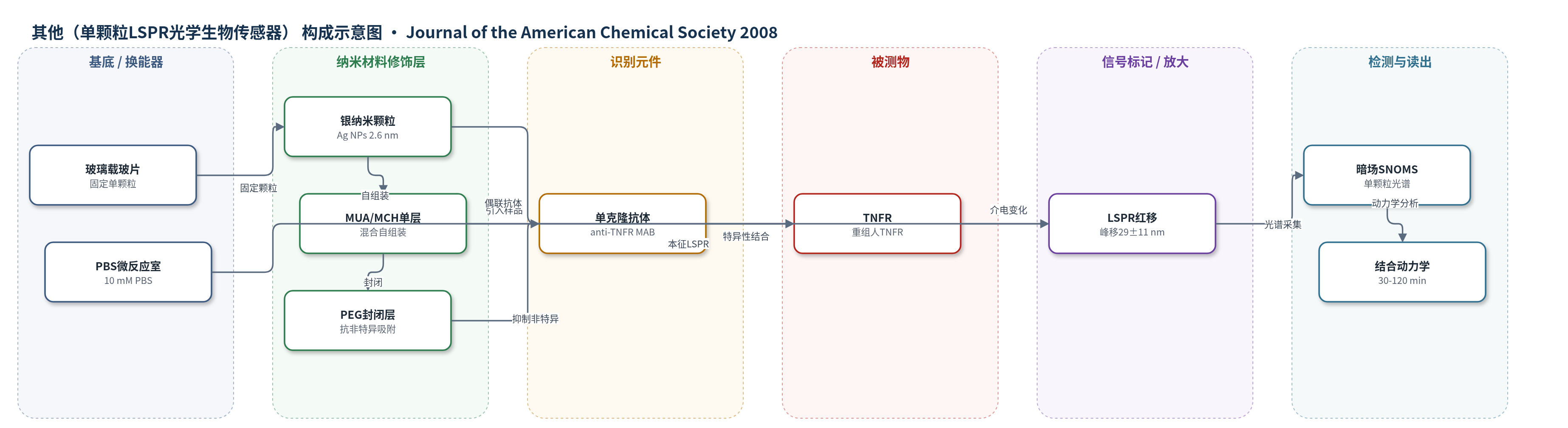
点击图片查看大图 · 依据论文自动绘制
传感器类型
其他(单颗粒LSPR光学生物传感器)
检测对象
重组人肿瘤坏死因子-R(TNFR/TNFSF1A),样品基质:PBS 缓冲液(溶液)
检测原理
传感器以 2.6 nm Ag 纳米颗粒为光学换能单元,表面 MUA/MCH 自组装单层通过 EDC/sulfo-NHS 将单个 anti-TNFR MAB 共价固定,形成单分子检测体积。当 PBS 中的 TNFR 扩散至颗粒表面并与 MAB 特异性结合时,颗粒表面介电环境、化学界面阻尼和有效半径/长径比发生变化,导致局域表面等离子共振(LSPR)峰波长红移。单个 TNFR 结合通常引起约 29±11 nm 的峰移,颜色由绿变黄绿;未结合颗粒峰位基本不变。暗场 SNOMS 实时采集单颗粒 LSPRS 和散射强度,峰移随结合事件出现并趋于稳定,从而在单分子水平反映结合/解离动力学。批量体系中 TNFR 与 MAB 结合后颗粒沉淀/吸光度下降,吸光度变化与 TNFR 浓度在 0-200 ng/mL 线性相关。
检测灵敏度
线性范围: 0-200 ng/mL (0-11.4 nM);灵敏度斜率: 1.2 × 10^-4 mL/ng;R^2 = 0.99
效应效果
SMNOBS 对 TNFR 选择性高:BSA 对照 8 h 内未引起单颗粒 LSPRS 显著变化,批量 BSA 对照吸光度变化仅来自稀释。传感器在约 0.070 W 白光下连续 12 h 光稳定,无光漂白和闪烁;MAB 保持生物活性,KB=(1.7±0.1)×10^6 M^-1,接近文献 1.8×10^6 M^-1。批量动态范围 0-200 ng/mL,覆盖健康血浆 TNFR 1.2-130 pg/mL 及疾病升高 100-1000 倍水平;相比 ELISA 检测限约 5 pg/mL 且需多步洗涤,本方法免洗涤并可实时单分子检测。单颗粒结合平衡时间 30-120 min,适用于 TNFR 疾病诊断、治疗监测和单分子功能研究。
传感器的构成
- 基底/固定层:洁净玻璃载玻片(glass slide),用于固定单颗粒并构建微反应室
- 纳米换能层:2.6±1.1 nm 银纳米颗粒(Ag NPs),由 AgNO3、柠檬酸钠、PVP、H2O2 和 NaBH4 合成,提供 LSPR 光学信号
- 自组装功能化层:11-巯基十一酸(MUA)与 6-巯基-1-己醇(MCH)混合单层,MUA:MCH=1:9,MUA 提供羧基偶联位点,MCH 稳定颗粒并帮助分子直立
- 识别元件:抗人 TNFR 单克隆抗体(MAB),经 EDC/sulfo-NHS 与 MUA 羧基共价偶联,每颗粒约一个 MAB,特异性识别 TNFR
- 封闭/抗非特异层:聚乙二醇(PEG,0.05% w/v),抑制 MAB 非特异吸附
- 信号换能层:无外源标记,TNFR 结合引起 Ag NPs 局域表面等离子共振(LSPR)峰波长红移,作为本征光学信号
- 读出层:暗场单颗粒光学显微/光谱系统(SNOMS),配 Nuance 多光谱成像、EMCCD/CCD 和 SpectraPro-150,采集 LSPRS 与散射强度
中文摘要
本研究合成了直径 2.6±1.1 nm 的超小稳定银纳米颗粒,并利用其小表面积和表面功能基团控制单颗粒上的单分子检测体积,从而发展出本征单分子纳米颗粒光学生物传感器(SMNOBS),用于实时检测和成像单个细胞因子分子——重组人肿瘤坏死因子-R(TNFR),以及探测其与单个单克隆抗体(MAB)分子的结合反应。结果表明,SMNOBS 在数月内保持生物活性,并表现出极高的光稳定性。研究还发现,更小的纳米颗粒其光学性质对表面功能基团的依赖性更强,因而可作为更灵敏的生物传感器。当单个 TNFR 分子与单个纳米颗粒上的单个 MAB 分子结合时,SMNOBS 的局域表面等离子共振光谱(LSPRS)峰波长出现 29±11 nm 的显著红移。基于 LSPRS,作者在单分子水平实时定量测量了结合反应,观察到随机结合动力学,结合平衡时间约为 30-120 min。SMNOBS 具有极高的灵敏度和选择性,动态范围达 0-200 ng/mL (0-11.4 nM)。因此,该传感器适用于研究单个蛋白质分子的生物功能、化学功能基团与纳米颗粒表面的单分子相互作用,以及疾病诊断和治疗的发展。
英文摘要
We synthesized tiny stable silver nanoparticles (2.6 +/- 1.1 nm) and used its small surface area and functional groups to control single molecule detection (SMD) volumes on single nanoparticles. These new approaches allowed us to develop intrinsic single molecule nanoparticle optical biosensors (SMNOBS) for sensing and imaging of single human cytokine molecules, recombinant human tumor necrosis factor-alpha (TNFalpha), and probing its binding reaction with single monoclonal antibody (MAB) molecules in real-time. We found that SMNOBS retained their biological activity over months and showed exceptionally high photostability. Our study illustrated that smaller nanoparticles exhibited higher dependence of optical properties on surface functional groups, making it a much more sensitive biosensor. Localized surface plasmon resonance spectra (LSPRS) of SMNOBS showed a large red shift of peak wavelength of 29 +/- 11 nm, as single TNFalpha molecules bound with single MAB molecules on single nanoparticles. Utilizing its LSPRS, we quantitatively measured its binding reaction in real time at single molecule (SM) level, showing stochastic binding kinetics of SM reactions with binding equilibrium times ranging from 30 to 120 min. SMNOBS exhibited extraordinarily high sensitivity and selectivity, and a notably wide dynamic range of 0-200 ng/mL (0-11.4 nM). Thus, SMNOBS is well suited for the fundamental study of biological functions of single protein molecules and SM interactions of chemical functional groups with the surface of nanoparticles, as well as development of effective disease diagnosis and therapy.