组成图示
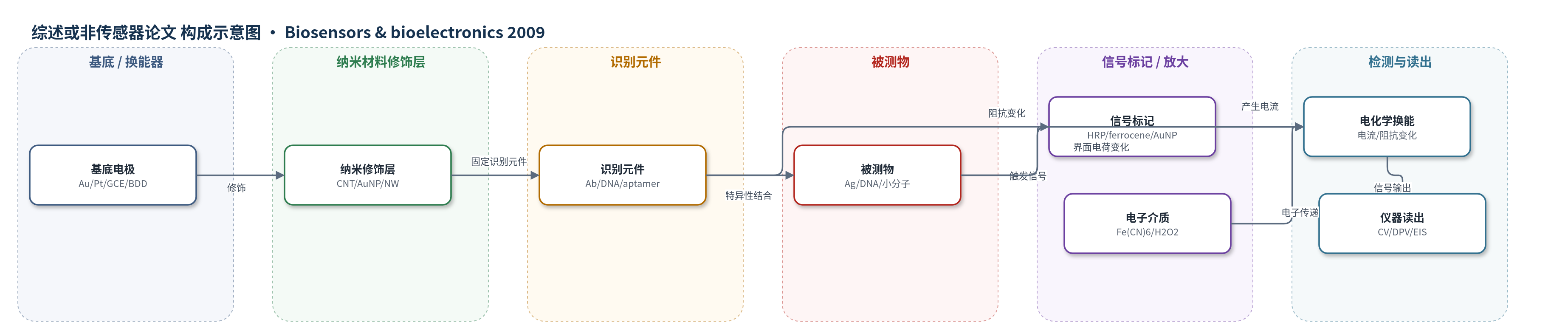
点击图片查看大图 · 依据论文自动绘制
传感器类型
综述或非传感器论文
检测对象
DNA(溶液/组织提取液)、抗原/抗体(血清、唾液、缓冲液)、小分子(cisplatin、PCBs、cocaine、ATP,溶液/临床样品)、葡萄糖(全血、组织间液、缓冲液)、病原菌(食品、临床体液)、肿瘤标志物(CEA、AFP,血清/组织)
检测原理
电化学生物传感器通常将抗体、DNA探针、适配体或酶固定于电极或纳米修饰层表面。被测物与识别元件结合后,可改变电极界面电荷、双电层电容、电子传递阻力或阻抗,实现无标记检测;也可触发标记物氧化还原或酶催化反应。酶标HRP/AP催化H2O2、TMB等底物生成电化学活性产物,金属纳米颗粒、银增强和MED通过放大氧化还原信号提高灵敏度。微电极阵列和CMOS芯片将界面变化转换为电流、电位或阻抗信号,经CV、DPV、EIS等读出,信号随被测物浓度变化。
检测灵敏度
LOD: 7.5 × 10⁻¹³ M;LOD: 100 aM (or 10 zmol);LOD: 10 pM;线性范围: 7–150 pM;LOD: 0.3 nM;LOD: 1.6 fmol in 0.1 mL;线性范围: 3 × 10⁻³–1.6 × 10⁻² ng/mL;LOD: 1.57 pg/mL;线性范围: 1–40 pg/mL;LOD: 0.626 pg/mL;LOD: 1 ng/mL;灵敏度: 260 μA mM−1 cm−2;R^2 > 0.900
效应效果
综述指出电化学生物传感具有低成本、易微型化和可多路复用优势。MED免疫传感器检测Histatin的LOD为0.626 pg/mL,比ELISA和毛细管荧光ELISA分别高约100倍和10倍;对1 μg/mL胱抑素和histatin干扰响应很小,交叉反应可忽略。CombiMatrix微电极阵列可达阿托摩尔级检出、4–5个数量级动态范围,样品量≤50 μL,适合多路免疫分析。双电极酶免疫传感器可同时检测CEA和AFP至1 ng/mL且无串扰。PtNW-CNT-CHIT电极对H2O2灵敏度为260 μA mM−1 cm−2,葡萄糖检测在−0.1 V下选择性良好。原文未给出RSD和实际样品回收率。
传感器的构成
- 基底/换能器电极:Au、Pt、Ag、石墨/碳基导体、GCE、BDD微电极阵列、CMOS微电极芯片,提供电子转导与信号读出
- 纳米材料修饰层:CNT、AuNP、NW、Ppy、PANI、Ni-Al LDHNS、ZnO纳米片,提高比表面积、电子传递和生物相容性
- 识别元件:Ab、Ag、DNA探针、aptamer、HRP、GOx、AP,实现特异性生物识别
- 信号标记/放大元件:HRP/AP酶标、ferrocene、methylene blue、Ru(bpy)3、Os(bpy)3、AuNP/Ag增强、导电聚合物,将识别事件转换为电流或阻抗变化
- 电子供体/介质:K3Fe(CN)6、H2O2、TMB、Os(bpy)2(pyr-CH2-NH2)Cl、ferrocene,参与氧化还原或酶催化产生可测信号
中文摘要
自1991年Iijima发现碳纳米管以来,纳米颗粒、纳米线和纳米棒等纳米材料在电化学生物传感中的应用快速增长。无标记传感器有望简化分子识别过程,但仍需克服若干关键挑战:必须在统计上具有代表性的真实大样本中验证传感器,而非仅使用短合成寡核苷酸、实验室标准品或生物试剂;还需实现传感器多路复用,以支持高通量多分析物检测,并应用于复杂临床和环境样品。本文综述电化学检测生物分子识别的现状,分析该领域的趋势、局限、挑战和商业设备,并总结微电极阵列与微流控技术集成、商业多路电化学生物传感器、适配体传感器以及金属增强电化学检测(MED)等进展,其中MED可达到阿托摩尔级检出限。文章还讨论了癌症监测、食品病原体检测以及电化学葡萄糖生物传感器的新应用。
英文摘要
The use of nanoscale materials (e.g., nanoparticles, nanowires, and nanorods) for electrochemical biosensing has seen explosive growth in recent years following the discovery of carbon nanotubes by Sumio Ijima in 1991. Although the resulting label-free sensors could potentially simplify the molecular recognition process, there are several important hurdles to be overcome. These include issues of validating the biosensor on statistically large population of real samples rather than the commonly reported relatively short synthetic oligonucleotides, pristine laboratory standards or bioreagents; multiplexing the sensors to accommodate high-throughput, multianalyte detection as well as application in complex clinical and environmental samples. This article reviews the status of biomolecular recognition using electrochemical detection by analyzing the trends, limitations, challenges and commercial devices in the field of electrochemical biosensors. It provides a survey of recent advances in electrochemical biosensors including integrated microelectrode arrays with microfluidic technologies, commercial multiplex electrochemical biosensors, aptamer-based sensors, and metal-enhanced electrochemical detection (MED), with limits of detection in the attomole range. Novel applications are also reviewed for cancer monitoring, detection of food pathogens, as well as recent advances in electrochemical glucose biosensors.