组成图示
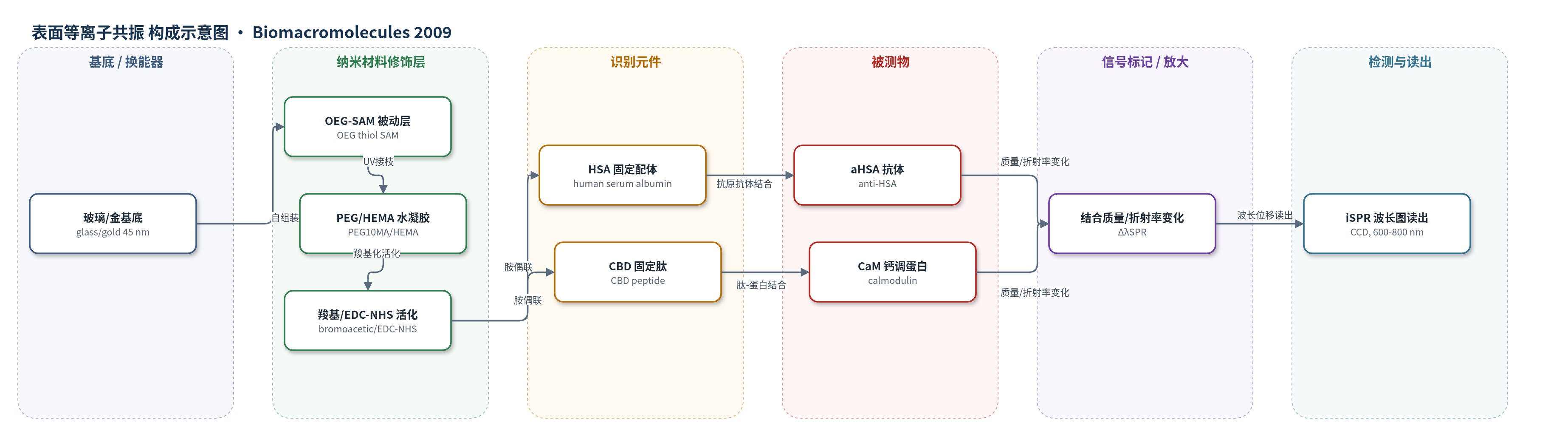
点击图片查看大图 · 依据论文自动绘制
传感器类型
表面等离子共振(SPR)生物传感器
检测对象
兔抗人血清白蛋白抗体(anti-HSA/aHSA,HBS-EP 缓冲液)、钙调蛋白(calmodulin/CaM,HBS-N 含 CaCl2 缓冲液)、人纤维蛋白原(human fibrinogen/HFib,HBS-EP 缓冲液);人血清白蛋白(HSA,乙酸钠/HBS-EP 缓冲液)作为固定配体结合对象
检测原理
传感器以金膜为 SPR 换能基底,OEG-SAM 提供被动背景,PEG10MA/HEMA 水凝胶经溴乙酸引入羧基,再用 EDC/NHS 活化后通过胺偶联固定 HSA 或 CBD。当 aHSA 或 CaM 流过时,与固定配体特异性结合,结合生物分子增加界面有机质量并改变金膜附近折射率,使表面等离子体共振条件改变。iSPR 在固定入射角下扫描 600–800 nm,每个像素反射率最小值对应 λSPR;结合量越大,λSPR 红移越大。水凝胶厚度、组成和交联度决定分子渗透:小分子 CaM 可进入内部,响应随厚度增加;大分子 aHSA 受尺寸排阻,主要结合表层,响应不随厚度明显增加。
检测灵敏度
灵敏度: δλSPR/δn ≈1.4 nm/mRIU;厚度相关斜率 ∼0.02 mRIU-1。
效应效果
混合 PEG10MA/HEMA 水凝胶非特异结合很低,25% PEG10MA 即可基本消除人纤维蛋白原(HFib)非特异吸附,OEG-SAM 间隔区对 HFib、HSA、aHSA 均呈被动屏障。HSA 固定量随 HEMA 含量和斑点厚度增加,75% HEMA 基质固定 HSA 最多;aHSA 结合不随厚度增加,说明大抗体受水凝胶尺寸排阻,仅结合表层。CaM 结合随厚度增加,表明小分子可进入基质内部。非特异响应通常低于 aHSA 特异响应的 1%。作者认为该梯度基质与 iSPR 适合快速筛选水凝胶厚度/组成,用于蛋白微阵列和生物传感器。
传感器的构成
- 基底/换能器:玻璃片(glass slides)上 45 nm 金层(gold),提供 SPR 换能表面
- 自组装单分子层:HS(CH2)11CONH(C2H4O)11CH3 寡聚乙二醇硫醇(OEG-SAM),形成被动屏障并抑制非特异吸附
- 水凝胶接枝层:PEG10MA 与 HEMA 单体(总浓度 240 mM,HEMA 25/50/75/100%)经 254 nm UV 接枝共聚,形成厚度约 5–45/70 nm 的梯度斑点
- 功能化层:溴乙酸(bromoacetic acid)处理引入羧基,为 EDC/NHS 活化提供反应位点
- 活化层:EDC/NHS 将羧基转化为活性酯,用于与配体伯胺共价偶联
- 识别元件:人血清白蛋白(HSA)或钙调蛋白结合肽(CBD,2.3 kDa 合成多肽)共价固定,作为配体捕获分析物
- 封闭剂:乙醇胺(ethanolamine,1 M)封闭未反应酯基,减少非特异结合
- 信号/读出:无外源标记,结合生物分子改变界面折射率/质量,由 iSPR 在 600–800 nm 波长扫描下读取 ΔλSPR
中文摘要
本文利用成像表面等离子共振(iSPR)研究了紫外引发接枝共聚聚乙二醇甲基丙烯酸酯(PEG10MA)与羟乙基甲基丙烯酸酯(HEMA)构成的生物传感器水凝胶基质。通过光掩模和可编程快门横向改变曝光时间,在同一芯片上制备厚度为数纳米至数十纳米的梯度水凝胶斑点。iSPR 采用波长扫描模式,通过提取每个像素反射光谱最小值构建 SPR 波长图,并测量生物特异性相互作用引起的 SPR 波长位移随基质厚度和组成的变化。作者以人血清白蛋白(HSA)固定、其与抗体结合及人纤维蛋白原(HFib)非特异结合评价基质性能,并用合成多肽与钙调蛋白(CaM)体系研究尺寸选择性。结果表明,梯度基质适合快速筛选最优水凝胶性能;混合水凝胶非特异结合很低;小分子 CaM 可自由扩散并在整个水凝胶内相互作用,而较大的 HSA 及其抗体部分或完全无法进入基质内部。该尺寸选择性归因于制备中紫外引发交联/支化及固定中蛋白多点结合。
英文摘要
A biosensor matrix based on UV-initiated graft copolymerized poly(ethylene glycol) methacrylate and 2-hydroxyethyl methacrylate has been studied using imaging surface plasmon resonance (iSPR). By using a photo mask and a programmable shutter to vary the exposure time laterally, a gradient of matrix spots with physical thicknesses ranging from a few to tens of nanometers was generated. To maximize the dynamic range, imaging SPR was employed in wavelength interrogation mode. By finding the minimum in the reflectance spectra from each pixel of an image, SPR wavelength maps were constructed. The shift in SPR wavelength upon biospecific interaction was then measured both as a function of matrix thickness and composition. The performance of the matrix was evaluated in terms of immobilization of human serum albumin, biomolecular interaction with its antibody, and nonspecific binding of human fibrinogen. In addition, a low molecular weight interaction pair based on a synthetic polypeptide and calmodulin was also studied to explore the size selectivity of the hydrogel matrix. Our results show that the gradient matrix exhibits excellent properties for quick evaluation and screening of optimal hydrogel performance. The mixed hydrogel matrices display very low levels of nonspecific binding. It is also evident that the low molecular weight calmodulin is capable of freely diffusing and interacting throughout the entire hydrogel matrix, whereas the much larger albumin and its corresponding antibody, in particular, are partly/completely hindered from penetrating the interior of the matrix. This size-selectivity is attributed to a significant UV-initiated cross-linking or branching of the matrix during fabrication and/or protein mediated multipoint attachment during immobilization.