组成图示
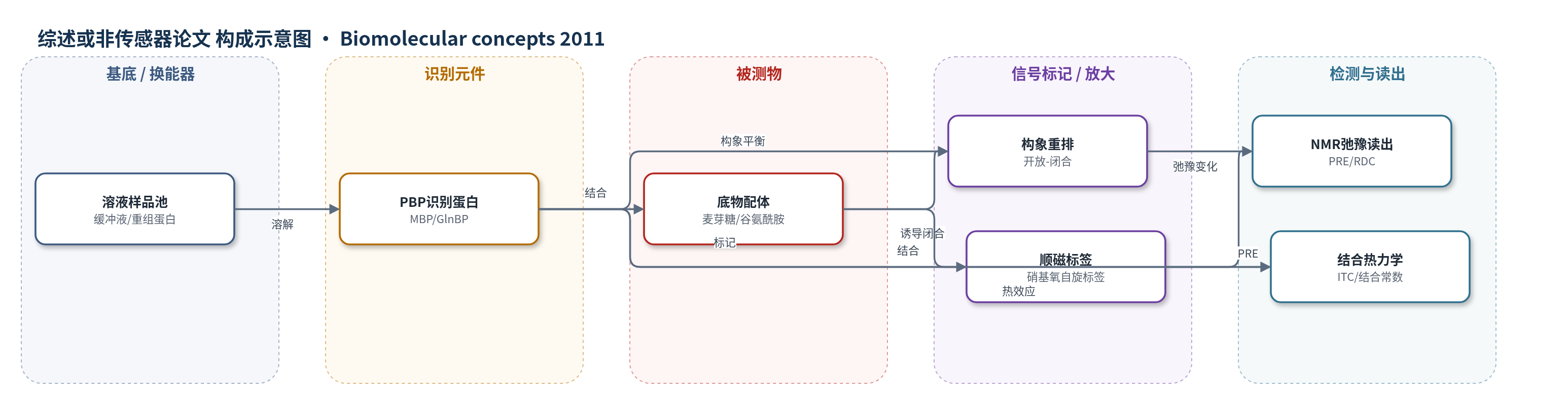
点击图片查看大图 · 依据论文自动绘制
传感器类型
综述或非传感器论文
检测对象
麦芽糖/麦芽寡糖(maltose/maltooligosaccharides)、L-谷氨酰胺(L-glutamine)、β-环糊精(β-cyclodextrin)等;样品基质为缓冲液/溶液中的重组PBP样品,并涉及与膜转运蛋白(TMD/ABC)的相互作用研究。
检测原理
本文并非报道传感检测,而是用溶液NMR研究PBP的识别与构象开关。PBP由两个球状结构域和铰链区组成,底物结合后两域由开放转向闭合,形成转运信号。NMR通过残余偶极耦合(RDC)测定溶液中的平均域间取向,通过顺磁弛豫增强(PRE)利用自旋标签与核磁核之间r^-6距离依赖关系,检测低占比闭合构象;弛豫、动力学和等温滴定量热(ITC)进一步给出结合亲和力、构象交换速率和能量学。信号随配体浓度、构象平衡和蛋白-蛋白相互作用变化,而非传统电/光传感输出。
检测灵敏度
原文未报告LOD、线性范围、灵敏度斜率或相关系数。
效应效果
作为结构生物学综述,本文强调NMR与晶体学互补:晶体学提供静态构象,NMR揭示溶液动态与低占比状态。对MBP铰链突变体的研究显示,I329W和I329W/A96W分别使麦芽糖结合亲和力提高约20倍和60倍;未结合态稳定性随闭合角线性下降,速率约-12±16 cal/mol/deg,结合自由能变化速率约-15±38 cal/mol/deg。顺磁NMR在MBP中检测到约5%的半闭合无配体构象,交换时间尺度约20 ms至20 ns;GlnBP则未见明显无配体闭合态。作者认为PBP可作为生物传感器模型,用于理解别构开关和底物识别。
传感器的构成
- 基底/换能器:未报道,本文无具体传感器装置
- 识别元件:周质结合蛋白(PBP,如MBP、GlnBP),识别底物并发生开放-闭合构象变化
- 信号/读出:溶液NMR(RDC、PRE、弛豫、ITC),监测构象、动力学与结合,非实际传感器换能器
- 样品基质:缓冲液中的重组蛋白与配体,用于结构/功能研究
中文摘要
周质结合蛋白(PBP)是革兰氏阴性菌ATP结合盒(ABC)输入系统的关键组分,其核心功能是在无配体开放构象与结合配体后闭合构象之间发生大规模构象重排,从而指示底物存在并启动跨膜转运。PBP不仅对营养摄取至关重要,也常作为生物传感器技术和别构机制研究的基础模型。尽管晶体学提供了静态原子结构,但溶液核磁共振(NMR)能够补充动态过程、构象平衡、结合能量学及蛋白-蛋白相互作用方面的信息。本文综述了PBP的溶液NMR研究,重点讨论麦芽糖结合蛋白(MBP)、谷氨酰胺结合蛋白(GlnBP)等体系中的构象、动力学、能量学、底物结合机制及其与膜转运蛋白的相互作用。结合顺磁NMR、晶体学和功能观察,作者提出一种机制,用以解释为何某些PBP可在无配体时达到闭合构象,而另一些PBP则保持开放直至配体诱导闭合。
英文摘要
Periplasmic binding proteins (PBPs) are a crucial part of ATP-binding cassette import systems in Gram-negative bacteria. Central to their function is the ability to undergo a large-scale conformational rearrangement from open-unliganded to closed-liganded, which signals the presence of substrate and starts its translocation. Over the years, PBPs have been extensively studied not only owing to their essential role in nutrient uptake but also because they serve as excellent models for both practical applications (e.g., biosensor technology) and basic research (e.g., allosteric mechanisms). Although much of our knowledge at atomic level has been inferred from the detailed, static pictures afforded by crystallographic studies, nuclear magnetic resonance (NMR) has been able to fill certain gaps in such body of work, particularly with regard to dynamic processes. Here, we review NMR studies on PBPs, and their unique insights on conformation, dynamics, energetics, substrate binding, and interactions with related transport proteins. Based on the analysis of recent paramagnetic NMR results, as well as crystallographic and functional observations, we propose a mechanism that could explain the ability of certain PBPs to achieve a closed conformation in absence of ligand while others seem to remain open until ligand-mediated closure.