组成图示
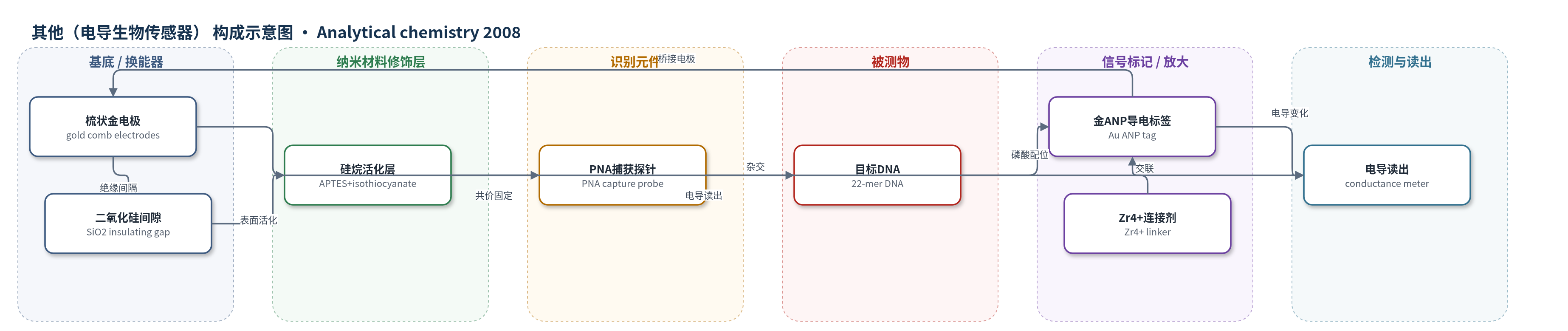
点击图片查看大图 · 依据论文自动绘制
传感器类型
其他(电导生物传感器)
检测对象
22-mer寡核苷酸DNA(22-mer oligonucleotide DNA);样品基质:TE缓冲液
检测原理
芯片间隙中固定中性骨架PNA探针,目标DNA杂交后引入带负电磷酸骨架。PNA无磷酸基团,因此未杂交时无磷酸位点,避免导电标签非特异结合。Au NP表面经3-巯基丙酸引入羧基,再与Zr4+配位形成含数百个Au NP的ANP,表面残留Zr4+。杂交DNA的磷酸基团与残留Zr4+配位,使ANP选择性定位到梳状金电极间的SiO2绝缘间隙。ANP在间隙内形成导电网络,干燥后聚集体塌缩,进一步降低间隙电阻。目标DNA浓度越高,间隙内定位ANP越多,电导越大,通过测量两电极间电导变化实现定量检测。
检测灵敏度
LOD: 5 × 10^-14 M;检测范围: 50 fM–10 pM;校准方程: conductance/(nS) = 10^12.97 [DNA/(M)]^1.05;r = 0.997
效应效果
该传感器对目标DNA具有序列特异性:与单碱基错配DNA(DNA ii)和双碱基错配DNA(DNA iii)相比,目标DNA产生明显更高的电导响应,空白对照较低,说明PNA中性骨架可避免无磷酸基团时的非特异结合。芯片采用100个串联指状间隙并至少测量30个阵列,以平均制造、修饰和测量随机差异。SEM显示ANP可定位到间隙并在干燥后塌缩,增强导电网络;与单个Au NP相比,ANP标签显著提高响应。论文未报告实际生物样品加标回收率、RSD、长期稳定性或与ELISA/qPCR等方法的直接对比,但作者认为该电导检测可推广至其他DNA序列。
传感器的构成
- 基底/换能器电极:梳状金电极(gold comb electrodes),提供导电通路并测量间隙电导
- 绝缘间隔层:二氧化硅(SiO2),位于梳状电极间隙,形成绝缘间隙
- 表面活化层:氨丙基三乙氧基硅烷(APTES)与4-苯基二异硫氰酸酯修饰,用于共价固定PNA
- 识别元件:肽核酸(PNA)捕获探针,共价固定于间隙,与目标DNA杂交
- 信号标记/导电标签:3-巯基丙酸(HS-C2H4-COOH)修饰金纳米颗粒(Au NP)经Zr4+连接形成的金纳米颗粒聚集体(Au ANP)
- 连接/桥接剂:Zr4+(锆离子,来自氯化锆酰八水合物),连接Au NP形成ANP并与DNA磷酸骨架配位
- 封闭剂:乙醇胺(aminoethanol),封闭未反应异硫氰酸酯基团
- 读出装置:Alessi REL-6100探针台与Advantest R8340A超高电阻计,测量间隙电导
中文摘要
本文报道了一种基于芯片的电导生物传感器,用于在低浓度下直接电学检测22-mer寡核苷酸DNA,检测范围50 fM至10 pM。首先,用3-巯基丙酸通过硫醇-金键修饰金纳米颗粒,使其表面羧基与无机连接剂Zr4+形成强配位作用,从而将数百个金纳米颗粒连接成纳米颗粒聚集体(ANP),作为电学检测DNA的导电标签。其次,在由二氧化硅绝缘材料间隔、高度约50 nm、间距300–350 nm的梳状金电极间隙中,将肽核酸(PNA)共价固定为DNA捕获位点。目标DNA杂交后,其带负电磷酸骨架进入间隙,并与ANP表面残余Zr4+发生配位,使导电标签定位到间隙中,改变两梳状电极间的电导。电导变化程度与杂交DNA量及样品中目标DNA浓度直接相关。与单个金纳米颗粒标签相比,金ANP可获得显著增强响应。
英文摘要
Sequence-specific DNA detection is a routine job in medical diagnostics and genetic screening. Alternative to a fluorescence readout scheme or electrophoresis approach, various kinds of rapid, low-cost, facile, and label-free methods have also been developed in last decades. Among these, direct electrical detection of DNA received increasing attention but more research is desirable. Particularly, enhancement with high discrimination must be employed to selectively amplify the responding signal. A chip-based biosensor was developed in this work to electrically detect 22-mer oligonucleotide DNA at low concentration, from 50 fM to 10 pM. First, a gold nanoparticle (NP) was capped with 3-mercaptopropionic acid through a thiol-gold bond. The derivatized carboxylic acid group showed strong complex interaction with an inorganic linker, Zr(4+). As a result, Zr(4+) could link several hundreds of individual gold NPs together to form an aggregate of nanoparticles (ANP), which was capable of being used as a conductive tag for the electrical detection of DNA. Second, in order to achieve the discriminative localization of ANP to bridge two comb-shaped electrodes (with height of approximately 50 nm and interdistance of 300-350 nm) gapped with insulative material of silicon oxide, peptide nucleic acids were covalently bonded to the silicon oxide in the gap as capture sites for DNA. After hybridization with target DNA, the charged phosphate-containing backbone of DNA was introduced into the gap. Phosphate groups also exhibited strong complex interaction with the linker of Zr(4+) and could react with the residual Zr(4+) on the ANP surface. As a consequence, the conductive tags were linked to the phosphate groups and localized into the gap, which could modify the conductance between the two comb-shaped electrodes in turn. The degree of modification correlated directly to the amount of hybridized DNA and to the concentration of target DNA in sample solution. Compared with the individual NPs used as the tag, a strong enhancement from the gold ANP was obtained.