组成图示
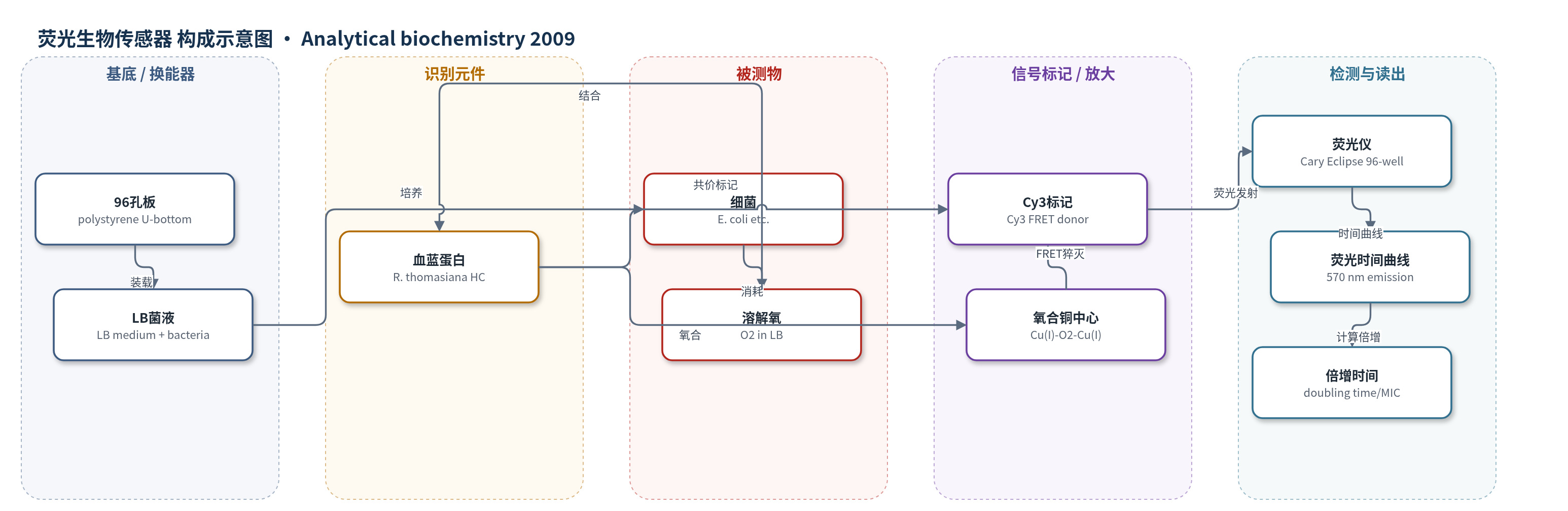
点击图片查看大图 · 依据论文自动绘制
传感器类型
荧光生物传感器
检测对象
溶解氧(dissolved oxygen, O2);样品基质:LB肉汤细菌培养液(E. coli、P. aeruginosa、P. denitrificans、S. simulans)
检测原理
Cy3共价标记的Rapana thomasiana血蓝蛋白作为可溶性氧传感器。血蓝蛋白含III型双核铜中心,脱氧态为Cu(I),结合O2后形成[Cu(I)-O2-Cu(I)]并产生340和570 nm吸收变化。Cy3作为FRET供体,脱氧时其激发能量主要以荧光形式释放;氧合时能量非辐射转移至铜中心,使Cy3荧光猝灭。在矿物油封孔的96孔LB培养液中,细菌有氧生长消耗O2,溶解氧下降,传感器荧光逐渐升高。通过荧光时间曲线的一阶导数确定脱氧中点时间,再对初始菌量log2作图,由斜率获得倍增时间;抗生素抑制生长则延迟或阻止脱氧。该方法无酶或核酸放大,依赖蛋白选择性与荧光高灵敏度。
检测灵敏度
原文未报告LOD、线性范围、灵敏度斜率或相关系数。
效应效果
对照无显著变化,信号特异。E. coli倍增时间22±1 min,OD600对照23±1 min;P. aeruginosa 30±1 min(对照29±2 min);S. simulans 25±2 min(对照31±2 min)。Arrhenius活化能58±7 kJ mol^-1。E. coli Kanr对kanamycin 50 µg/ml以下不敏感,500 µg/ml延迟脱氧,5000 µg/ml无耗氧;ampicillin 50–5000 µg/ml杀菌,5 µg/ml复氧;chloramphenicol 0.5 µg/ml减慢耗氧。约100 min可完成初筛。
传感器的构成
- 样品容器/换能基底:Corning polystyrene 96-well U-bottom plate,承载菌液与传感器并适配荧光板读取
- 反应介质:LB broth (Luria-Bertani),提供细菌生长与耗氧环境
- 识别元件:Rapana thomasiana hemocyanin (HC),III型铜蛋白,双核铜中心特异性结合O2
- 信号标记物:Cy3 NHS ester 共价标记HC,作为FRET供体,氧合时荧光降低、脱氧时荧光升高
- 封孔层:mineral oil,覆盖孔液面,减少蒸发与外界O2扩散
- 读出系统:Cary Eclipse Fluorometer (Varian) 96-well plate reader,550 nm激发、570 nm发射监测荧光
中文摘要
荧光标记血蓝蛋白此前被提出作为氧传感器。本研究探索该生物传感器监测细菌生物耗氧,并用于大肠杆菌、铜绿假单胞菌、副球菌和模拟葡萄球菌的细胞生长与活力检测。实验采用96孔U底微孔板,将不同初始菌量的LB培养液与Cy3标记的Rapana thomasiana血蓝蛋白混合,并以矿物油封孔,通过550 nm激发、570 nm发射监测荧光随时间的变化。血蓝蛋白为III型铜蛋白,其双核铜中心结合O2后引起Cy3荧光通过FRET机制猝灭;细菌耗氧使介质脱氧,荧光升高。通过完全脱氧时间曲线可提取倍增时间,并进一步用于抗菌药物筛选。结果表明,该方法简单、定量、灵敏,可为原核细胞生长监测和抗生素敏感性高通量筛选提供原理验证。
英文摘要
Fluorescently labeled hemocyanin has been previously proposed as an oxygen sensor. In this study, we explored the efficacy of this biosensor for monitoring the biological oxygen consumption of bacteria and its use in testing bacterial cell growth and viability of Escherichia coli, Pseudomonas aeruginosa, Paracoccus denitrificans, and Staphylococcus simulans. Using a microwell plate, the time courses for the complete deoxygenation of samples with different initial concentrations of cells were obtained and the doubling times were extracted. The applicability of our fluorescence-based cell growth assay as an antibacterial drug screening method was also explored. The results provide a proof-of-principle for a simple, quantitative, and sensitive method for high-throughput monitoring of prokaryotic cell growth and antibiotic susceptibility screening.