组成图示
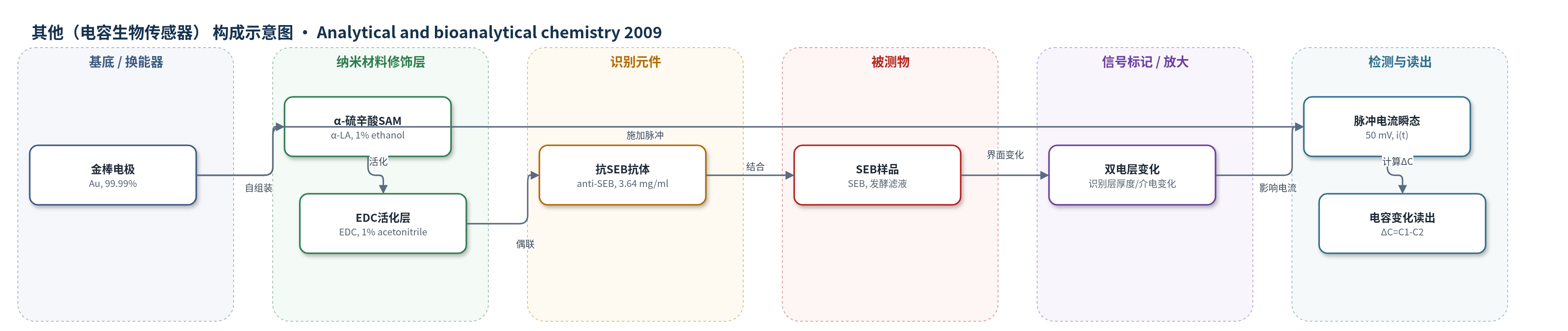
点击图片查看大图 · 依据论文自动绘制
传感器类型
其他(电容生物传感器)
检测对象
金黄色葡萄球菌肠毒素B(staphylococcal enterotoxin B, SEB);样品基质:金黄色葡萄球菌发酵滤液及其纯化样品、缓冲液标准品
检测原理
该传感器采用无标记电容检测。金电极表面经α-硫辛酸自组装单分子层和EDC活化后,共价固定抗SEB抗体,并用1-十二硫醇封闭。当SEB与固定抗体结合时,识别层厚度、介电性质和界面电阻发生变化,从而改变电极/溶液双电层总电容。系统以10 mM PB(pH 7.4)为流动相,每隔1 min向工作电极施加50 mV电位脉冲,记录电流瞬态i(t)=u/Rs exp(−t/RsC);通过ln(i)对t线性拟合获得Rs和C。进样前后分别取最后5 min电容平均值C1和C2,ΔC=C1−C2随SEB浓度升高而增大,在2.8 pg/mL至2.8 ng/mL内与SEB浓度对数呈线性。响应时间约10 min,无需酶或荧光标记放大。
检测灵敏度
LOD: 0.3 pg ml−1;线性范围: 2.8 pg ml−1–2.8 ng ml−1;回归方程: ΔC (nanofarads)=0.2648×log (SEB concentration in picograms per milliliter)+0.7657;相关系数: 0.9565
效应效果
该传感器与ELISA参考方法在粗滤液及三步纯化样品中SEB测定结果一致良好,但结果略高,作者归因于抗体非特异性结合;ELISA经12次洗涤可抑制该效应。ELISA线性范围1.6–25 ng/mL,R²=0.9989,RSD 2.8%–4.8%;电容传感器RSD 3.4%–12.5%。表面经25 mM glycine/HCl(pH 2.4)再生后电容无显著下降,可重复使用并连续运行数小时。其LOD 0.3 pg/mL优于多数方法,但低于PEMC(2.5 fg/mL)和间接双夹心荧光酶联免疫分析(0.1 fg/mL),适合发酵废物流在线监测及法医、污染恢复中痕量SEB检测。
传感器的构成
- 基底/换能器电极:金棒电极(gold rod electrode,∅3 mm,99.99% purity),作为电容换能器的工作电极
- 自组装单分子层:α-硫辛酸(α-lipoic acid,α-LA,1% in absolute ethanol)自组装于金表面,提供羧基连接位点
- 活化层:EDC(N-(3-dimethylaminopropyl)-N'-ethyl-carbodiimide hydrochloride,1% in dry acetonitrile)活化羧基,用于抗体共价偶联
- 识别元件:抗SEB多克隆抗体(anti-SEB,rabbit polyclonal antibody,3.64 mg ml−1)固定于电极表面,特异性结合SEB
- 封闭层:1-十二硫醇(1-dodecanethiol,10 mM in ethanol)封闭非特异性吸附位点
- 流动注射系统:流动池(flow cell)、蠕动泵(peristaltic pump)和0.25 ml进样环,以10 mM PB(pH 7.4)为流动相,流速0.1 ml min−1
- 再生剂:25 mM glycine/HCl buffer(pH 2.4),用于每次进样后再生传感表面
中文摘要
本文报道了一种用于检测金黄色葡萄球菌肠毒素B(SEB)的流动注射电容生物传感器。SEB 从金黄色葡萄球菌粗培养滤液中经三步层析纯化:前两步为离子交换层析,最后一步为凝胶过滤层析,各步回收率分别为88%、74%和12%。采用高碘酸盐法制备辣根过氧化物酶标记抗SEB抗体,并用于夹心酶联免疫吸附试验(ELISA),测定纯化过程中不同样品中的SEB浓度。在优化条件下,电容生物传感器可检测低至0.3 pg/mL的SEB,线性范围为2.8 pg/mL至2.8 ng/mL,响应时间约10 min。该传感器与ELISA参考方法在多种纯化样品中的SEB测定结果一致良好。新传感器具有结构简单、灵敏度高和可重复使用等优点。
英文摘要
A sensitive method for the detection of staphylococcal enterotoxin B (SEB) using a flow-injection capacitive biosensor is presented. SEB was purified from a crude culture filtrate of Staphylococcus aureus through three chromatographic steps. The first two steps were based on ion-exchange chromatography, and the last step was carried out on a gel filtration column. The SEB recovery values after the purification stages were 88%, 74%, and 12%, respectively. A horseradish peroxidase labeled antistaphylococcal enterotoxin B was prepared by the periodate method and was further employed in a sandwich-enzyme-linked immunosorbent assay (ELISA) for the determination of SEB concentrations in different samples obtained during the processing of the crude filtrate. The capacitive biosensor could detect SEB concentrations as low as 0.3 pg ml(-1) with a linearity ranging from 2.8 pg ml(-1) to 2.8 ng ml(-1) under optimized conditions. The response time was about 10 min. A good agreement was achieved between the developed capacitive biosensor system and ELISA as a reference method for detection of SEB levels in different purification samples. The newly developed sensor has the benefits of simplicity, high sensitivity, and multiple use capability.