组成图示
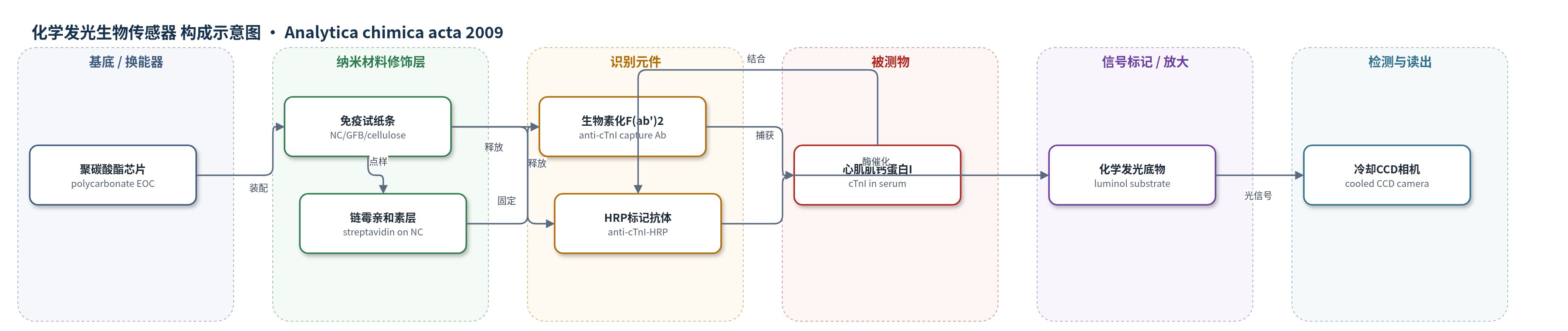
点击图片查看大图 · 依据论文自动绘制
传感器类型
化学发光生物传感器
检测对象
心肌肌钙蛋白I(cardiac troponin I, cTnI);样品基质:人血清(human serum,阴性血清加标)
检测原理
样品加入EOC后沿免疫试纸条垂直层析,生物素化抗cTnI F(ab')2迁移至NC膜上的链霉亲和素层并被固定,样品中cTnI被捕获;HRP标记抗cTnI抗体同时层析并与cTnI形成夹心免疫复合物。随后水平流加入HRP化学发光底物(luminol类),HRP催化底物氧化发光,发射约425 nm光。发光峰面积与cTnI浓度成正比。冷却CCD在暗室中成像,图像数字化为光密度并积分峰面积定量。生物素-链霉亲和素捕获增强复合物固定和信噪比,酶催化提供信号放大,交叉流色谱使结合与发光反应顺序进行,无需洗脱。
检测灵敏度
LOD: 0.027 ng mL−1;线性范围: 0.1–100 ng mL−1(logit–log线性化)
效应效果
优化后EOC对人血清加标cTnI的LOD为0.027 ng/mL,较胶体金快速试纸(0.82 ng/mL)提高约30倍;logit–log线性化动态范围0.1–100 ng/mL,三次重复变异<16%。加底物后30 s成像定量,比相同HRP比色底物约5 min更快。质控线恒定,可监控反应一致性。与未用生物素-链霉亲和素捕获的比色EOC相比,化学发光EOC灵敏度约高3倍;若均用捕获技术则相当。作者称其优于荧光微珠(约0.04 ng/mL)和磁性颗粒(约0.5 ng/mL)POCT系统,且此前与Beckman Coulter Access临床系统高度相关,适合低成本即时检测。
传感器的构成
- 芯片基底:聚碳酸酯(polycarbonate)上下板,注塑成型,形成垂直/水平流道、样品孔、底物孔和监测窗,无胶组装。
- 免疫试纸条:玻璃纤维膜(GFB-R4)样品垫、玻璃纤维膜(PT-R5)抗体释放垫、硝酸纤维素膜(NC)信号生成垫、纤维素膜(17 CHR)吸收垫,实现层析传递。
- 捕获识别元件:生物素化F(ab')2(biotinylated F(ab')2,抗cTnI抗体BD clone 12)负载于释放垫,迁移至NC膜捕获cTnI。
- 固定捕获层:链霉亲和素(streptavidin, 7 mg/mL)点样于NC膜,通过生物素-链霉亲和素结合固定捕获抗体;山羊抗小鼠IgG(goat anti-mouse IgG)作质控线。
- 检测标记元件:HRP标记抗cTnI单克隆抗体(clone 19C7-HRP)负载于释放垫,与cTnI形成夹心复合物。
- 发光底物:HRP化学发光底物(SuperSignal West Femto,含luminol)经水平流加入,催化产生425 nm光。
- 读出装置:冷却CCD相机(cooled CCD camera)暗室成像,图像分析转换为光密度(OD)定量。
中文摘要
开发了一种用于即时检测的化学发光生物传感器系统,采用免疫层析法结合辣根过氧化物酶(HRP)示踪酶,产生可用简单探测器测量的光信号。利用交叉流色谱实现抗原-抗体结合与信号生成的顺序进行。酶联免疫吸附测定(ELISA)在重新设计以简化制备的塑料芯片上进行。为提高灵敏度,采用生物素-链霉亲和素捕获技术制备免疫试纸条并装入芯片,形成芯片ELISA(EOC)生物传感器。用EOC分析含心肌肌钙蛋白I(cTnI)的样品。向芯片上与被测物结合的示踪酶加入发光底物,产生与浓度成正比的化学发光信号。发光信号在装有冷却电荷耦合器件(CCD)的暗室中检测,并转换为光密度定量。该EOC系统可检测血清中低至0.027 ng/mL的cTnI,比使用胶体金示踪的传统快速试纸低30倍。此外,加入酶底物后30 s内即可获得最终数据,比使用相同示踪酶的比色底物检测更快。
英文摘要
A chemiluminometric biosensor system for point-of-care testing has been developed using an immuno-chromatographic assay combined with an enzyme (e.g., horseradish peroxidase) tracer that produces a light signal measurable on a simple detector. Cross-flow chromatography, a method previously investigated by our laboratory, was utilized in order to accomplish sequential antigen-antibody binding and signal generation. This enzyme-linked immunosorbent assay (ELISA) was effectively carried out on a plastic chip that was redesigned to simplify the fabrication process. To enhance the sensitivity, biotin-streptavidin capture technology was employed in preparing an immuno-strip that was then incorporated onto the chip in order to generate the ELISA-on-a-chip (EOC) biosensor. Samples containing cardiac troponin I (cTnI) were analyzed using the EOC. A chemiluminescent signal proportional to the analyte concentration was produced by adding a luminogenic substrate to the tracer enzyme complexed with the analyte on the chip. The luminescent signal was detected in a dark chamber mounted with a cooled charge-coupled device and the signal was converted to optical density for quantification. This EOC biosensor system was capable of detecting cTnI present in serum at concentrations as low as 0.027 ng mL(-1), 30 times lower than those measured using the conventional rapid test kit with colloidal gold as the tracer. In addition, the final data was acquired within 30s after the addition of the enzyme substrate, which was faster than the detection time required when using a colorimetric substrate with the same tracer enzyme.