组成图示
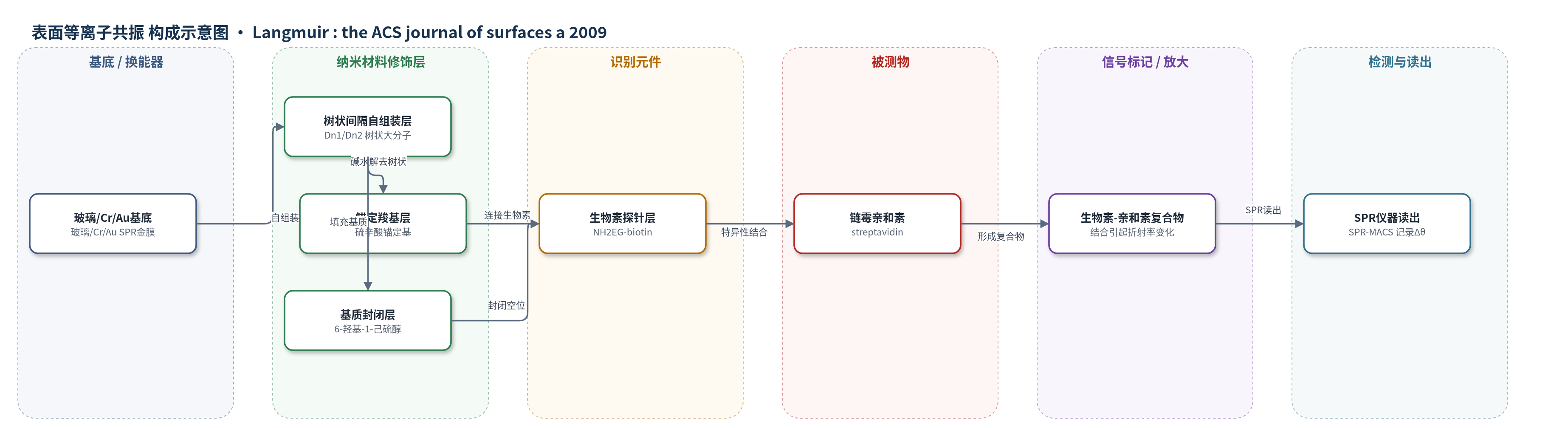
点击图片查看大图 · 依据论文自动绘制
传感器类型
表面等离子共振(SPR)生物传感器
检测对象
链霉亲和素(streptavidin),样品基质为 PBS 缓冲液(0.1 mol/L,pH 7.4)
检测原理
该传感器基于生物素与链霉亲和素的高亲和特异性结合,并以 SPR 作为光学换能机制。金表面先自组装含树状间隔基的硫辛酸锚定分子,树状分支的位阻决定锚定基间距;碱处理去除树状分支后,保留间距受控的羧基锚定基,并用 6-羟基-1-己硫醇封闭空位。随后 NHS/EDC 活化羧基并连接 NH2EG-生物素探针。当 PBS 中链霉亲和素流过表面时,生物素探针捕获目标蛋白,形成生物素-链霉亲和素复合物;结合事件增加金膜界面质量与折射率,使 SPR 共振角 Δθ 增大。冲洗去除非特异结合后,Δθ 的饱和值反映捕获量。由于探针间距优化可降低小尺寸生物素探针之间的位阻,提高每个生物素对大尺寸链霉亲和素的结合效率,因此信号随目标浓度增加而增强。
检测灵敏度
原文未报告 LOD、线性范围、灵敏度斜率或 R^2。
效应效果
在 PBS(0.1 mol/L,pH 7.4)中注入 100 µg/mL 链霉亲和素,流速 15 µL/min,结合约 5 min 达到饱和,PBS 冲洗 15 min 后读取 SPR 信号。XPS 显示 Dn2 树状间隔表面的生物素相对浓度与 10% 硫辛酸混合单分子层相近,但 Dn2 表面的总链霉亲和素结合量比 10% 硫辛酸表面高约 40%;按每个生物素计,Dn2 表面结合效率最高。混合单分子层中生物素浓度越低,结合量越低。6-羟基-1-己硫醇封闭层有助于减少非特异吸附,但论文未报告 RSD、长期稳定性或实际样品回收率。作者认为该方法可优化探针间距,提高蛋白捕获效率,适用于微纳阵列和 SPR 生物传感器界面制备。
传感器的构成
- 基底/换能器电极:玻璃基底上蒸镀 Cr(5 nm)/Au(50 nm),作为 SPR 金膜换能器。
- 自组装间隔层:Dn1/Dn2 树状大分子(Frechet 型苄基醚树状分支与硫辛酸锚定基,碱不稳定酯键),自组装控制锚定基间距。
- 锚定/功能化层:碱水解去除树状分支后暴露硫辛酸羧基,作为后续连接生物素的反应位点。
- 基质封闭层:6-羟基-1-己硫醇(6-hydroxy-1-hexanethiol)填充空位并覆盖无探针区域,减少非特异吸附。
- 活化层:NHS 与 EDC 将羧基活化为 NHS 酯,用于与氨基生物素反应。
- 识别元件:NH2EG-生物素(3,6-二氧杂-8-氨基-辛烷-1-N-生物素酰胺)通过酰胺键连接,作为探针。
- 信号读出:链霉亲和素(streptavidin)结合生物素后改变金膜界面折射率,由 SPR 仪记录共振角变化 Δθ。
中文摘要
本文报道利用可断裂树状间隔基控制表面修饰探针分子间距的方法。首先将带有树状修饰基的锚定分子吸附到金表面,大体积树状分支的位阻作用决定锚定分子在表面的密度;随后通过碱处理使树状分支从锚定分子上脱离,再将锚定基化学修饰为探针分子,从而获得探针间距受控的表面。当探针分子尺寸远小于目标分子时,这种间距控制尤为重要。作者以生物素探针表面捕获链霉亲和素蛋白为模型,评估探针空间控制对目标捕获效率的影响,并制备一系列混合单分子层进行对比。表面修饰过程采用傅里叶变换红外反射吸收光谱(FTIR-RAS)监测,表面探针相对浓度采用 X 射线光电子能谱(XPS)测定。结果表明,经优化间距的硫代生物素表面相比间距非最优或未受控表面,在表面等离子共振(SPR)检测中表现出更高的链霉亲和素捕获效率。该结果对化学与生化测量中微纳阵列的优化和制备具有潜在意义。
英文摘要
In this paper we demonstrate control over the spacing of surface-modifying probe molecules through the use of labile dendron spacers. During this process, anchor molecules are first adsorbed to a surface, with dendron modifiers attached. Steric interactions of the bulky dendrons control the density of anchor molecules bound to the surface. The dendron branches are subsequently detached from the anchor molecules, and the anchors are chemically modified with probe molecules, resulting in a surface with controlled spacing between probe molecules. Control over this spacing is important when the probe size is small in comparison with the target molecule. This importance is demonstrated for the binding of protein (streptavidin) targets to the probe (biotin) surface. The effect of probe space control on the efficiency of target capture is evaluated by examining the binding of streptavidin to thiolated biotin for a series of mixed monolayers. Surface modification is monitored by Fourier transform infrared reflection absorption spectroscopy (FTIR-RAS). The relative concentration of probe molecules at the surface is measured using X-ray photoelectron spectroscopy (XPS) measurements. Thiolated-biotin surfaces with optimized spacing show an increased capture efficiency for streptavidin relative to surfaces with nonoptimal or no control over probe spacing, as measured by surface plasmon resonance (SPR) spectroscopy. These results are of potential significance for the optimization and fabrication of micro- and nanoarrays used in chemical and biochemical measurements.