组成图示
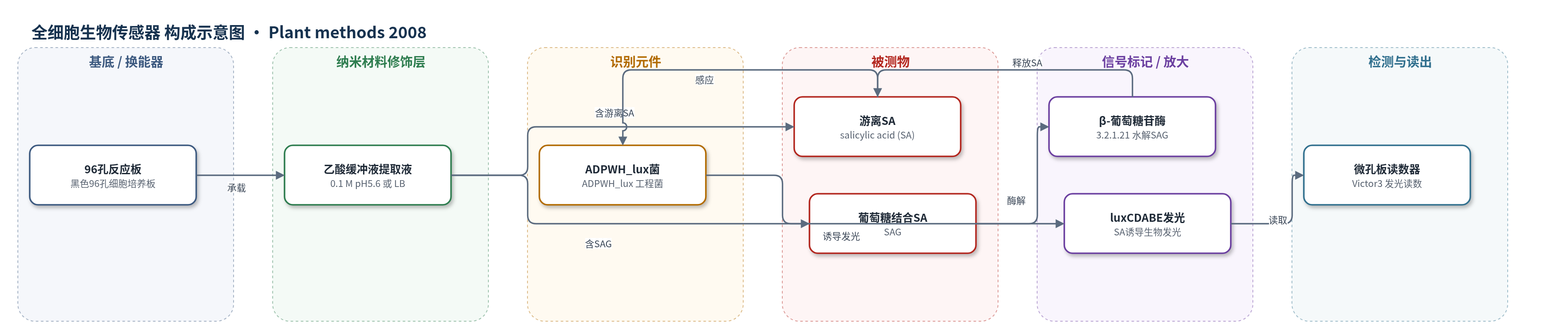
点击图片查看大图 · 依据论文自动绘制
传感器类型
全细胞生物传感器
检测对象
水杨酸(salicylic acid, SA)、葡萄糖结合态水杨酸(salicylic acid 2-O-β-D-glucoside, SAG);样品基质:植物粗提取物(乙酸缓冲液或 LB 提取液,如拟南芥叶片)
检测原理
植物粗提取物中的游离 SA 直接进入 Acinetobacter sp. ADPWH_lux 菌内,被 SA 感应调控系统识别,诱导染色体整合的 luxCDABE 发光操纵子表达。luxCDABE 操纵子提供发光所需的底物与催化酶,产生 SA 响应生物发光;在一定范围内发光强度随 SA 浓度升高而增强,通过以植物提取物为基质的 SA 标准曲线换算浓度。SAG 本身不诱导发光,先在 0.1 M 乙酸缓冲液(pH 5.6)中用 β-葡萄糖苷酶水解为游离 SA 和葡萄糖,再按游离 SA 检测,从而得到 SA+SAG。该方法无需有机溶剂提取、蒸发和色谱纯化,可在复杂植物提取物中直接检测;高浓度时响应下降,需分段标准曲线或稀释。
检测灵敏度
LOD: 0.28 μg SA/g FW;有效范围: 1.6–64 ng SA(0.28–11 μg SA/g FW);R^2 = 0.9777(SA 随组织质量);R^2 = 0.9926(SA+SAG 随组织质量)
效应效果
该方法对 12 种结构类似物无发光响应,显示较好选择性。改进提取法测得 Psm ES4326 感染拟南芥 SA 为 3.50 ± 0.89 μg/g FW,与原方法 3.1 ± 0.73 μg/g FW 相近;SA 和 SA+SAG 随组织质量线性增加,R^2 分别为 0.9777 和 0.9926。与 GC/MS 相比,生物传感器法检测的 SA 更高,加标样品中更接近加入量,且两者均随浓度线性增加;时间动态中游离 SA 在 12 hpi 最高,SA+SAG 在 24 hpi 最高。野生型感染后 SA 约为 sid2 的 6 倍,SA+SAG 约为 40 倍,SA+SAG 约为 SA 的 10 倍。方法标准差为均值的 15%–25%,最低检测约 0.28 μg/g FW;约 50 个样品可在 5.0 h 内完成,适合高通量 SA 代谢研究。
传感器的构成
- 反应容器:黑色 96 孔细胞培养板,承载样品、菌液并适配微孔板读数。
- 样品基质:乙酸缓冲液(0.1 M,pH 5.6)或 LB 植物粗提取物,提供 SA/SAG 并作为反应介质。
- 传感细胞:Acinetobacter sp. ADPWH_lux 工程菌,作为全细胞识别与换能单元。
- 识别元件:菌内 SA 感应调控系统,响应 SA 并启动发光操纵子,不响应 SAG。
- 信号元件:染色体整合的 salicylate-inducible luxCDABE 操纵子,产生 SA 响应生物发光。
- 水解酶:β-葡萄糖苷酶(3.2.1.21,Sigma-Aldrich),将 SAG 水解为游离 SA 和葡萄糖。
- 标准品:SA 标准品,溶于 LB 或乙酸缓冲液并稀释于植物提取物,用于标准曲线。
- 读出设备:Victor3 PerkinElmer 多检测微孔板读数器,测量发光强度。
中文摘要
水杨酸(SA)是植物抵御生物营养型病原菌的重要信号分子,也参与产热、开花和萌发等过程。植物体内 SA 以游离态和生物惰性的葡萄糖结合态(水杨酸 2-O-β-D-葡萄糖苷,SAG)存在。Huang 等开发了仅响应游离 SA 而不响应 SAG 的细菌生物传感器 Acinetobacter sp. ADPWH_lux。本文基于该传感器建立了改进的游离 SA 定量方法,实现高通量分析,并提出从植物粗提取物中定量 SAG 的方法。作者优化了提取与定量流程:先用 β-葡萄糖苷酶处理粗提取物,再用生物传感器测定释放的游离 SA。乙酸缓冲液提取液中酶解释放的 SA 多于 LB 提取液,且酶解比酸解释放更多游离 SA。该方法在病原菌感染植物中检测到的 SA 高于 GC/MS 法,并在野生型与 sid2 突变体中验证了有效性。方法可检测低至 0.28 μg SA/g FW,样品标准差最高约为均值的 25%。该策略简单、快速、低成本,可同时测定游离和葡萄糖结合态 SA,适用于 SA 代谢研究、动态变化分析和突变体筛选。
英文摘要
BACKGROUND: Salicylic acid (SA) is an important signalling molecule in plant defenses against biotrophic pathogens. It is also involved in several other processes such as heat production, flowering, and germination. SA exists in the plant as free SA and as an inert glucose conjugate (salicylic acid 2-O-beta-D-glucoside or SAG). Recently, Huang et al. developed a bacterial biosensor that responds to free SA but not SAG, designated as Acinetobacter sp. ADPWH_lux. In this paper we describe an improved methodology for Acinetobacter sp. ADPWH_lux-based free SA quantification, enabling high-throughput analysis, and present an approach for the quantification of SAG from crude plant extracts.
RESULTS: On the basis of the original biosensor-based method, we optimized extraction and quantification. SAG content was determined by treating crude extracts with beta-glucosidase, then measuring the released free SA with the biosensor. beta-glucosidase treatment released more SA in acetate buffer extract than in Luria-Bertani (LB) extract, while enzymatic hydrolysis in either solution released more free SA than acid hydrolysis. The biosensor-based method detected higher amounts of SA in pathogen-infected plants than did a GC/MS-based method. SA quantification of control and pathogen-treated wild-type and sid2 (SA induction-deficient) plants demonstrated the efficacy of the method described. Using the methods detailed here, we were able to detect as little as 0.28 mug SA/g FW. Samples typically had a standard deviation of up to 25% of the mean.
CONCLUSION: The ability of Acinetobacter sp. ADPWH_lux to detect SA in a complex mixture, combined with the enzymatic hydrolysis of SAG in crude extract, allowed the development of a simple, rapid, and inexpensive method to simultaneously measure free and glucose-conjugated SA. This approach is amenable to a high-throughput format, which would further reduce the cost and time required for biosensor-based SA quantification. Possible applications of this approach include characterization of enzymes involved in SA metabolism, analysis of temporal changes in SA levels, and isolation of mutants with aberrant SA accumulation.