组成图示
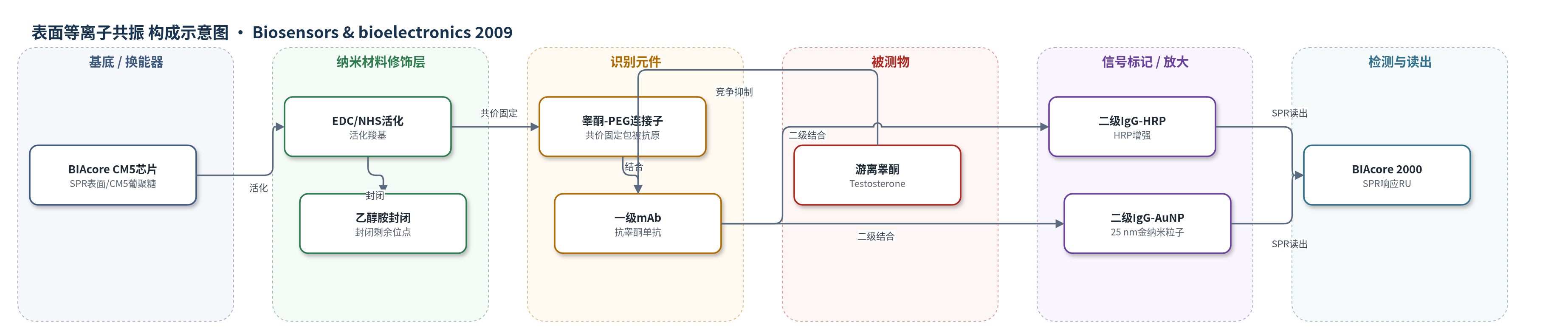
点击图片查看大图 · 依据论文自动绘制
传感器类型
表面等离子共振(SPR)生物传感器
检测对象
睾酮(testosterone,T);样品基质:运行缓冲液(HBS-EP)、脱除内源激素的人唾液(stripped human saliva)
检测原理
该传感器采用竞争式SPR免疫检测。睾酮-寡聚乙二醇连接子偶联物经EDC/NHS共价固定于CM5葡聚糖SPR表面,作为包被抗原。样品中抗睾酮单克隆一级抗体(mAb)与表面固定睾酮结合;游离睾酮与mAb竞争,使表面结合mAb减少。随后加入抗小鼠IgG二级抗体,其偶联HRP或25 nm金纳米粒子(AuNP),在mAb上形成二级结合,显著增加界面结合质量;AuNP还可与SPR发生等离子体耦合,进一步放大响应。SPR通过监测金膜表面折射率变化输出响应单位(RU),信号随睾酮浓度升高而下降。PEG/白蛋白用于稳定金胶体并降低唾液非特异结合。
检测灵敏度
LOD: 3.7 pg ml−1(buffer, primary Ab);LOD: 23 pg ml−1(buffer, gold);LOD: 15.4 pg ml−1(stripped saliva, gold);线性范围: 25 to 250 pg ml−1;灵敏度: 122 RU ml/ng;R^2 = 0.9992
效应效果
该表面经共价固定后稳定超过330次结合/再生循环,类似表面可超过1100次,适合高通量复用。金纳米增强使信号灵敏度较一级抗体单独使用提高12.5倍;降低金胶体稀释度可使非特异结合下降38%。缓冲液中一级抗体格式LOD 3.7 pg/ml,CV 3.9%;金增强格式LOD 23 pg/ml,线性范围25–250 pg/ml,灵敏度122 RU ml/ng。脱除激素人唾液中,未增强LOD升至36 pg/ml,金增强为66 pg/ml;降低一级抗体并加白蛋白后LOD达15.4 pg/ml,可覆盖男性唾液生理范围29–290 pg/ml,单样品<13 min。相比RIA/ELISA,该方法快速、低耗、可近实时监测。
传感器的构成
- 基底/换能器:BIAcore 2000 CM5 芯片(SPR 表面,羧甲基葡聚糖 CM5 层)
- 活化/封闭层:EDC/NHS 活化羧基,乙醇胺封闭剩余活性位点
- 固定抗原层:睾酮-寡聚乙二醇连接子偶联物(testosterone–oligoethylene glycol linker conjugate)共价固定,作为包被抗原
- 识别元件:抗睾酮单克隆一级抗体(mAb),与游离睾酮竞争结合表面固定抗原
- 信号标记物:抗小鼠 IgG 二级抗体偶联 HRP 或 25 nm 金纳米粒子(IgG–HRP / IgG–AuNP)
- 稳定/抗非特异组分:PEG-400/PEG-4000 稳定金胶体并降低非特异结合;唾液实验中一级抗体稀释液加入白蛋白(albumin)
- 运行/再生介质:HBS-EP 运行缓冲液(HEPES、缓冲盐水、EDTA、Tween-20);20% 乙腈/50 mM NaOH 再生
中文摘要
合成了一种理性设计的睾酮寡聚乙二醇连接子偶联物,并共价固定于表面等离子共振(SPR)生物传感器表面。传感表面可稳定经历超过330次结合与再生循环,具有较高重复使用性。基于该表面,开发了用于缓冲液中睾酮的超灵敏免疫生物传感器系统,同时采用二级抗体和金纳米粒子信号增强。灵敏度提高源于结合质量增加及金等离子体耦合效应。与仅用一级抗体相比,连接金纳米粒子的二级抗体使检测信号灵敏度提高12.5倍。增强格式下,运行缓冲液标准品检出限为3.7 pg/mL,脱除内源激素的人唾液基质中为15.4 pg/mL。该免疫生物传感器系统具有足够灵敏度,可在13 min内覆盖男性唾液中睾酮的宽生理相关范围(29–290 pg/mL),实现近实时监测。
英文摘要
A rationally designed oligoethylene glycol linker conjugate to testosterone was synthesised and covalently immobilized on a surface plasmon resonance (SPR) biosensor surface. The sensing surface was stable for more than 330 binding and regeneration cycles allowing a high degree of re-use. This surface was then used in the development of an ultrasensitive immunobiosensor system for testosterone in buffer utilizing both secondary antibody and gold nanoparticle signal enhancement. The mechanism for the increased sensitivity results from increased binding mass and a gold plasmon coupling effect. The addition of a secondary antibody with an attached gold nanoparticle increased the signal sensitivity of the assay 12.5-fold compared with primary antibody alone. In the enhanced format the assay had limits of detection (LOD) of 3.7 pgml(-1) with standard in running buffer, and 15.4 pgml(-1) in a stripped human saliva matrix. This immunobiosensor system has sufficient sensitivity to measure testosterone across the broad physiologically relevant range in male saliva (29-290 pgml(-1)) in under 13 min allowing monitoring of testosterone in near real-time.