组成图示
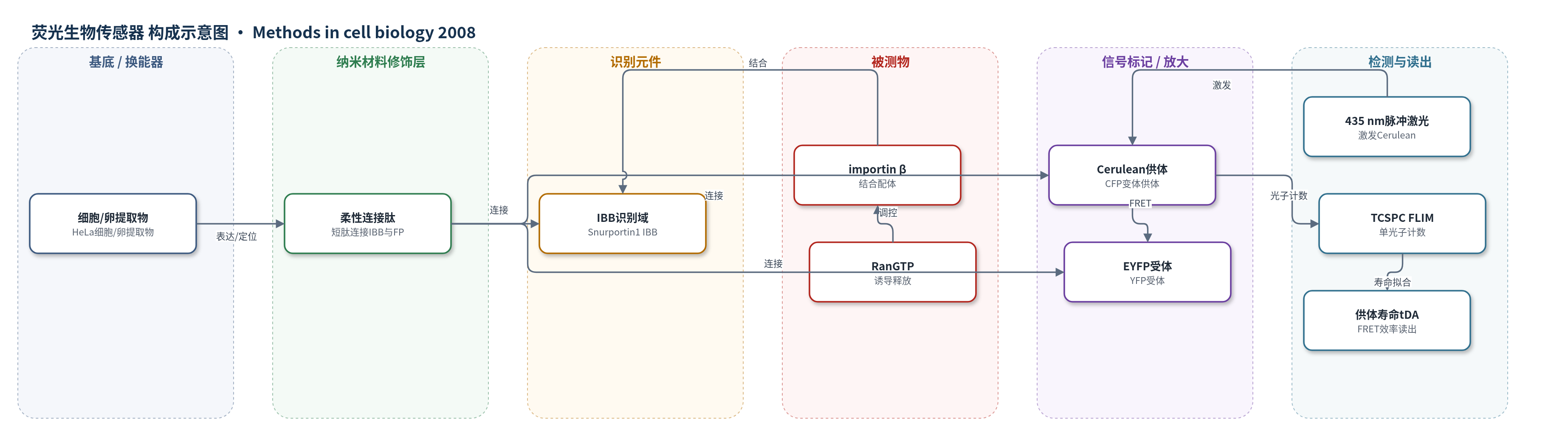
点击图片查看大图 · 依据论文自动绘制
传感器类型
荧光生物传感器
检测对象
importin β(Importin β,结合/释放状态)、RanGTP 梯度(间接读出);样品基质:HeLa 活细胞、Xenopus laevis 卵提取物
检测原理
Rango 由 Cerulean 供体、IBB 识别域和 EYFP 受体串联组成。游离态 Rango 中供体与受体距离较近,FRET 效率高,Cerulean 荧光寿命 tDA 较短;当 IBB 结合 importin β 后,识别域伸展,供体-受体距离增大,FRET 效率下降,tDA 延长。RanGTP 与 importin β 结合后置换 IBB,使 Rango 从 importin β 释放,游离 Rango 比例升高,供体寿命进一步变化。FLIM 通过 TCSPC 测量每个像素的供体寿命衰减,利用体外 importin β 滴定获得的剂量-响应曲线(Kd = 2 nM)将 tDA 转换为结合/游离分数,从而定量反映 RanGTP 梯度调控的 importin β 货物释放。
检测灵敏度
原文未报告LOD、线性范围、灵敏度斜率或R^2;Kd = 2 nM。
效应效果
Rango 与 importin β 的结合具有高度特异性,并可用光谱分析、强度比成像、受体光漂白和生化实验交叉验证。相比 ECFP 基传感器,Cerulean-EYFP 的 Rango 在转染或显微注射的有丝分裂细胞中耐受性更好,FLIM 信号更稳健、空间分辨更高。体外校准得到 Kd = 2 nM;在 Xenopus 卵提取物中,平衡态约 40% Rango 与 importin β 结合,扰动响应与计算模型在较宽浓度范围内一致。HeLa 有丝分裂细胞中,细胞边缘约 68% 类似 Rango 的货物游离,染色体 RanGTP 梯度峰值处约 86% 货物释放,梯度直径与纺锤体尺寸相近,支持 RanGTP 梯度并非简单开关式调控。
传感器的构成
- 表达/成像基质:HeLa 细胞或 Xenopus laevis 卵提取物,承载 Rango 并提供 RanGTP 梯度环境
- 柔性连接肽:短肽连接 IBB 与 Cerulean/EYFP,允许结合/释放时距离变化(原文建议 GGSGGS 类短肽)
- 识别元件:Snurportin 1 的 importin β 结合域(IBB),特异性结合 importin β
- 供体荧光蛋白:Cerulean(CFP 变体),作为 FRET 供体,其荧光寿命随受体距离变化
- 受体荧光蛋白:EYFP,作为 FRET 受体,接受供体能量并改变供体寿命
- 信号读出:TCSPC FLIM 测量 Cerulean 荧光寿命 tDA
中文摘要
理解细胞功能常需对复杂胞内通路进行定量描述。荧光寿命成像显微镜(FLIM)结合 Förster 共振能量转移(FRET)分子生物传感器的发展,使活细胞内生化活性的精确测量成为可能。本文讨论如何将定量活体成像与体外生化表征相结合,建立用于模拟生化网络行为的计算系统模型,并以有丝分裂纺锤体组装中 Ran GTPase 功能的计算建模为例加以说明。围绕染色体的 RanGTP 浓度梯度可诱导纺锤体组装因子(SAF)梯度,其机制是 RanGTP 促使 SAF 从 importin β 抑制复合物中释放。为在活细胞中可视化激活态 SAF 梯度,作者利用 FLIM 检测 FRET 生物传感器 Rango 的信号,该传感器报告其受 RanGTP 诱导从 importin β 释放的状态。文章还综述了 FRET/FLIM 的技术要点,并阐述了在定量成像辅助下逐步构建系统模型的策略。有丝分裂 Ran 梯度研究表明,计算模拟是检验生物学功能新假设的有力工具。
英文摘要
The understanding of cell function often requires that complex intracellular pathways are considered in quantitative terms. The access to precise measurement of activities in live cells is increasingly provided by the advances in fluorescence lifetime imaging microscopy (FLIM) of Förster (or fluorescence) resonance energy transfer (FRET)-based molecular biosensors. We discuss how quantitative in vivo imaging can be combined with in vitro biochemical characterization to develop computational systems models simulating the behavior of biochemical networks. We describe the application of such approach in computational modeling of the Ran GTPase function in mitotic spindle assembly. The RanGTP concentration gradient surrounding mitotic chromosomes induces the formation of a gradient of spindle assembly factors (SAFs) activated by RanGTP-induced release from inhibitory complexes of SAFs with importin beta. To visualize the gradient of activated SAFs in live cells, we used FLIM to detect the signal of a FRET-based biosensor that reports its RanGTP-induced liberation from importin beta. We review the technical aspects of FRET measurements by FLIM and discuss the step-wise design of systems models aided by quantitative imaging. As evidenced by the example of mitotic Ran gradient studies, the computational simulations are a powerful tool to test new hypotheses on biological function.