组成图示
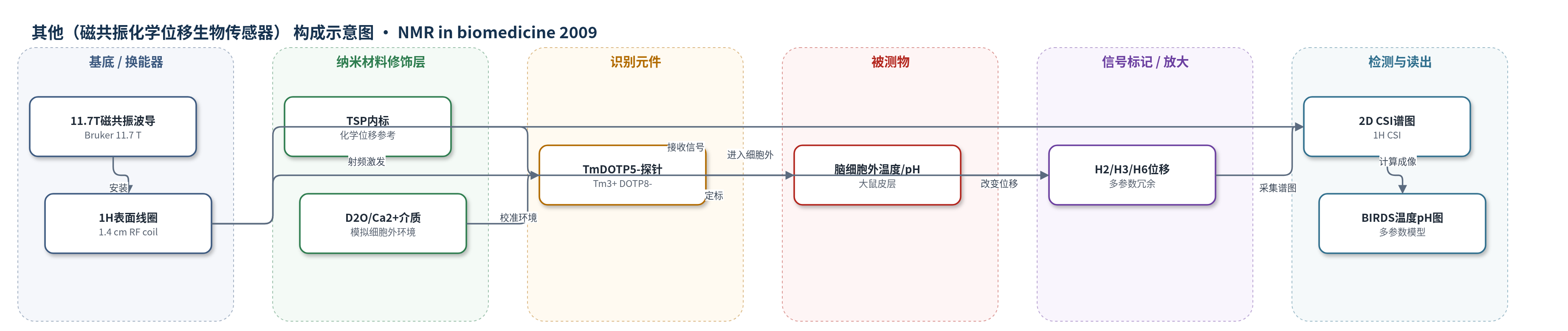
点击图片查看大图 · 依据论文自动绘制
传感器类型
其他(磁共振化学位移生物传感器)
检测对象
温度(temperature)、pH(pH);样品基质:大鼠脑组织细胞外间隙/皮层(in vivo rat brain cortex extracellular space)
检测原理
Na[TmDOTP5-]经静脉输注后主要进入大鼠脑细胞外间隙。Tm3+顺磁离子使DOTP8-配体上的H2、H3、H6质子产生超精细化学位移,且这些位移随温度和pH发生非线性变化:温度升高时H2、H3位移减小,H6位移增大;pH变化引起相反方向的位移。由于不同质子对温度和pH的依赖关系不同,形成冗余信息。1H表面线圈在11.7 T下以2D CSI采集这些质子共振,TSP用于化学位移定标。基于体外校准的BIRDS多参数模型,通过[H2,H6]与[H3,H6]两组位移组合平均解算每个体素的温度和pH,从而将生理参数转换为可成像的磁共振化学位移信号。
检测灵敏度
校准范围: 26–40 °C、pH 6.9–7.7;温度灵敏度: H1 1.27 ppm/°C、H2 -0.59 ppm/°C、H3 -0.46 ppm/°C、H6 1.00 ppm/°C;pH灵敏度: H1 -4.23 ppm/pH、H2 4.16 ppm/pH、H3 3.61 ppm/pH、H6 -3.91 ppm/pH;R(温度)=0.99978;R(pH)=0.99654
效应效果
体外双室体模(pH 7.0/7.4)在37.3±0.1 °C和30.1±0.1 °C下,计算温度分别为37.2±0.3/37.0±0.3 °C和30.0±0.3/29.9±0.3 °C,pH分别为7.39±0.05/7.01±0.05和7.40±0.06/7.05±0.07,与设定值一致。体内TmDOTP5-输注2 h后稳定,总浓度4.0±0.1 mM,细胞外3.75±0.12 mM,约82%信号来自非血液区。SNR约15时温度标准差0.008 °C、pH标准差0.0013,与NAA-水(0.06 °C)和31P(0.004)方法相当或更优。皮层平均温度34.3 °C、pH 7.40,与热电偶35.4±0.8 °C、NAA-水35.2±0.4 °C和31P 7.30±0.01一致,可用于功能激活、脑冷却和肿瘤治疗监测。
传感器的构成
- 换能器/射频线圈:1H表面线圈(1.4 cm直径)置于11.7 T磁共振波导中,用于选择性激发和接收TmDOTP5-质子信号。
- 传感探针:Na[TmDOTP5-](Tm3+与DOTP8-大环螯合物),静脉输注后主要分布于脑细胞外间隙,其H2、H3、H6质子化学位移同时依赖温度和pH。
- 校准内标:TSP(3-(三甲基硅基)丙酸-2,2,3,3-d4)作为化学位移参考,用于谱图定标。
- 校准介质:含10% D2O和1 mM Ca2+的缓冲体系,模拟体内细胞外Ca2+/TmDOTP5-比例并降低水信号。
- 信号读出:Bruker 11.7 T磁共振系统2D化学位移成像(CSI)与BIRDS多参数模型,由H2/H3/H6化学位移计算温度和pH分布。
中文摘要
温度和pH是反映生物体能量代谢的重要生理参数,但哺乳动物脑内精确、无创测量方法缺乏。本文在11.7 T磁场下证明,经静脉输注的钍基大环配合物TmDOTP5-可作为传感器,通过对其自身1H化学位移成像(CSI)并结合依赖多个质子共振的多参数模型,在大鼠脑内同时获得温度和pH分布图。该传感器主要位于细胞外间隙,其测量精度取决于CSI过程中信号稳定以及温度与pH敏感信息的冗余。钍传感器与温度方法(1H MRS的N-乙酰天冬氨酸和水、铜-康铜热电偶)及pH方法(31P MRS的无机磷酸盐和磷酸肌酸)在体外和体内研究中比较良好。双室不同pH的体模在不同环境温度下生成了精确的温度和pH分布图。α-氯醛糖麻醉并肾结扎大鼠体内结果显示皮层温度约33–34 °C、pH约7.3–7.4,与其他方法一致。结果表明,基于BIRDS的钍传感器可在大鼠脑内同时、准确测量温度和pH分布。
英文摘要
Temperature and pH are two of the most important physiological parameters and are believed to be tightly regulated because they are intricately related to energy metabolism in living organisms. Temperature and/or pH data in mammalian brain are scarce, however, mainly because of lack of precise and non-invasive methods. At 11.7 T, we demonstrate that a thulium-based macrocyclic complex infused through the bloodstream can be used to obtain temperature and pH maps of rat brain in vivo by (1)H chemical shift imaging (CSI) of the sensor itself in conjunction with a multi-parametric model that depends on several proton resonances of the sensor. Accuracies of temperature and pH determination with the thulium sensor - which has a predominantly extracellular presence - depend on stable signals during the course of the CSI experiment as well as redundancy for temperature and pH sensitivities contained within the observed signals. The thulium-based method compared well with other methods for temperature ((1)H MRS of N-acetylaspartate and water; copper-constantan thermocouple wire) and pH ((31)P MRS of inorganic phosphate and phosphocreatine) assessment, as established by in vitro and in vivo studies. In vitro studies in phantoms with two compartments of different pH value observed under different ambient temperature conditions generated precise temperature and pH distribution maps. In vivo studies in alpha-chloralose-anesthetized and renal-ligated rats revealed temperature (33-34 degrees C) and pH (7.3-7.4) distributions in the cerebral cortex that are in agreement with observations by other methods. These results show that the thulium sensor can be used to measure temperature and pH distributions in rat brain in vivo simultaneously and accurately using Biosensor Imaging of Redundant Deviation in Shifts (BIRDS).