组成图示
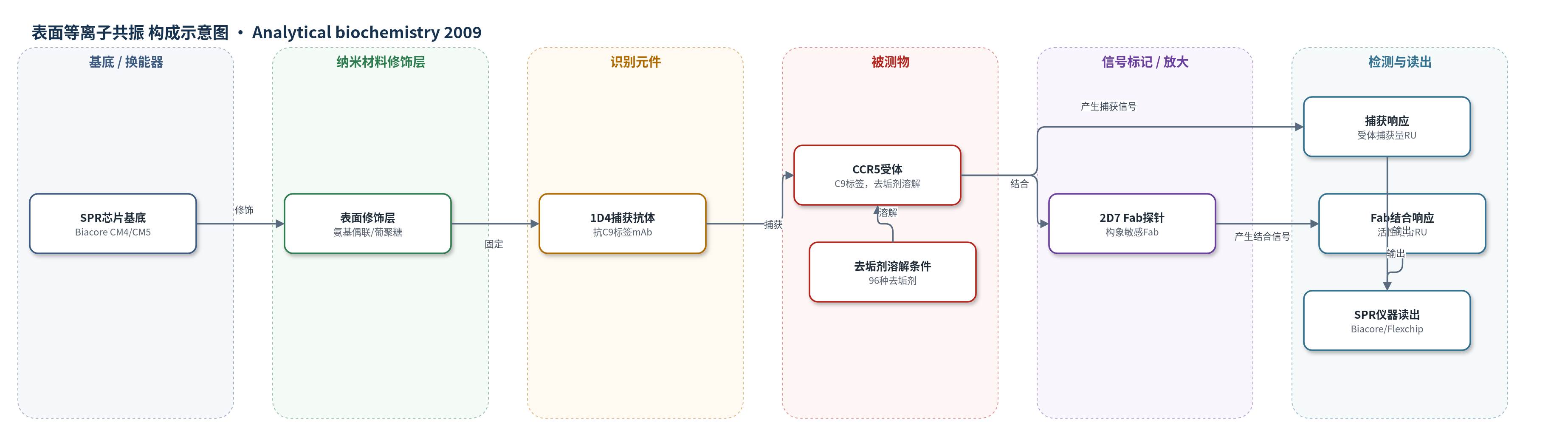
点击图片查看大图 · 依据论文自动绘制
传感器类型
表面等离子共振(SPR)生物传感器
检测对象
C9标签CCR5受体(C9-tagged CCR5)的溶解与2D7 Fab结合活性;样品基质:Cf2Th犬胸腺细胞裂解后含去垢剂的溶解上清
检测原理
该检测基于SPR实时无标记相互作用分析。1D4抗体经氨基偶联固定在SPR芯片表面,作为捕获探针;不同去垢剂溶解的C9标签CCR5流过芯片后被1D4捕获,捕获量反映去垢剂溶解效率。随后注入构象敏感2D7 Fab,只有保持天然构象的CCR5能与Fab结合,结合事件使界面质量/折射率增加,产生SPR响应(RU或mdeg)。串行平台可在线监测捕获与结合,并用1% OGPS/10 mM NaOH再生;阵列平台将96个样品离线点样捕获后同时流过Fab,用双参考校正漂移。信号强度正比于捕获受体量与活性Fab结合量,无酶放大。
检测灵敏度
LOD: approximately 5000 Da(Flexchip 阵列平台)
效应效果
串行Biacore 2000约24 h完成96孔去垢剂筛选,可在线监测受体捕获量并归一化Fab结合,但需再生且耗时;Flexchip阵列可在1 h内同时检测96个样品,避免受体活性随时间损失,适合不稳定GPCR,但离线捕获使归一化困难,灵敏度较低,分析物需>5000 Da。两种方法结果高度一致,均识别出13种有效去垢剂,其中10种为C9–C13麦芽糖苷,3种非麦芽糖苷(Cymal-6、Cymal-7、蔗糖单癸酸酯)保持活性;短链C6–C8和长链>C14麦芽糖苷无效。作者认为该方法可用于优化GPCR溶解、纯化和结晶条件。
传感器的构成
- 换能器基底:Biacore CM4/CM5 SPR芯片,提供表面等离子共振信号读出
- 表面修饰层:氨基偶联化学(amine-coupling)及Flexchip葡聚糖包被亲和芯片(dextran-coated affinity chip),用于固定1D4
- 识别/捕获元件:抗C9标签单克隆抗体1D4 mAb,特异性捕获C9标签CCR5
- 被测物/配体:C9标签CCR5(C9-tagged CCR5),以不同去垢剂溶解后捕获
- 信号探针:构象敏感2D7 Fab(100 nM),结合活性CCR5产生SPR响应
- 再生/清洗:1% OGPS/10 mM NaOH,洗脱CCR5并再生1D4表面
- 分析缓冲液:Hepes、NaCl、CHS、DDM、Chaps、DOPC/DOPS、BSA,用于结合分析
中文摘要
本文比较了两种表面等离子共振(SPR)生物传感器方法在筛选G蛋白偶联受体(GPCR)溶解条件中的优势与局限。作者以趋化因子受体CCR5为模型,利用Biacore 2000/3000/T100串行仪器和Biacore Flexchip阵列平台,评估96种去垢剂在溶解CCR5的同时是否保持其对构象敏感Fab(2D7)的结合活性。串行平台每个30 min结合循环可分析3个样品,约24 h完成96孔板筛选;在线捕获使2D7结合响应可按不同受体捕获量归一化。阵列平台可同时表征96种去垢剂,1 h内完成检测,但需离线捕获GPCR制备物,受体捕获水平归一化较困难,且灵敏度低于串行平台,分析物需大于5000 Da。两种方法高度互补,均识别出能产生活性溶解CCR5的去垢剂以及无效或使受体失活的去垢剂。
英文摘要
We describe the benefits and limitations of two biosensor approaches for screening solubilization conditions for G-protein-coupled receptors (GPCRs). Assays designed for a serial processing instrument (Biacore 2000/3000/T100) and an array platform (Biacore Flexchip) were used to examine how effectively 96 different detergents solubilized the chemokine receptor CCR5 while maintaining its binding activity for a conformationally sensitive Fab (2D7). Using the serial processing instrument, we were able to analyze three samples in each 30-min binding cycle, thereby requiring approximately 24h to screen an entire 96-well plate of conditions. In-line capturing allowed us to normalize the 2D7 binding responses for different receptor capture levels. In contrast, with the array system, we could characterize the effects of all 96 detergents simultaneously, completing the assay in less than 1h. But the current array technology requires that we capture the GPCR preparations off-line, making it more challenging to normalize for receptor capture levels. Also, the array platform is less sensitive than the serial platforms, thereby limiting the size of the analyte to larger molecules (>5000Da). Overall, the two approaches proved to be highly complementary; both assays identified identical detergents that produced active solubilized CCR5 as well as those detergents that either were ineffective solubilizers or inactivated the receptor.