组成图示
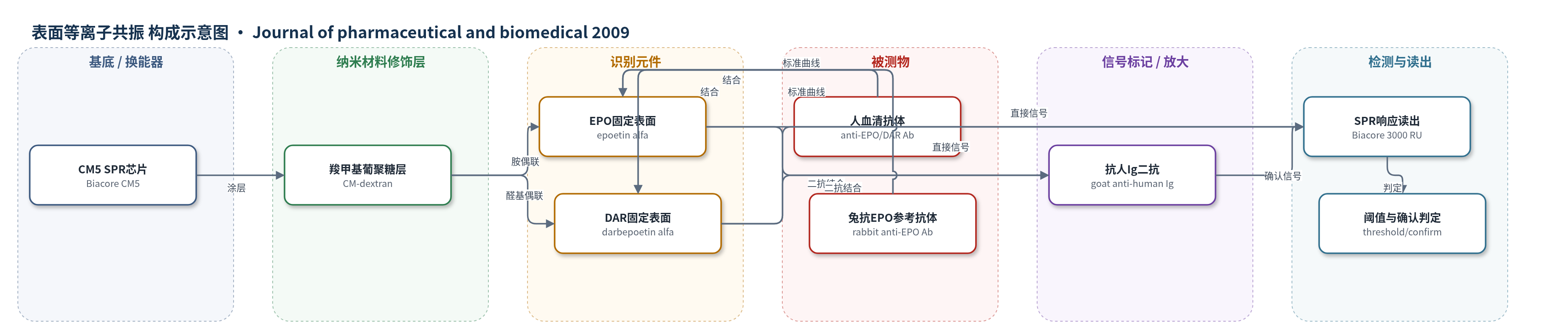
点击图片查看大图 · 依据论文自动绘制
传感器类型
表面等离子共振(SPR)生物传感器
检测对象
抗达比泊汀α(darbepoetin alfa)抗体、抗促红素α(epoetin alfa)抗体;样品基质:人血清(human serum)
检测原理
该传感器以CM5芯片上的羧甲基葡聚糖层为界面,通过EDC/NHS胺化学将epoetin alfa固定于一个流通室,通过高碘酸氧化糖基、肼/腙键化学将darbepoetin alfa固定于另一流通室。人血清中的抗EPO或抗DAR抗体与固定抗原特异性结合,使界面质量增加并改变局部折射率,SPR仪实时记录响应单位(RU)变化,RU响应随抗体浓度升高而增大。随后注入goat anti-human IgA+IgM+IgG二抗,若结合物为人免疫球蛋白则产生确认响应。样本结合超过阈值且确认响应/阴性对照中位数≥2判为阳性;兔抗EPO标准曲线用于半定量。方法无酶或核酸放大,但通过双流通室、高盐高pH降低非特异结合,并实时监测可捕获快速解离抗体。
检测灵敏度
LOD: 80 ng/ml(anti-epoetin alfa)、100 ng/ml(anti-darbepoetin alfa);线性范围: 0.078 μg/ml–10.0 μg/ml
效应效果
方法特异性高:7种人源蛋白多克隆抗体以100倍LOD加标均阴性;10倍过量可溶性EPO/DAR可抑制结合,但1和5 ng/ml谷浓度不干扰LOD检测。精密度:批内CV 0.0–19.1%(EPO)和0.1–7.6%(DAR),批间CV 4.0–16.5%(EPO)和2.9–11.2%(DAR);准确度回收率95–120%。表面可重复使用:EPO面245循环、DAR面97循环,每芯片约80样本。可检测IgG、IgM、IgE、IgA及快速解离抗体(40 min损失>68%)。相比ELISA(1 ng/ml)和RIP(8 ng/ml),SPR能同时检测双靶、确认人抗体并表征解离率,作者认为适用于抗ESA抗体监测与PRCA风险识别。
传感器的构成
- 换能基底:Biacore CM5传感器芯片,提供SPR光学换能表面
- 修饰层:carboxymethyl dextran(CM-dextran)羧甲基葡聚糖涂层,提供羧基用于共价偶联
- 识别元件1:epoetin alfa(EPO)经伯胺共价固定于流室1/3,捕获抗EPO抗体
- 识别元件2:darbepoetin alfa(DAR)经高碘酸氧化糖基后以醛基/腙键固定于流室2/4,捕获抗DAR抗体
- 确认信号元件:goat anti-human IgA+IgM+IgG(H+L)二抗,结合人血清抗体后产生确认SPR响应
- 封闭与再生:ethanolamine hydrochloride封闭未反应酯基;50 mM HCl+5% P-20再生液解离抗体并恢复表面
中文摘要
本研究开发并验证了一种基于表面等离子共振(SPR)的生物传感器免疫分析方法,用于检测、半定量和表征人血清中抗达比泊汀α(darbepoetin alfa)和抗促红素α(epoetin alfa)抗体。该双流通室分析采用Biacore 3000仪器,将epoetin alfa和darbepoetin alfa分别共价固定于羧甲基葡聚糖涂层传感器芯片的相邻流通室。稀释的人血清样品依次流过两个表面,血清抗体与固定蛋白的结合基于SPR原理实时记录。随后注入抗人免疫球蛋白二抗以确认抗体结合;阳性样品进一步使用亲和纯化的兔抗epoetin alfa抗体作为参考对照进行相对浓度评估。该方法可检测80 ng/ml的抗epoetin alfa抗体和100 ng/ml的抗darbepoetin alfa抗体,动态范围为0.078 μg/ml至10 μg/ml,并具有良好的准确度和批内、批间精密度。每枚传感器芯片可分析约80个血清样品,同时保持基线稳定和一致的免疫反应性。对接受epoetin alfa或darbepoetin alfa治疗受试者血清的分析表明,该方法能够检测具有不同解离速率、同种型及IgG亚类的抗体。
英文摘要
A surface plasmon resonance (SPR)-based biosensor immunoassay was developed and validated using the Biacore 3000 instrument to detect, semi-quantitate, and characterize serum antibodies against darbepoetin alfa (Aranesp) and epoetin alfa (EPOGEN). In this sensitive, dual-flow cell assay, epoetin alfa and darbepoetin alfa are covalently immobilized onto consecutive flow cells of a carboxymethyl dextran-coated sensor chip. Diluted human serum samples are injected sequentially over both surfaces. The binding of serum antibodies to the immobilized proteins are detected and recorded in real time based on the principles of SPR. Furthermore, antibody binding is confirmed with a secondary anti-human immunoglobulin antibody. Positive samples are further characterized to determine the relative concentration of the antibodies using an affinity-purified, rabbit anti-epoetin alfa antibody as a reference control. The assay can detect 80ng/ml and 100ng/ml of antibody to epoetin alfa and darbepoetin alfa, respectively. The dynamic range of the assay is from 0.078microg/ml to 10microg/ml using a rabbit antibody with demonstrated accuracy and intra- and inter-assay precision. Approximately 80 serum samples can be analyzed on each sensor chip while maintaining a stable baseline and consistent immunological reactivity. The analysis of serum samples from subjects administered with epoetin alfa or darbepoetin alfa provided evidence that the assay can detect varying concentrations of antibodies of different off rates, isotypes, and IgG subclasses.