组成图示
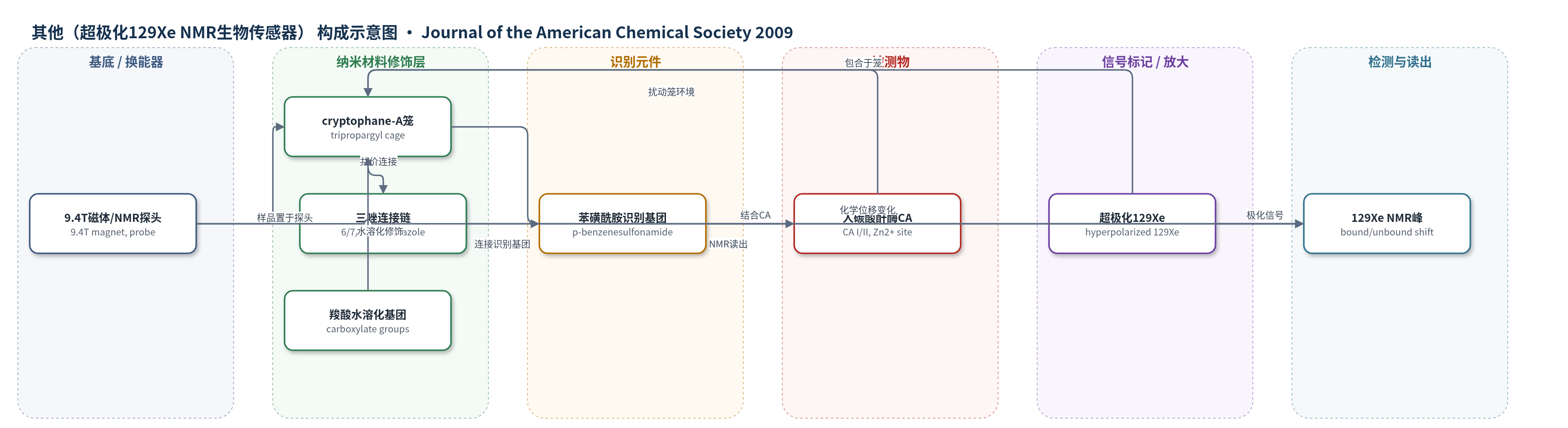
点击图片查看大图 · 依据论文自动绘制
传感器类型
其他(超极化129Xe NMR生物传感器)
检测对象
人碳酸酐酶I(human carbonic anhydrase I, CA I)、人碳酸酐酶II(human carbonic anhydrase II, CA II);样品基质:50 mM Tris-SO4缓冲液(pH 8.0)中的酶溶液,体外溶液样品。
检测原理
该传感器以cryptophane-A笼包合单个129Xe,笼外通过三唑连接链连接对位苯磺酰胺。苯磺酰胺与人碳酸酐酶活性位点Zn2+配位,实现CA I/II识别。结合后,蛋白界面改变cryptophane笼的电子与机械微环境,使包合129Xe的NMR化学位移下移3.0–7.5 ppm,且结合态峰线宽较窄。超极化129Xe经Rb自旋交换光学极化,将NMR信号增强约10000倍,提高检测灵敏度。信号可通过直接检测结合态峰,或采用HyperCEST选择性激发/淬灭结合态氙,使整体129Xe信号下降,从而反映CA存在与浓度。
检测灵敏度
原文未报告LOD、线性范围、灵敏度斜率或相关系数。
效应效果
ITC显示C6B、C7B、C8B对CA I/II的Kd为20–110 nM;C6B对CA I为20±10 nM、对CA II为100±20 nM,约5倍选择性。X射线晶体学证实C8B结合于CAII活性位点。结合CA后产生可重复的化学位移下移,最大7.5 ppm,大于临床MRI约1 ppm场不均匀度;C6B与C8B有约0.5 ppm同位酶差异,C7B对CAII出现独特峰,较CAI下移4.3 ppm。结合态线宽23–50 Hz,游离态约12±1 Hz,水溶性良好。作者认为可用于体内超极化129Xe MRI和多路蛋白标志物检测。
传感器的构成
- 换能/读出基底:9.4 T超导磁体与自制129Xe NMR探头(Oxford Instruments 9.4 T magnet, home-built 129Xe probe),提供磁场并采集129Xe射频信号
- 信号载体/包合层:三炔基cryptophane-A笼(tripropargyl cryptophane-A, 1),包单个129Xe并形成可调化学位移的笼状微环境
- 连接/间隔层:三唑连接链(triazole linkers, 6/7/8-bond spacers),连接cryptophane与苯磺酰胺并调节笼–蛋白界面作用
- 识别元件:对位苯磺酰胺(p-benzenesulfonamide),与CA活性位点Zn2+配位,实现碳酸酐酶识别
- 水溶化修饰层:两个羧酸基团(carboxylic acid groups, 由3-azidopropionic acid 5引入),提高水溶液溶解度
- 信号标记/极化核:超极化129Xe(hyperpolarized 129Xe, 86% 129Xe),经Rb自旋交换光学极化增强NMR信号
中文摘要
129Xe NMR生物传感器有望用于早期疾病检测,尤其当其与目标生物分子相互作用时,能使129Xe化学位移变化显著超过临床MRI常见磁场不均匀度。本文以人碳酸酐酶(CA)作为单结合位点酶模型,研究氙生物传感器与蛋白质的相互作用。作者将可结合氙的cryptophane-A通过不同长度的连接链与对位苯磺酰胺偶联,得到避免引入额外手性中心、具有单一129Xe NMR共振的生物传感器。X射线晶体学证实八键连接生物传感器中的单个氙原子位于CAII活性位点。等温滴定量热法测得CA I和CA II的解离常数为20–110 nM。生物传感器–CA复合物产生窄线宽的结合态超极化129Xe NMR共振,且化学位移较游离态下移3.0–7.5 ppm,明显大于此前报道。尽管CA I与CA II结构相似,其同位酶特异性化学位移仍能清晰区分二者。因此,氙生物传感器可为诊断以特定CA同位酶或其他蛋白生物标志物上调为特征的疾病提供强有力策略。
英文摘要
(129)Xe NMR biosensors are promising agents for early disease detection, especially when their interactions with target biomolecules can perturb (129)Xe chemical shifts well beyond the typical field inhomogeneity of clinical MRI. We introduce human carbonic anhydrase (CA) as a single-binding-site enzyme for studying xenon biosensor-protein interactions. A xenon-binding cryptophane was substituted with linkers of varying lengths to p-benzenesulfonamide to yield nondiastereomeric biosensors with a single (129)Xe NMR resonance. X-ray crystallography confirmed binding of the eight-bond-linked biosensor containing a single xenon atom in the CAII active site. Biosensor dissociation constants (K(d) = 20-110 nM) were determined by isothermal titration calorimetry (ITC) for isozymes CA I and II. The biosensor-CA complexes yielded "bound" hyperpolarized (129)Xe NMR resonances of narrow line width that were shifted by 3.0-7.5 ppm downfield, signifying much larger shifts than seen previously. Moreover, isozyme-specific chemical shifts clearly differentiated CA I and II, despite their similar structures. Thus, xenon biosensors may provide a powerful strategy for diagnosing human diseases characterized by the upregulation of specific CA isozymes and other protein biomarkers.