组成图示
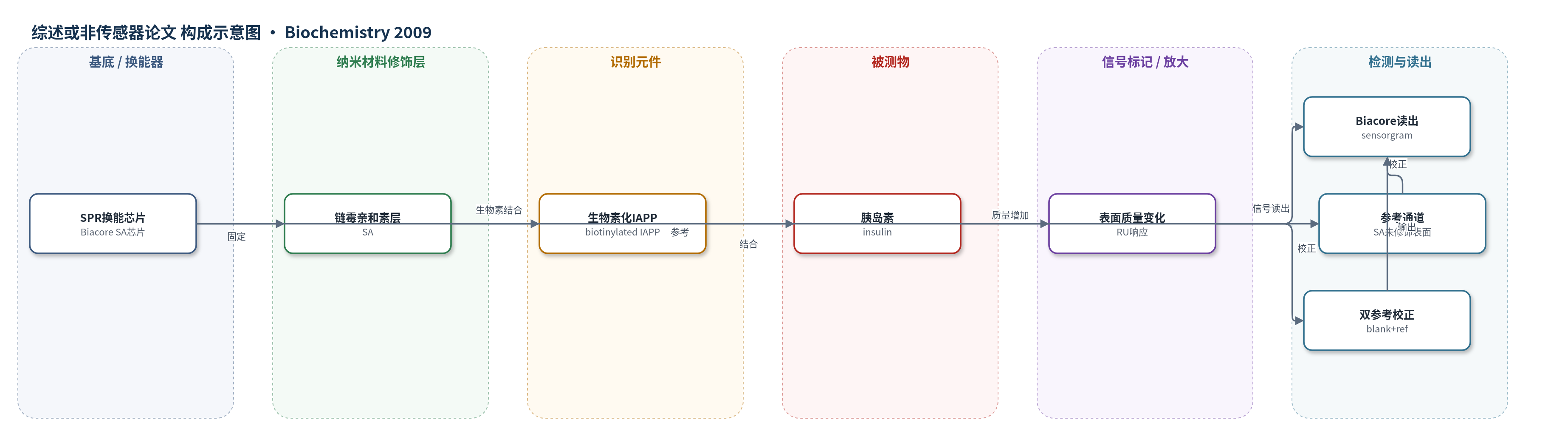
点击图片查看大图 · 依据论文自动绘制
传感器类型
综述或非传感器论文
检测对象
胰岛素(insulin);样品基质:HBS-EP 缓冲液(10 mM HEPES、150 mM NaCl、3.4 mM EDTA、0.0005% surfactant P20,pH 7.4)
检测原理
本研究以 SPR 表征 IAPP-胰岛素结合。生物素化 hIAPP/rIAPP 通过生物素-链霉亲和素高亲和作用固定于 Biacore SA 芯片表面,形成配体层。胰岛素以 HBS-EP 缓冲液按浓度梯度注入,与表面 IAPP 的 N 端结合区发生特异性结合;NMR 与 REMD 提示结合主要由 rIAPP Arg11/Arg18 与胰岛素 B 链 Glu13 的盐桥及邻近疏水残基介导。结合事件改变芯片表面质量/折射率,SPR 换能器将界面变化转换为响应单位(RU)传感器图。响应随胰岛素浓度升高而增大,采用稳态结合模型拟合,得到毫摩尔级 KD;未修饰 SA 参考通道与空白缓冲双参考校正非特异吸附。
检测灵敏度
原文未报告 LOD、线性范围、灵敏度斜率或相关系数;SPR 稳态结合分析给出 KD 介于 0.1 mM 与 1 mM。
效应效果
SPR 显示胰岛素与固定化 hIAPP/rIAPP 结合特异,未修饰 SA 表面几乎无结合;重复 5 次,KD 介于 0.1–1 mM。NMR 显示结合位于 rIAPP 1-18 区,尤其 Arg11/Arg18 及邻近疏水残基;弛豫色散提示交换快于 1000 s^-1,无新分子间 NOE。REMD 显示 rIAPP Arg18 与胰岛素 B 链 Glu13 接触约 19%,hIAPP His18 仅约 6%,解释 His/Arg-18 突变降低亲和力。作者认为该结合可隔离 IAPP 疏水区,抑制毒性寡聚体与纤维形成。
传感器的构成
- 换能基底:Biacore 研究级 SA 芯片(SPR 换能表面,用于表面等离子共振检测)
- 表面捕获层:链霉亲和素(SA),固定于芯片表面,用于结合生物素化 IAPP
- 配体/识别元件:生物素化 hIAPP/rIAPP(biotinylated hIAPP/rIAPP),以 10 mM 醋酸钠 pH 5.0 稀释后捕获,hIAPP/rIAPP 约 200/700 RU
- 样品流路:HBS-EP(10 mM HEPES、150 mM NaCl、3.4 mM EDTA、0.0005% surfactant P20,pH 7.4),输送胰岛素并稳定表面
- 参考通道:未修饰 SA 表面(SA unmodified surface),用于双参考校正
- 信号换能:SPR 界面质量/折射率变化,转换为响应单位(RU)
中文摘要
胰岛淀粉样多肽(IAPP)是 37 氨基酸多肽激素,与胰岛素共同分泌于胰腺 β 细胞颗粒。IAPP 可形成毒性寡聚体和淀粉样纤维,与 2 型糖尿病相关。本文 NMR 分析显示,游离及与胰岛素结合的 IAPP 均保留残余二级结构。化学位移、15N 弛豫及 49 ns 副本交换分子动力学模拟表明,残基 11-18 的瞬时螺旋结构对胰岛素结合至关重要。结合主要由大鼠 IAPP 的 Arg11 或 Arg18 与胰岛素 B 链 Glu13 形成盐桥,并由邻近疏水残基稳定。人 IAPP 与大鼠 IAPP 的胰岛素结合区基本相同,仅 His/Arg-18 不同,提示结合模式一致。SPR 生物传感器分析显示,His/Arg-18 突变使人 IAPP 与胰岛素结合亲和力低于大鼠 IAPP。文章讨论了可溶性 IAPP-胰岛素相互作用抑制人 IAPP 寡聚化的意义。
英文摘要
Islet amyloid polypeptide (IAPP), a 37-amino acid polypeptide hormone of the calcitonin family, is colocalized and cosecreted with insulin in secretory granules of pancreatic islet beta cells. IAPP can assemble into toxic oligomers and amyloid fibrils, a hallmark of type 2 diabetes. Its interactions with insulin in the secretory granules might influence the formation of cytotoxic oligomers and amyloid fibrils. Presented NMR analysis shows that IAPP, free in solution and in complex with insulin, retains elements of residual secondary structure. NMR chemical shifts and (15)N relaxation data as well as 49 ns replica exchange molecular dynamic simulations indicate that the transiently populated helical structure in residues 11-18 is essential for interactions with insulin. These interactions are mediated by salt bridges between positively charged residues Arg11 or Arg18 of rat IAPP and Glu13 of insulin B chain as well as by hydrophobic interactions flanking the salt bridges. The insulin binding region is composed of the same amino acids in amyloidogenic human IAPP and soluble rat IAPP (with the sole exception of His/Arg-18), implying the same binding mode for both hormones. This His/Arg-18 mutation results in reduced affinity binding of human IAPP to insulin in comparison to rat IAPP as it is detected by surface plasmon resonance biosensor analysis. Implications of the described interactions between soluble forms of IAPP and insulin in preventing oligomerization of human IAPP are discussed.