组成图示
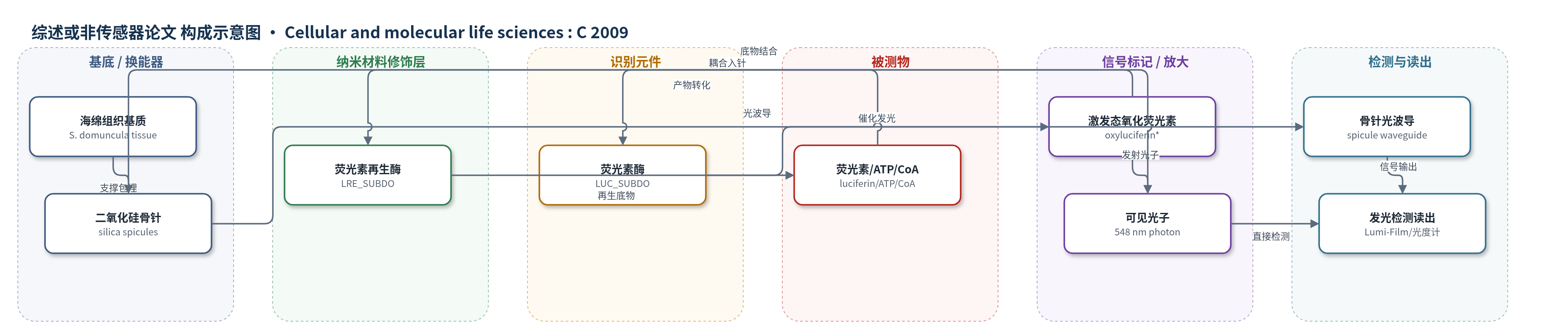
点击图片查看大图 · 依据论文自动绘制
传感器类型
综述或非传感器论文
检测对象
光信号/生物发光(light/bioluminescence)、荧光素酶活性(luciferase activity);样品基质:海绵组织、primmorphs原基、重组酶反应液、海绵粗提物。
检测原理
该天然系统以荧光素酶(LUC_SUBDO)为发光元件,以二氧化硅骨针为光波导。在海绵组织或重组酶反应体系中,d-荧光素在ATP和CoA存在下被荧光素酶腺苷酸化,随后与O2反应生成激发态氧化荧光素(oxyluciferin*);激发态退激发射约548 nm可见光子。光子可被邻近骨针捕获并沿硅质波导传输,形成体内光信号。荧光素再生酶(LRE_SUBDO)可将oxyluciferin与D-cysteine再生为luciferin,维持发光底物。信号强度与酶量、底物浓度及ATP/CoA可用性相关;缺ATP或CoA、热灭活酶时信号消失。光照通过下调luciferase转录降低发光能力,构成光调控反馈。系统无外源化学放大,主要依赖酶催化发光与骨针全内反射/波导传输。
检测灵敏度
原文未报告 LOD、线性范围、灵敏度斜率或相关系数。
效应效果
重组海绵荧光素酶具有生物活性,0.5 mg蛋白比活为72,000 RLU,平行萤火虫酶为346,000 RLU/mg;无酶、缺ATP或CoA时仅约920 RLU,热灭活后几乎无信号。粗提物10 mg蛋白发光25,300±3,200 RLU(n=5)。发射峰548 nm,次峰590 nm;pH 9.0活性最高(83,000 RLU/0.5 mg),pH 7.0/10.0下降。暗适应组织在Lumi-Film上24 h出现信号,rotenone预处理无信号。免疫荧光显示酶位于骨针附近,预免疫血清无染色。光照使luciferase转录降至0.2倍(黑暗为1倍)。作者认为该天然系统可作光感受/信号传导模型。
传感器的构成
- 光波导/换能层:二氧化硅骨针(silica spicules,tylostyles,约150 μm×6 μm),作为无机光波导传输可见光。
- 发光催化元件:海绵荧光素酶(luciferase,LUC_SUBDO,67 kDa重组蛋白),催化荧光素氧化发光。
- 底物/电子供体:d-荧光素(d-luciferin free acid)、ATP、辅酶A(CoA)、MgCl2和O2,提供发光反应底物与能量。
- 再生维持元件:荧光素再生酶(luciferin-regenerating enzyme,LRE_SUBDO,306 aa),将oxyluciferin与D-cysteine再生为luciferin。
- 组织定位层:S. domuncula海绵组织细胞与骨针邻近,免疫荧光显示LUC_SUBDO定位于骨针周围。
- 光调控读出:primmorphs原基在黑暗或50 lux光照下培养,Northern blot显示LUC_SUBDO转录受光调控。
中文摘要
两类海绵(动物界多孔动物门)具有由骨针组成的硅质骨骼。此前对六放海绵大型骨针(>5 cm)的光纤-力学性能研究表明,它们是有效的光收集光纤。本文报道,海绵Suberites domuncula具有由有机发光酶荧光素酶(luciferase)和无机光传导二氧化硅骨针(silica spicules)组成的生物传感器系统。作者证明了该海绵较小骨针(约200 μm)的光传输特性,并证明海绵组织能够产生光。通过EST数据库筛选成功获得S. domuncula荧光素酶基因;重组荧光素酶被制备并显示具有生物活性。荧光素酶蛋白在骨针邻近区域大量存在。荧光素酶基因的表达受光调控,光照条件下表达下调。该结果支持海绵骨针可作为体内光波导,与荧光素酶发光系统共同构成新型光感受/信号传导机制。
英文摘要
Two classes of sponges (animal phylum Porifera) possess a siliceous skeleton which is composed of spicules. Studying the optical fiber-mechanical properties of large spicules from hexactinellid sponges (> 5 cm) it was demonstrated that they are effective light-collecting optical fibers. Here, we report that the demosponge Suberites domuncula is provided with a biosensor system composed of the (organic) light producing luciferase and the (inorganic) light transducing silica spicules. The light transmission feature of these smaller spicules (200 microm) has been demonstrated and the ability of sponge tissue to generate light has been proven. Screening for a luciferase gene in S. domuncula was successful; the recombinant luciferase was prepared and shown to be bioactive. The luciferase protein is abundantly present in the close neighborhood of the spicules. The expression of the luciferase gene is under the control of light.